


AI-Based Interview Analysis: Turning Interview Notes into Actionable Hiring Insights
Hiring decisions often depend on interview notes that are incomplete, inconsistent, and difficult to compare across candidates.
As hiring scales, this creates a serious challenge, as teams rely on subjective impressions instead of structured evaluation. Important signals are missed, bias creeps in, and decision-making slows down.
AI-based interview analysis addresses this gap by transforming unstructured interview notes and conversations into structured, data-driven insights. This allows hiring teams to move from intuition-based decisions to a more consistent and measurable approach.
Aligned with SkillSauce’s mission, this approach enables organizations to improve hiring quality while scaling efficiently through structured assessments and intelligent analytics.
What is AI-based interview analysis?
AI-based interview analysis uses technologies such as natural language processing (NLP), machine learning, and pattern recognition to convert interview data into structured insights.
Instead of relying only on manual notes, AI processes interview transcripts to:
- Identify relevant skills and competencies
- Detect patterns in candidate responses
- Standardize evaluation across interviewers
- Generate objective scores and summaries
This creates a reliable foundation for comparing candidates and making informed hiring decisions.
For teams using SkillSauce, this translates into standardized evaluation frameworks, real-time analytics, and consistent hiring processes across roles and locations.
Why is interview data analytics critical in modern hiring
As hiring velocity increases, the risk of mis-hires grows. AI-based interview analysis mitigates this risk by removing subjective guesswork and surfacing patterns that may be invisible to human panels. This supports skills-based hiring, a trend echoed by industry leaders and researchers who emphasize competencies over credentials alone. A growing body of evidence shows organizations turning to data-driven hiring insights to improve ramp-up speed, retention, and performance. See NACE’s findings and learn more from thought leaders like McKinsey and BCG.
How AI transforms notes into data-driven insights
Below is the typical AI-driven pipeline that turns notes into decision-ready data:
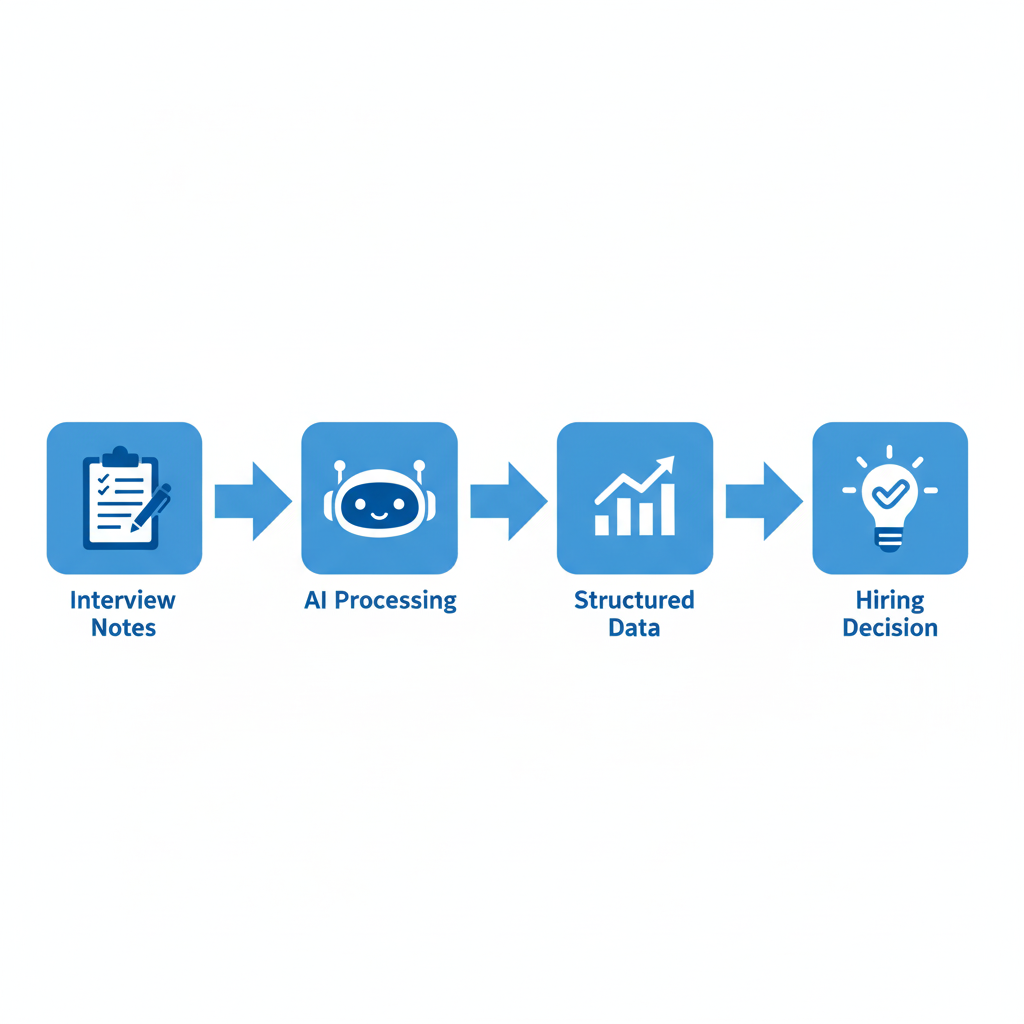
Transcription and Standardization
AI converts interviews into a consistent and searchable format, ensuring no information is lost.
Contextual Analysis and Pattern Recognition
Using NLP, the system analyzes responses to understand intent, depth, and relevance to the role.
Competency Mapping and Scoring
Candidate responses are mapped to predefined skills and evaluation criteria, generating structured scores.
Dashboards and Reporting
Interactive dashboards provide insights into candidate performance, comparisons, and hiring metrics.
Continuous Improvement Loop
Insights from hiring data help refine job roles, interview frameworks, and evaluation criteria over time.
In practice, SkillSauce combines these capabilities with an extensive assessment library and analytics dashboards to create a complete hiring stack. Explore our features and assessment library for concrete examples of how this looks in real-world workflows. You can also learn how AI proctoring supports secure, scalable assessments.
Before vs After AI-Based Interview Analysis
ROI and the business case for smart hiring
AI-based interview analysis delivers measurable business outcomes by improving hiring efficiency and accuracy.
Organizations can expect:
- Faster time-to-hire
- Improved candidate quality
- Greater consistency in evaluation
- Reduced hiring bias
- Better long-term employee performance
By turning interviews into structured data, companies can make hiring decisions that are both scalable and reliable.
See Verval data on ROI and the broader trend toward skills-based hiring in the literature: ROI discussions and case studies.
Practical tips for adopting AI-based interview analysis
- Define measurable success metrics (quality of hire, ramp-up time, retention) to anchor AI investments.
- Use standardized rubrics and train interviewers to ensure reliable AI interpretations.
- Start with a pilot on a few roles, then scale as value is demonstrated.
- Prioritize fairness and governance—monitor for bias, protect privacy, and be transparent with stakeholders. See SHRM’s guidance on skills-based hiring and inclusive assessments.
- Leverage a platform with strong analytics, dashboards, and a rich assessment library.
Risks, safeguards, and best practices
Automation brings value, but it requires governance. Key risks include privacy concerns, model bias, and data stewardship. Best practices include:
- Transparent scoring rubrics and candidate-facing explanations where possible.
- Regular AI audits to detect and mitigate bias.
- Clear data governance policies and compliance with relevant regulations.
- Alignment with industry standards and ongoing stakeholder training.
For broader guidance on responsible hiring, see SHRM and inclusive hiring resources from SocialTalent.
Industry trends and practical case studies
The hiring landscape is shifting toward skills-based evaluation, where competencies matter more than credentials.
AI-based interview analysis plays a key role in this transition by enabling:
- Objective skill measurement
- Standardized evaluation across candidates
- Better alignment between job requirements and candidate capabilities
This trend is expected to continue as organizations prioritize efficiency, fairness, and performance-driven hiring.
Industry analyses from McKinsey and BC&G underscore a shift toward skills-based hiring as a core strategic capability. Real-world case studies from Criteria Corp and other practitioners illustrate improved performance and cost efficiencies when analytics inform hiring decisions.
Read more in McKinsey and BCG.
Faqs
What is AI-based interview analysis?
How does interview data analytics improve hiring outcomes?
Is AI interview analysis reliable?
Can AI replace human interviewers?
Final Thoughts
AI-based interview analysis is not just a technological upgrade; it is a shift toward more structured, data-driven hiring.
By transforming interview notes into actionable insights, organizations can improve decision-making, reduce bias, and build stronger teams.
Ready to adopt AI-based interview analysis in your hiring workflow?
Explore SkillSauce’s AI Interview , assessment library , or contact us for a tailored demo.