


Artificial intelligence is rapidly reshaping the recruitment landscape, with the AI video interview standing at the centre of this transformation. Between 2023 and 2025, global adoption of AI-based interviews and hiring tools grew by over 70%, as companies across all sectors embraced automation to speed up candidate screening and enhance consistency.
Yet, one critical question continues to dominate HR discussions: Are AI video interviews truly fair to every candidate?
As sophisticated algorithms increasingly assess non-verbal cues—including tone, language patterns, and facial expressions—concerns around AI hiring bias, transparency, and ethics are taking center stage. Addressing this debate is crucial for building trust in the future of digital hiring.
The Rise of AI Video Interviews and the Trust Gap
AI video interviews have rapidly become a standard component in large-scale and high-volume recruitment. These systems work by analyzing various data points from a candidate's recorded or live response, often benchmarking them against data from thousands of past successful employees or predefined criteria. The promise is compelling: faster, standardized hiring decisions with reduced subjective human bias.
However, AI recruitment fairness is not automatically achieved; it depends entirely on how these algorithms are designed, trained, and regularly audited.
According to a Gartner (2025) study:
- 58% of employers believe AI ensures consistency in hiring decisions.
- Only 26% of candidates trust AI to evaluate them fairly.
This significant trust gap exists because fairness must be actively engineered and maintained. For HR leaders, bridging this gap requires moving beyond the hype and confronting the myths surrounding AI objectivity.
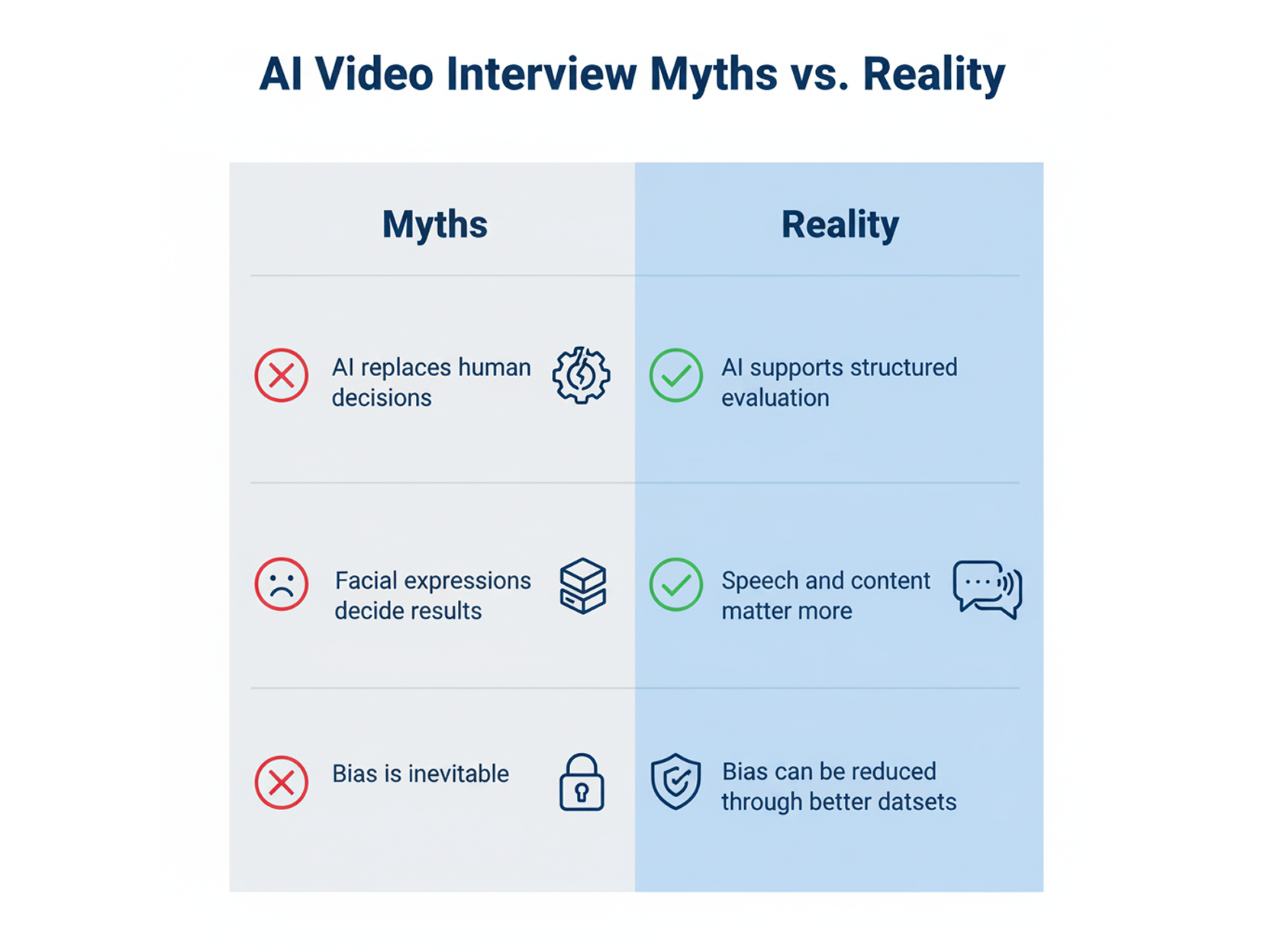
Myth #1: “AI Video Interviews Are Completely Unbiased”
The most persistent myth is that algorithms operate in a vacuum of objectivity, producing purely merit-based decisions.
In truth, AI is fundamentally a reflection of its training data and design parameters. An algorithm is only as unbiased as the historical data it learns from.
A Harvard Business Review (2025) analysis found that many candidates consciously adapt their answers based on what they believe the AI wants to hear—a form of "algorithmic conformity" that reduces authenticity and organic insight.
Common Sources of AI Hiring Bias:
- Training Data Bias: If the historical data used to train the system favored a certain demographic group, the AI will learn to associate the attributes of that group (e.g., speech cadence, background noise, or specific vocabulary) with success, penalizing others.
- Visual Recognition Bias: Studies show some visual systems are less accurate at reading micro-expressions or tone in individuals with darker skin tones or different lighting setups, potentially leading to misinterpretation.
- Language and Accent Bias: Models can unintentionally penalize specific regional or non-native English accents, as well as communication styles that are indirect or less fluent, confusing anxiety with incompetence.
Fairness, therefore, isn't a pre-installed feature—it's an ongoing ethical discipline. Continuous audits, pre- and post-processing checks, and robust ethical oversight are essential to keep bias in check and ensure genuine AI recruitment fairness.
Myth #2: “AI Interviews Replace Human Judgment”
Contrary to the widespread fear of full automation, AI doesn't typically replace recruiters; it enhances them, particularly in the later stages of the hiring process.
Modern AI video interview tools primarily function as decision-support systems, not autonomous decision-makers. They are designed to standardize and quantify data points that are difficult for humans to track consistently across hundreds of candidates.
According to Gartner (2025) data:
- 70% of HR teams automate at least one stage of hiring (e.g., initial screening).
- Final hiring decisions in critical roles still involve human validation in the vast majority of cases.
Hybrid systems—where AI provides data insights and recruiters apply human context—outperform fully automated decision processes by up to 32% in placement accuracy. This is because:
- Recruiters are essential for interpreting AI insights with empathy and organizational context (e.g., assessing true cultural fit).
- AI highlights objective patterns and potential red flags (or hidden gems) that human reviewers might miss due to cognitive overload.
The partnership between human and machine is the key to minimizing blind spots and ensuring decisions remain human-centric, aligning with principles of ethical AI recruitment.
Myth #3: “AI Interviews Always Improve Diversity”
Another significant misconception is that automation naturally boosts diversity outcomes. While the potential is there, it's not an automatic result.
AI can reinforce bias if datasets are not intentionally inclusive.
The Deloitte Inclusion Report (2024) emphasized that generative and analytical AI tools can only support diversity goals if their training datasets actively reflect varied genders, abilities, communication styles, and cultural backgrounds. Without this, the AI optimises for the successful profile of the past, rather than the diverse workforce of the future.
Companies are proactively addressing this challenge by:
- Fairness Audits and Bias-Detection Tools: Using secondary AI to check the primary assessment AI for potential bias against protected classes.
- Inclusive Datasets: Investing heavily in training data that covers multiple accents, regional dialects, varied expressions, and diverse educational backgrounds.
- Transparency Reporting: Making scoring mechanisms explainable to stakeholders to demonstrate how non-job-related attributes are excluded from the final score.
Diversity improvements are not a side effect of automation—they are the direct result of responsible data design and continuous ethical governance.
Reality Check: How Fair Are AI Video Interviews in Practice?
When governed correctly, AI interviews offer powerful benefits. When governance is weak, they introduce significant challenges.
Advantages of AI-Based Interviews
| Advantage | Description |
|---|---|
| Standardization | Every candidate faces identical questions, time limits, and scoring logic—removing inconsistencies inherent in human interviews. |
| Efficiency & Scale | Enables global, 24/7 hiring at scale, dramatically reducing time-to-hire metrics and recruiter workload. |
| Accessibility | Offers asynchronous interviews, accommodating remote candidates across different time zones and increasing participation. |
| Focus on Content | Forces a measurable focus on the actual content of answers rather than the interviewer's subjective first impression. |
Challenges Requiring Ethical Governance
| Challenge | Ethical Risk |
|---|---|
| Opaque Algorithms | Many vendors offer limited transparency on exactly what the algorithm measures, leading to skepticism and reduced trust. |
| Data Privacy | Candidates are often unsure about the retention, monitoring, and security of their video and biometric data. |
| Accessibility Gaps | Neurodiverse individuals, or those with certain speech patterns, may struggle without adaptive or customizable interfaces. |
A SecondTalent (2025) study revealed a disparity: 72% of AI-driven companies conduct internal fairness audits, yet only 48% share any transparency reports with candidates. The ultimate takeaway is that genuine fairness is secured through governance, ethics, and accountability, not technology alone.
The Psychology of AI Interviews: Candidate Experience Matters
Being evaluated by an algorithm often induces significant candidate assessment anxiety and self-censorship.
The human element of being monitored by AI means candidates may overthink gestures, language, and tone, limiting their authentic and best performance. Addressing the candidate experience is crucial for unlocking the technology's true value.
Employers can significantly improve comfort and performance by prioritizing:
- Pre-Interview Transparency: Clearly explain what the AI measures (e.g., content, pace, tone) and what it ignores (e.g., background, visual appearance).
- Practice Environments: Offer robust, optional practice interviews or demo environments so candidates can familiarize themselves with the tool.
- Empathetic UX Design: Use clear, friendly, and conversational prompts and interfaces instead of robotic or intimidating language.
- Constructive Feedback: Provide personalized performance insights post-interview, reinforcing a professional and helpful employer brand, regardless of the outcome.
These steps build trust and psychological safety, reinforcing a positive perception of ethical AI recruitment.
Best Practices for Ethical & Fair AI Video Interviews
Building a genuinely fair AI video interview framework requires intentional ethics and continuous oversight. This goes beyond compliance and steps into true responsibility.
1. Transparency and Explainability
- Be clear about how AI evaluates candidates and how much weight its score carries relative to human review.
- Explain how recruiters use the AI scores to prioritize or review—not just to automatically exclude.
2. Data Privacy and Compliance
- Disclose video retention and data usage policies explicitly and obtain informed consent.
- Adhere rigorously to global standards like GDPR, the EEOC, and India’s DPDP Act, especially regarding sensitive personal data.
3. Human Oversight is Non-Negotiable
- Maintain recruiter involvement for all final hiring decisions and the review of candidates flagged by the AI (positive or negative).
- Treat AI scores as input and powerful insight, not authority.
4. Diversity Audits and Bias Mitigation
- Run quarterly fairness tests using diverse control groups to detect algorithmic drift.
- Utilize counterfactual testing—testing how a change in non-essential attributes (like simulated gender or accent) affects the score.
5. Accessibility and Accommodations
- Offer robust accessibility features (subtitles, screen reader compatibility, flexible timing).
- Provide alternate, human-led interview modes when a candidate requests an accommodation due to neurodiversity or other factors.
As SHRM (2024) notes: “When AI supports human capabilities rather than replaces them, it mitigates—not multiplies—bias.”
Conclusion: Toward Responsible, Human-Centered AI Interviews
So, are AI video interviews fair?
They have the unique potential to be the fairest screening tool ever created, but only if HR leaders and developers intentionally make them that way. Fairness is not a passive outcome coded into the algorithm; it is actively shaped by ethical leadership, transparent design, and human empathy.
AI-based interviews can revolutionize hiring, enhancing speed, inclusion, and accuracy, but only when applied responsibly. By embracing radical transparency, prioritizing informed consent, and committing to regular bias monitoring, organizations can build candidate trust and transform skepticism into confidence—turning AI from a digital judge into a fair and powerful assistant for the future of inclusive, ethical AI recruitment.