


What is Employee Turnover?
Image Source: Dreamstime.com
"According to Gallup, a turnover rate of less than 10% is considered healthy, regardless of industry." — Gallup, Leading global analytics and advisory company specializing in workplace research
Employee turnover is the number of workers who leave an organization within a specific time frame, usually a year. This metric covers both people who choose to leave (resignations, retirements) and those who must leave (terminations, layoffs).
The turnover rate shows what percentage of the total workforce leaves during a given period. Companies calculate this rate by taking the number of departing employees and dividing it by the average number of total employees. Most organizations track these numbers based on their fiscal or calendar year.
Employees who leave on their own terms create voluntary turnover. They might find a new job, move to a different city, retire, or go back to school. On the other hand, involuntary turnover happens when companies let people go due to poor performance, misconduct, or downsizing.
People leave organizations for several reasons:
- Termination
- Resignation
- Retirement
- Death
- Transfers to other organizational sections
Outside factors often shape both individual decisions to leave and company-wide turnover patterns. These include money pressures, work-life balance issues, and the state of the economy. Demographics play a big role too—baby boomer retirements hit 28.6 million in the third quarter of 2020. Millennials now make up almost 40% of the U.S. workforce and tend to stay in jobs for just 2.8 years, while workers aged 55-64 average 9.9 years.
High turnover hurts productivity because skilled employees are hard to replace. The costs add up quickly—Gallup reports that replacing an employee costs between half to double their salary.
Companies watch turnover rates across departments, divisions, and employee groups to spot systemic problems. These comparisons help leaders identify whether certain teams or groups experience more departures than others, pointing to issues that need fixing. You can avoid calculation mistakes by using this free employee turnover calculator to check your organization's numbers.
Employee turnover serves as a key measure of how well an organization runs. Too many departures—especially of top performers—hurt both the bottom line and customer satisfaction.
Types of Employee Turnover
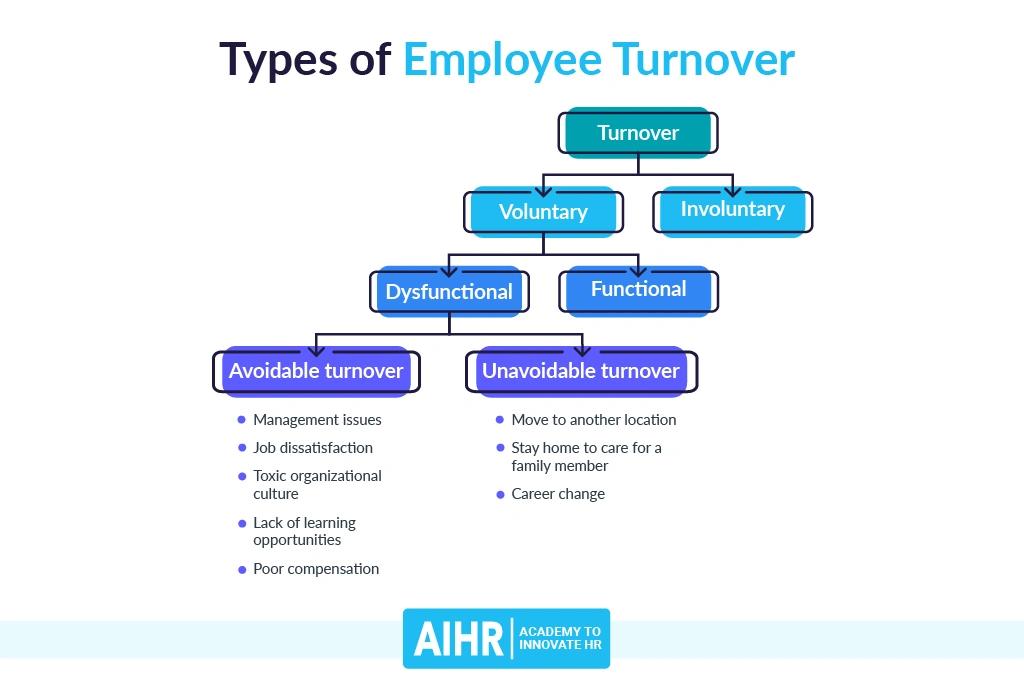
Image Source: AIHR
Organizations group employee turnover into different categories. This grouping helps them understand and handle staff departures better. Management teams can spot patterns and create better strategies to keep their employees.
Voluntary Turnover
Employees who choose to leave an organization create voluntary turnover. They might resign, retire, or leave for other jobs. People usually submit formal resignation letters with notice periods or tell their managers verbally. Sometimes they just stop coming to work - a practice known as "ghosting". When employees leave suddenly, their unfinished projects often disrupt teams and force others to pick up extra work.
Involuntary Turnover
The employer starts the separation process in cases of involuntary turnover. These exits have two main types. The first happens when companies fire people for specific reasons like poor performance, breaking rules, or bad behavior. The second occurs through layoffs, downsizing, or restructuring. People who lose their jobs without cause can usually get unemployment benefits. Those fired for specific reasons typically cannot.
Desirable vs Undesirable Turnover
Some employee departures help the organization. This desirable turnover happens when poor performers or employees with bad attitudes leave, which boosts team morale and productivity. The company suffers when skilled, high-performing employees who add great value decide to leave. After the pandemic, turnover rates moved between 40-55% across most western countries. Retail and hospitality businesses saw even higher numbers.
Functional vs Dysfunctional Turnover
Functional turnover happens when consistently poor performers leave. Companies often see these departures as positive changes. They can hire new talent that might better match their needs. The loss of top performers and valuable team members creates dysfunctional turnover. Their departure hurts operations and team morale. Replacing them can cost up to nine months of their salary. HR departments often use a free employee turnover calculator to track these patterns accurately.
Why Do Employees Leave?
"Poor management drives turnover risk by four times" — Perceptyx, Employee experience and engagement research organization
Companies need to understand why employees leave to create better retention strategies. People quit their jobs for many reasons, but career-related factors top the list.
Lack of career growth
Limited career advancement remains the biggest reason why people leave their jobs. About 19% of workers worldwide say they can't move up in their careers. When employees see no path forward, 34% start looking for new jobs. Young workers from Millennial and Gen-Z groups are even more likely to quit - 75% would leave if they can't develop new skills.
Poor management or leadership
Bad leadership makes people quit. 57% of employees leave their jobs because they're unhappy with their managers. Research shows that 50% to 75% of employees quit because of their boss or things their boss controls. People often leave when managers communicate poorly, micromanage, or show favoritism.
Low compensation or benefits
Money matters - 55% of employees leave for better pay. While it's not always the main reason, people feel undervalued when they discover they earn less than their coworkers.
Work-life imbalance
Long hours and rigid schedules drive people to quit. Burnout affects 42% of professionals. Remote workers are more than twice as likely to plan their exit compared to those working on-site.
Toxic workplace culture
A toxic culture pushes people out more than any other factor - 10.4 times more than salary issues. One in four American workers dreads going to work because they can't speak up or get credit for their work.
Lack of recognition
Good recognition keeps people around - employees who receive it are 45% less likely to leave within two years. Recognition programs help reduce absenteeism by 27%. Even motivated employees lose interest when nobody acknowledges their work.
Burnout and overwork
Burnout makes people quit. HR leaders know this - 95% say it affects retention. About half of these leaders blame burnout for 20-50% of yearly departures. Too many hours, not enough breaks, and constant understaffing wear people down.
Bad hiring or onboarding
One-third of employees find onboarding confusing. Poor training during onboarding leads 80% of employees to plan their exit, while only 7% of well-trained employees think about leaving. Good onboarding boosts retention by 43%.
How to Reduce Employee Turnover
Reducing employee turnover needs targeted actions that tackle why employees leave. Well-planned retention strategies can substantially cut turnover costs, which typically range from one-half to two times an employee's annual salary.
Offer competitive pay and benefits
Fair compensation is a key retention tool. Companies that pay market-rate salaries keep 50% more employees. Regular salary measurements help spot and fix pay gaps before employees leave.
Improve onboarding and training
A well-laid-out onboarding experience makes employees 58% more likely to stay for three years. The onboarding process should extend beyond simple orientation into a complete year-long program to speed up productivity.
Support career development
Employees leave ten times more often when their skills aren't properly used. Companies with strong learning cultures see 30-50% higher engagement and retention rates.
Encourage a positive work culture
Culture plays a crucial role in retention. Employees who view their culture positively are almost four times more likely to stay. Bad cultural elements like disrespect and poor leadership cause 54% of departures.
Use employee feedback tools
Regular feedback systems show potential issues before employees quit. Companies that use live organic feedback spot retention risks earlier and can take preventive action.
Recognize and reward performance
Recognition satisfies employees' need for validation. Workers who receive quality recognition are 45% less likely to leave after two years. Companies with good recognition programs see 31% lower turnover rates.
Train better managers
Managers influence up to 70% of employee engagement. Great managers reduce the risk of people leaving by 72% and increase retention 3.2 times.
Use HR software to track turnover
Modern retention software spots disengagement patterns before turnover becomes a problem. Many HR departments use a free employee turnover calculator to avoid manual calculation errors when analyzing different patterns.
Key Takeaways
Employee turnover is more than just staff departures—it's a critical indicator of organizational health that directly impacts productivity, costs, and company culture. Understanding the root causes and implementing targeted retention strategies can transform your workforce stability.
• Poor management drives 4x higher turnover risk - Train managers effectively as they account for up to 70% of employee engagement variance
• Career stagnation is the #1 turnover predictor - 75% of younger workers will leave without sufficient skills development opportunities
• Toxic culture outweighs compensation 10.4x - Focus on building positive workplace environments over just competitive pay packages
• Quality onboarding increases 3-year retention by 58% - Extend orientation beyond basics to comprehensive year-long development journeys
• Recognition reduces departure likelihood by 45% - Implement regular acknowledgment programs to fulfill employees' validation needs
• Replacement costs range from 0.5-2x annual salary - Proactive retention strategies provide significant ROI compared to constant recruiting and training