

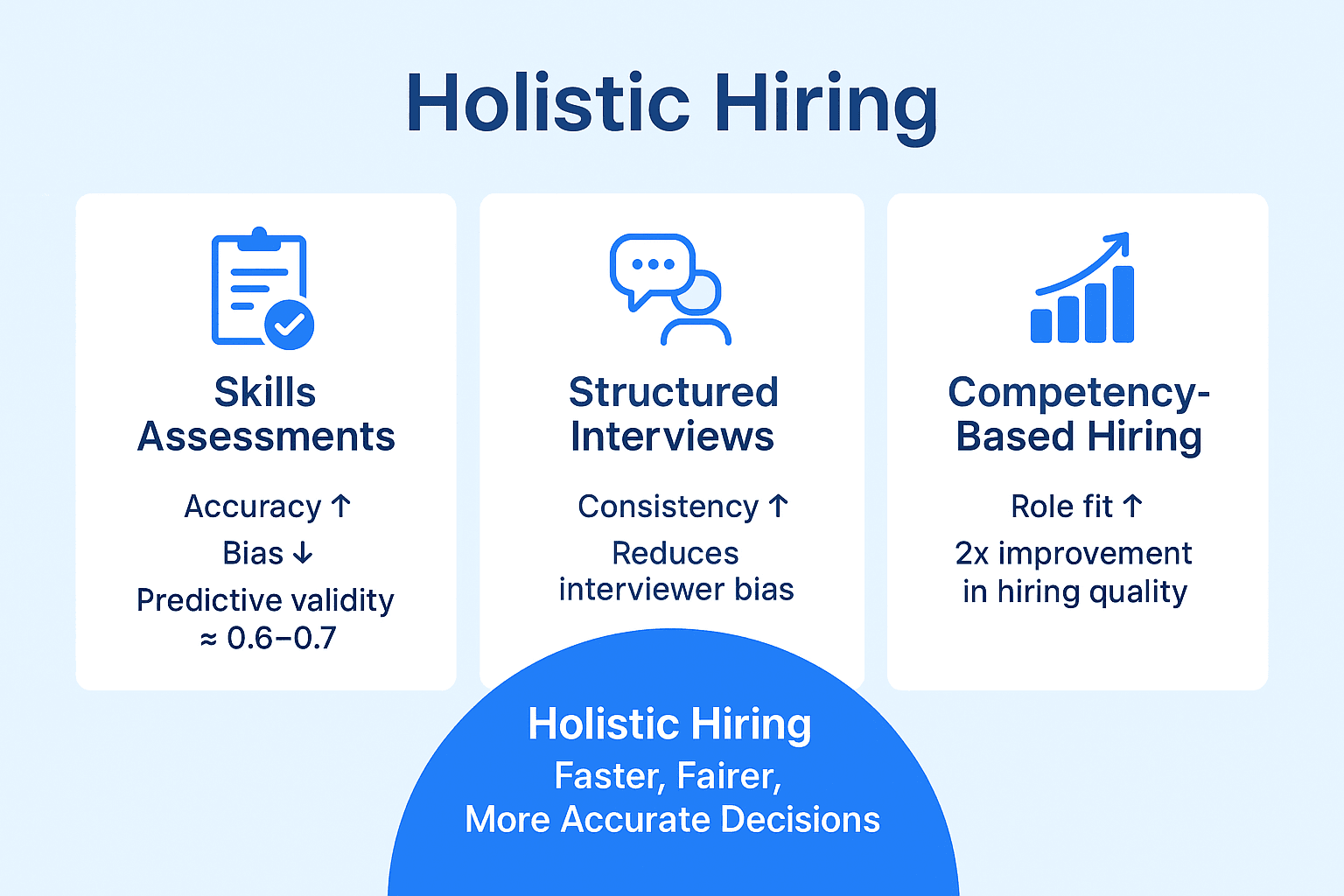
In today’s talent market, hiring isn’t limited to resumes or degrees. A holistic recruitment approach blends pre employment skills testing, structured interviews, and competency-based hiring to reveal true capability. At the core are skills assessments, which quantify practical ability and provide an objective basis for decisions. When embedded into a thoughtful hiring workflow, skills assessments accelerate quality hires, improve retention, and deliver measurable business impact.
Why skills assessments are central to holistic recruitment
A modern hiring strategy treats talent as a portfolio of capabilities—technical know-how, problem-solving speed, communication, and collaboration. Skills assessments convert these capabilities into data points that complement traditional signals like education and work history. In practice, the right tests help distinguish real ability from surface credentials, enabling fairer, more accurate candidate evaluations.
- Aligns with competency-based hiring by measuring actual performance signals that predict on-the-job success.
- Reduces bias by focusing on demonstrated ability rather than pedigree or background.
- Standardizes candidate evaluation, enabling apples-to-apples comparisons across applicants.
- Speeds up screening and time-to-hire while maintaining quality.
- Supports better onboarding through early performance indicators and smoother ramp-up.
Leading practitioners and researchers emphasize that combining skills assessments with structured interviews yields stronger predictive validity than traditional methods alone. This evidence-based approach supports faster, fairer, and more effective hiring outcomes. For example, major consultancies and HR bodies discuss the broader move toward data-driven hiring and skills-based practices. SHRM on skills-based hiring and Deloitte’s insights on organizational skill-based hiring offer practical context for adopting a holistic, skills-first approach.
The building blocks of a modern skills assessment strategy
Pre-employment testing
Pre-employment tests come in many forms—cognitive ability, job-skill simulations, situational judgment tests, and role-specific tasks. The most effective programs tailor assessments to the job family and level, ensuring relevance and fairness. Key guidelines:
- Pair cognitive screens with job-skill simulations to capture both reasoning and applied ability.
- Use role- and industry-specific tasks that reflect real work scenarios.
- Validate tests for fairness and reliability, and document validation data to support ongoing governance.
Competency-based hiring and the assessment library
Competency-based hiring focuses on the capabilities that drive success in a role. A robust assessment library lets recruiters pick validated tasks aligned to core competencies, with benchmarking options across teams and levels. Explore SkillSauce’s assessment library to see how validated items map to business outcomes.
AI-proctoring and test integrity
Integrity matters for high-stakes roles. AI-powered proctoring helps maintain exam security and fairness while reducing manual monitoring requirements. Integrate AI-proctoring with your holistic strategy to safeguard testing at scale. Learn more about proctoring and governance through practical resources such as AI-powered proctoring and related case studies.
Key metrics to measure the success of skills assessments
Before you launch, define what success looks like. The right metrics justify investment and guide continuous improvement:
- Quality of hire: on-the-job performance, ramp time, and 6–12 month outcomes.
- Time to fill: speed from requisition to offer without sacrificing rigor.
- Candidate experience: Net Promoter Score (NPS) and qualitative feedback.
- Predictive validity: correlation between test results and job performance.
- ROI and cost savings: lower turnover, reduced hiring costs, and faster scaling.
Industry analyses reinforce that skill-based approaches improve alignment with role requirements and long-term talent outcomes. For example, Harvard Business School and other sources discuss the strategic value of skills-first hiring in modern organizations. HBS: Skills-Based Hiring and McKinsey: Return on Talent provide actionable benchmarks for measurement.
Real-world signals: case studies and industry insights
Case studies show the tangible impact of a holistic, skills-first approach. For example, case studies on ROI from talent assessments demonstrate faster hiring decisions and improved quality at scale. See industry examples and practitioner reports for deeper context.
How to implement a holistic skills-based hiring program
1) Define competencies and align to business outcomes
Start with the roles you hire most and the outcomes you want. Map core competencies to observable behaviors and measurable performance indicators.
2) Build or curate a validated skills library
Use an library of validated, role-relevant items. Validate each test for construct validity and fairness, and keep the library current with role evolution. Explore SkillSauce’s assessment library and related resources.
3) Integrate testing into the hiring workflow
Embed tests early in the funnel and pair them with structured interviews. Use standardized rubrics to minimize bias and ensure consistent scoring.
4) Combine with structured interviewing
Triangulate signals by pairing data from skills assessments with behavior-based questions. Together, they improve data quality and reduce interviewer bias.
5) Ensure fairness and compliance
Regularly audit tests for adverse impact and maintain privacy protections. Stay aligned with regional guidelines (GDPR, EEOC) and keep documentation transparent. See guidance resources such as EEOC and GDPR guidance for practical framing.
6) Measure, learn, and iterate
Track defined metrics, collect applicant feedback, and iterate on tests and workflows. A learning mindset sustains long-term success.
Tools and platforms that support a holistic approach
The best solutions blend robust skills assessments with governance and a strong candidate experience. Look for:
- Extensive, validated assessment libraries
- Candidate experience tracking and feedback capture
- AI-powered proctoring and test integrity controls
- Assessment analytics tied to business outcomes
- Seamless integrations with ATS/HRIS
For teams evaluating the landscape, explore SkillSauce’s features, resources, and library, along with AI-proctoring options to anchor a holistic hiring strategy.
Ready to modernize hiring with skills-first workflows?
Learn about features, browse resources, and explore the assessment library for ready-to-use content. If you’re ready to see it in action, request a demo.
FAQ: skills assessments and holistic hiring
What are skills assessments?
Skills assessments are structured tasks or simulations designed to measure a candidate’s ability to perform job-related tasks. They provide objective, comparable data beyond resumes.
How do skills assessments support holistic recruitment?
They anchor hiring in demonstrated ability, complement behavioral interviews, reduce reliance on traditional signals, and align decisions with business outcomes.
Are pre-employment testing tools legally compliant?
Reputable tools offer ADA/EEOC and GDPR compliance, but organizations should review validation data and consult HR/legal for regional requirements. See guidance resources such as EEOC & GDPR guidance for practical framing.
How is ROI measured for skills-based hiring?
ROI is typically measured by quality of hire, retention, time-to-fill, and cost-per-hire. Case studies from the field illustrate tangible gains when programs are thoughtfully designed and scaled.
What is competency-based hiring?
Competency-based hiring evaluates candidates on core skills and behaviors that predict success in the role, rather than relying solely on educational pedigree or years of experience.
Ready to modernize your hiring with a holistic, skill-first approach? Explore SkillSauce’s features, assessment library, and demo options to start implementing skills assessments at scale.