

interviewers assess the same candidate differently. Interview fatigue clouds decision-making. Unconscious biases creep into evaluations. Meanwhile, 52% of recruiters cite candidate screening as their most challenging task, and traditional interviews often fail to effectively evaluate crucial soft skills like teamwork, adaptability, and problem-solving.
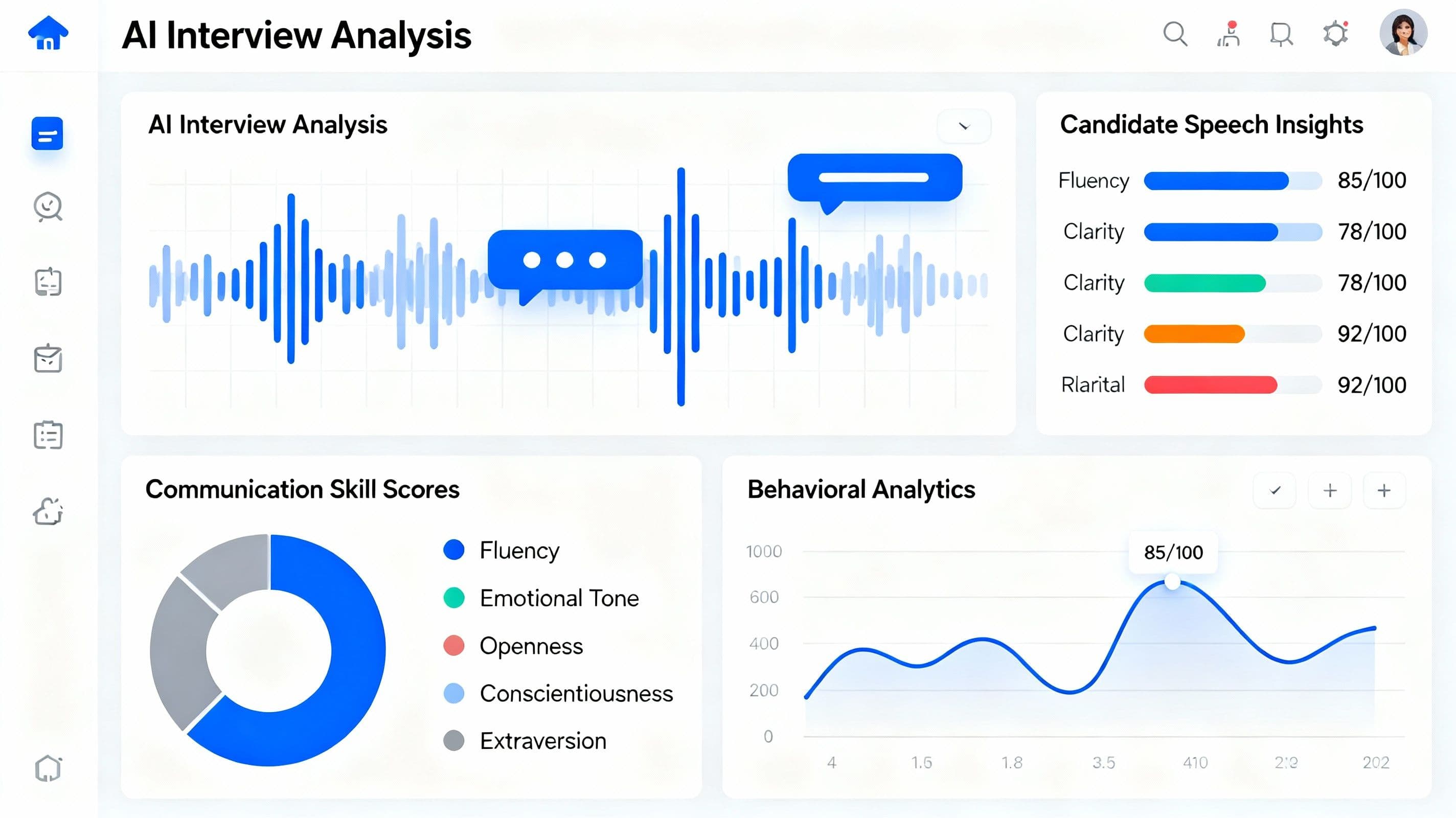
Enter AI interview assessment—a data-driven solution transforming how organizations evaluate the intangible skills that matter most. By analyzing speech patterns, tone, behavioral cues, and response content through Natural Language Processing (NLP) and machine learning, AI interview assessment provides objective, scalable, and consistent soft skills evaluation.
Here's how AI interview assessment works, why it outperforms traditional methods, and how SkillSauce enables recruiters to evaluate communication and soft skills with unprecedented precision.
Why Traditional Soft Skills Evaluation Fails
Before exploring AI solutions, we need to understand why conventional approaches fall short.
Human Bias Distorts Assessment
Unconscious biases systematically affect soft skills evaluation. Interviewers favor candidates who remind them of themselves (affinity bias), allow first impressions to overshadow later evidence (confirmation bias), and let irrelevant factors like appearance or accent influence judgments.
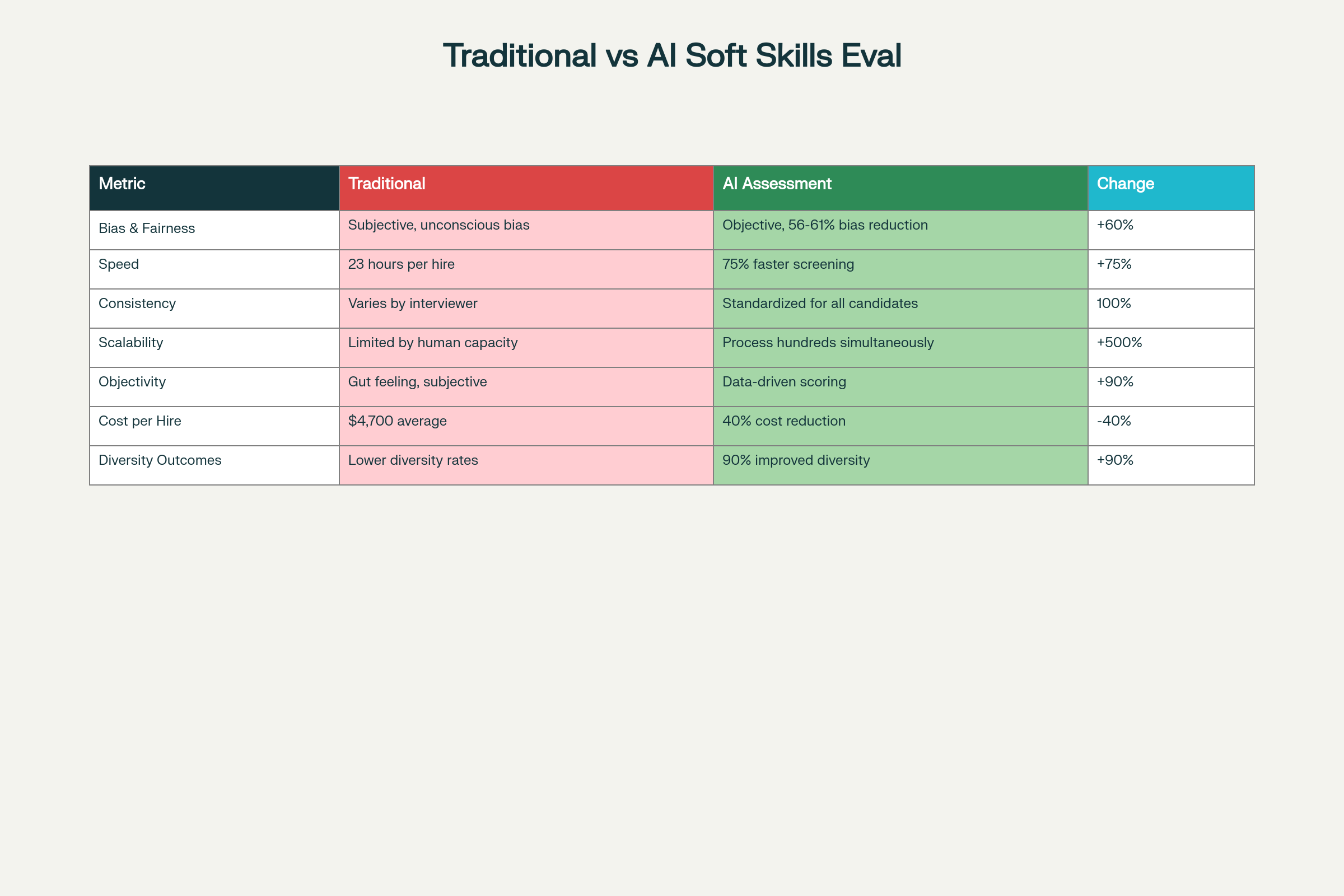
Research demonstrates that AI effectively minimizes sentiment-driven biases by 41.2% compared to human-only interviews. Traditional evaluators struggle to separate personal preferences from objective assessment—especially when evaluating subjective traits like "cultural fit" or "communication style."
The impact is measurable: organizations relying solely on human judgment for soft skills screening see higher turnover rates and lower quality-of-hire metrics compared to those using structured, data-driven methods.
Inconsistent Interviewer Judgment
Different interviewers apply different standards. One hiring manager prioritizes assertiveness; another values thoughtful listening. The same candidate receives contradictory feedback depending on who conducts the interview.
This inconsistency creates problems:
- Qualified candidates are rejected based on interviewer mood or personal preference
- Poor fits advance because they happened to charm a sympathetic evaluator
- Hiring decisions feel arbitrary rather than evidence-based
- Legal exposure increases when standards vary across candidates
Shell, the global energy company, addresses this challenge by using multiple assessment techniques throughout their hiring process—including presentations, self-assessments, and structured evaluations—to gather rigorous evidence rather than relying on single-point-in-time interviews.
Time-Consuming Assessment Rounds
Evaluating soft skills thoroughly requires significant time investment. Behavioral interview questions demand careful listening, probing follow-ups, and thoughtful evaluation. Multiply that by dozens or hundreds of candidates, and the time cost becomes prohibitive.
The traditional soft skills evaluation process involves:
- Preparing customized behavioral questions for each role
- Conducting 45-60 minute interviews per candidate
- Coordinating multiple interviewers for consistency
- Debriefing and aligning on candidate assessments
- Documenting observations and justifying decisions
For high-volume hiring, this approach simply doesn't scale. Recruiters spend an average of 23 hours screening for a single hire, with soft skills assessment consuming a disproportionate share of that time.
Lack of Standardized Scoring
Without standardized metrics, soft skills assessment becomes guesswork. How do you objectively measure "strong communication skills" or "demonstrates emotional intelligence"? Most organizations rely on subjective impressions rather than defined rubrics.
This creates three critical problems:
First, comparability suffers. When each interviewer uses their own internal standard, comparing candidates across different interview panels becomes impossible.
Second, accountability disappears. Without clear criteria, poor hiring decisions can't be traced to specific evaluation failures.
Third, improvement stagnates. Organizations can't refine their soft skills assessment process when they lack measurable outcomes to analyze.
What is AI Interview Assessment?
AI interview assessment uses artificial intelligence to objectively evaluate candidates' communication abilities, behavioral competencies, and soft skills through automated analysis of interview responses.
Unlike traditional interviews that depend entirely on human judgment, AI interview assessment leverages Natural Language Processing (NLP), machine learning algorithms, and speech analysis to provide data-driven insights into candidate capabilities.
How AI Interview Assessment Works
The technology combines multiple analytical layers:
Speech-to-Text Transcription: AI converts spoken responses into text transcripts with 94% accuracy, enabling detailed linguistic analysis.
Natural Language Processing: NLP algorithms analyze word choice, sentence structure, contextual meaning, and semantic patterns to assess communication clarity and depth of thinking.
Tone and Prosody Analysis: AI evaluates pitch variations, speech rate, volume modulation, and vocal confidence indicators to gauge emotional state and authenticity.
Behavioral Pattern Recognition: Machine learning models identify behavioral cues like problem-solving approach, adaptability signals, and collaboration indicators from response content.
Standardized Scoring: Algorithms generate objective scores across predefined competencies, eliminating subjective variation between evaluators.
SkillSauce's AI Interview Assessment Capability
SkillSauce combines conversational AI interview technology with comprehensive behavioral analysis, enabling organizations to evaluate soft skills at scale without sacrificing assessment quality.
The platform uses advanced NLP to conduct natural, adaptive interviews that feel like human conversations while generating objective, data-backed evaluations. Candidates respond to role-specific questions, and SkillSauce's AI analyzes speech clarity, emotional intelligence, problem-solving methodology, and communication effectiveness in real time.
This approach delivers the consistency of standardized testing with the depth of behavioral interviews—giving recruiters comprehensive soft skills insights without the time investment traditional methods require.
How AI Evaluates Communication Skills
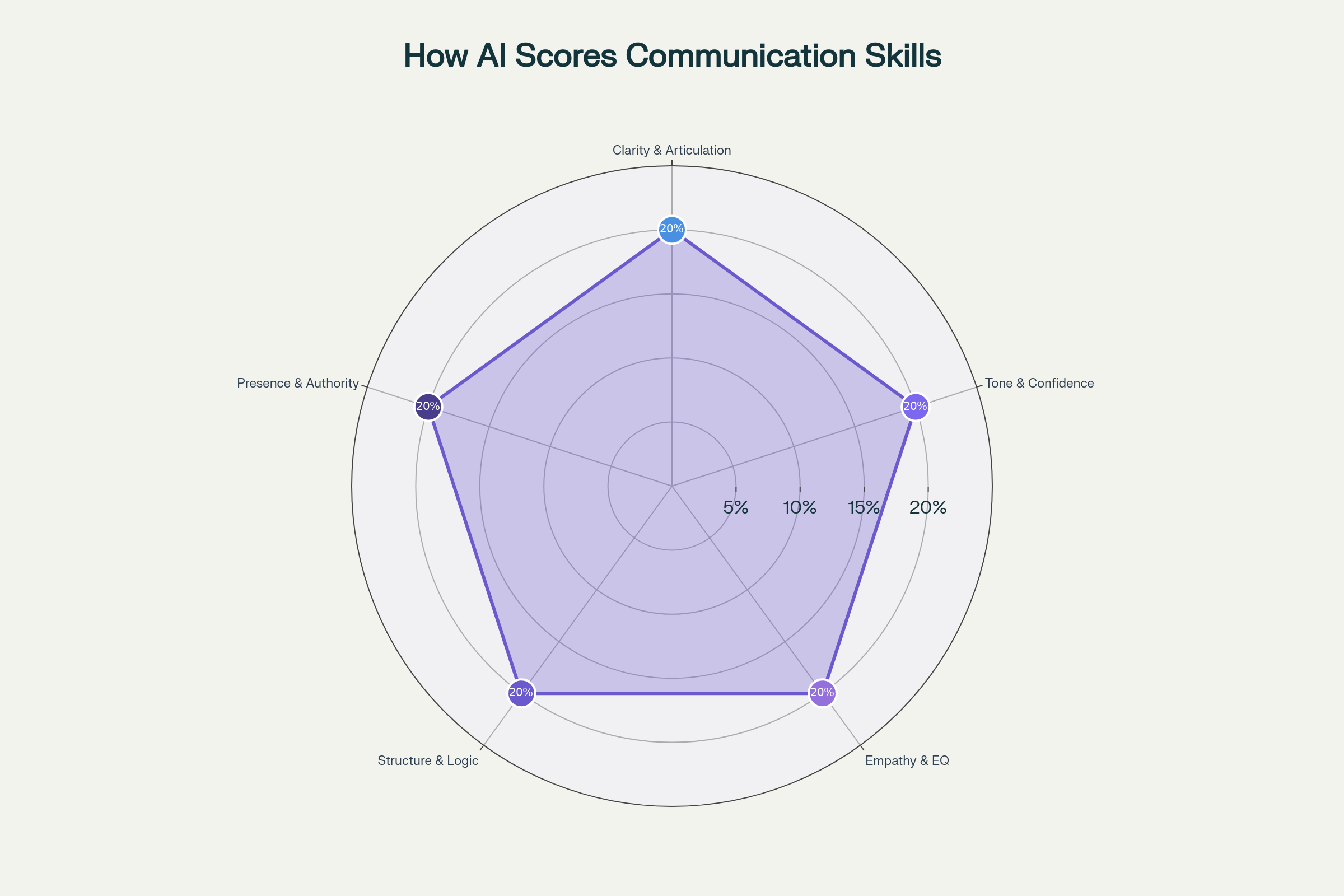
Communication assessment through AI interview platforms analyzes multiple dimensions simultaneously, providing a holistic view of candidate capabilities.
Speech Clarity and Articulation
AI measures pronunciation precision, enunciation quality, and verbal fluency to determine how effectively candidates convey information.
The system evaluates:
- Clarity: Can listeners easily understand the candidate without strain?
- Pace: Does the candidate speak at an appropriate speed—neither rushed nor sluggish?
- Filler words: How frequently does the candidate use "um," "uh," or other verbal placeholders?
- Pronunciation: Are words articulated clearly, or do speech patterns interfere with comprehension?
Research shows that AI systems can detect hesitations, filler words, and pronunciation patterns that human interviewers often miss or inconsistently evaluate.
Listening Ability and Comprehension
Strong communication requires active listening, not just speaking. AI assesses listening ability by analyzing response relevance and whether candidates directly address questions asked.
Indicators include:
- Question alignment: Does the response actually answer what was asked?
- Contextual understanding: Does the candidate demonstrate comprehension of nuanced or multi-part questions?
- Adaptive responses: Can the candidate adjust based on follow-up questions or clarifications?
Platforms like PMaps' EVA conversational AI voice interviewer specifically evaluate how well candidates grasp job expectations and demonstrate relevant experience through vocal cues and response content.
Structuring Thoughts and Logical Flow
AI evaluates how candidates organize ideas into coherent narratives—a critical communication skill often overlooked in traditional interviews.
The assessment identifies:
- Logical progression: Do thoughts flow naturally from introduction to conclusion?
- Coherence: Are ideas connected and easy to follow?
- Conciseness: Does the candidate communicate efficiently without unnecessary tangents?
- Example quality: Are supporting examples relevant and clearly explained?
NLP algorithms analyze sentence structure, transitional phrases, and narrative coherence to score organizational ability objectively.
Confidence and Vocal Authority
Tone analysis reveals confidence levels through pitch stability, volume consistency, and vocal modulation patterns.
AI detects:
- Assertiveness: Does the candidate sound self-assured or hesitant?
- Vocal variety: Is there appropriate modulation, or does monotone delivery suggest disengagement?
- Stress indicators: Do voice tremors or pitch spikes reveal anxiety or uncertainty?
- Enthusiasm: Does vocal tone convey genuine interest in the role?
According to research on voice stress and tone analysis, AI systems using Support Vector Machines (SVMs) and Neural Networks can classify voice patterns into categories like "stressed" vs. "neutral" speech with high accuracy.
Storytelling and Contextualization
Effective communicators use stories and examples to illustrate competencies. AI assesses storytelling quality by analyzing narrative structure, detail richness, and relevance to the question.
Evaluation criteria include:
- Situational context: Does the candidate set the scene effectively?
- Challenge articulation: Is the problem clearly explained?
- Action description: Are specific steps taken described in detail?
- Results quantification: Does the candidate provide measurable outcomes?
This mirrors the STAR method (Situation, Task, Action, Result) that behavioral interviews traditionally emphasize—but AI evaluates adherence objectively rather than subjectively.
Emotional Intelligence Indicators
AI can identify emotional intelligence signals through sentiment analysis and empathy markers in language use.
The system evaluates:
- Empathy vocabulary: Usage of perspective-taking language ("I understood their frustration...")
- Self-awareness: Recognition of personal strengths and development areas
- Interpersonal sensitivity: Acknowledgment of team dynamics and relationship factors
- Conflict awareness: Mature handling of disagreement or challenge discussions
Research shows that 80% of recruiters using AI tools for soft skills assessments report that AI can effectively evaluate emotional intelligence—a competency previously thought to be measurable only through human observation.
How AI Evaluates Soft Skills
Beyond communication, AI interview assessment analyzes broader behavioral competencies critical for workplace success.
Problem-Solving Behavior
AI identifies problem-solving approach through response content analysis.
Assessment includes:
- Analytical thinking: Does the candidate break problems into manageable components?
- Root cause analysis: Can they identify underlying issues versus symptoms?
- Solution generation: Do they propose creative, practical solutions?
- Critical evaluation: Can they weigh trade-offs and justify decisions?
Platforms like HiringBranch measure candidates' ability to think critically when managing complicated issues with 98% accuracy by analyzing response patterns that correlate with on-the-job performance.
Adaptability and Resilience
AI detects adaptability signals through candidates' descriptions of change management, learning experiences, and response to unexpected challenges.
Indicators include:
- Growth mindset language: References to learning from failures or seeking feedback
- Change embrace: Positive framing of transitions or new situations
- Flexibility demonstrations: Examples of adjusting approaches based on circumstances
- Stress management: Calm, composed communication even when discussing difficult situations
Deloitte's 2020 research emphasized that organizations prioritizing adaptability in recruitment build resilient teams capable of thriving in dynamic industries—making this a critical competency to evaluate accurately.
Collaboration and Teamwork
Team orientation emerges through language patterns that emphasize collective success over individual achievement.
AI evaluates:
- "We" vs. "I" language: Does the candidate credit team efforts appropriately?
- Role clarity: Can they articulate their specific contribution within group efforts?
- Conflict navigation: How do they describe resolving team disagreements?
- Support behaviors: Do examples include helping colleagues or sharing knowledge?
Ownership and Accountability
AI identifies accountability through how candidates discuss mistakes, challenges, and outcomes.
Assessment criteria:
- Responsibility acceptance: Do they acknowledge personal role in failures?
- Excuse avoidance: Are setbacks attributed to circumstances or learning opportunities?
- Initiative demonstration: Evidence of proactive problem-solving without prompting
- Results orientation: Focus on outcomes achieved rather than effort expended
Conflict Handling and Emotional Regulation
Mature conflict management appears in response tone, language, and problem framing.
AI detects:
- Emotional stability: Calm, measured tone when discussing conflicts
- Perspective-taking: Acknowledgment of others' viewpoints in disagreements
- Resolution focus: Emphasis on solutions rather than blame
- Learning integration: Recognition of conflicts as growth opportunities
Benefits for Recruiters & HR Teams
AI interview assessment delivers measurable advantages that transform talent evaluation.
Objective, Standardized Scoring
Every candidate is evaluated on identical criteria using the same algorithmic standards.
This eliminates:
- Interviewer mood variations affecting scores
- Inconsistent standards across hiring managers
- Subjective "gut feel" overriding evidence
- Bias from candidate appearance, accent, or background
The result: 90% of employers using skills-based hiring (enabled by AI assessment) report improved diversity outcomes.
Reduced Interviewer Fatigue
AI handles repetitive screening tasks, freeing human recruiters to focus on relationship-building and strategic evaluation.
Organizations implementing hybrid AI-human models report:
- 75% reduction in screening time
- 40% reduction in time-to-hire
- Higher recruiter satisfaction as they focus on meaningful interactions rather than administrative tasks
Faster Hiring Cycles
AI interview assessment compresses evaluation timelines dramatically.
Speed improvements include:
- Real-time scoring immediately after interview completion
- Parallel processing of hundreds of candidates simultaneously
- Automated reporting eliminating manual synthesis of interview notes
- Instant shortlisting based on objective performance thresholds
Companies using AI talent assessment cut time-to-hire by 36% and improve quality-of-hire metrics by up to 92%—demonstrating that speed doesn't compromise quality when assessment is data-driven.
Bias Minimization
Properly implemented AI reduces hiring bias by 56-61% across gender, racial, and educational categories.
AI achieves this through:
- Blind scoring: Demographics don't influence evaluation algorithms
- Standardized questions: All candidates answer identical questions
- Objective criteria: Scoring based on defined competencies, not subjective impressions
- Audit trails: Transparent decision-making enables bias detection and correction
Unilever's AI-driven hiring system led to a 16% increase in diversity by removing subjective bias from initial screening stages.
Better Candidate Experience
Contrary to expectations, AI interviews often improve candidate satisfaction.
Benefits include:
- 24/7 accessibility: Candidates interview on their schedule, not limited to business hours
- Immediate feedback: Many platforms provide instant performance insights
- Consistent treatment: All candidates experience the same professional evaluation process
- Reduced anxiety: Candidates can complete interviews in comfortable environments
70% of candidates prefer video or AI-powered interviews for flexibility and convenience, with satisfaction projected to reach 95% as interfaces become more intuitive.
Real-World Examples & Case Studies
Unilever: Transforming Graduate Recruitment
Unilever integrated AI interview assessment into their graduate hiring program, using video interviews analyzed by machine learning to evaluate soft skills like emotional intelligence and problem-solving.
Results:
- 75% reduction in recruiting cycle time
- Increased diversity in hiring outcomes
- Improved candidate experience through gamification and engaging assessments
- Significant cost savings from streamlined evaluation
The Harvard Business Review highlighted this case as evidence that AI assessment not only streamlines hiring but leads to better, more diverse teams.
Microsoft & Google: Behavioral Simulations
Tech giants Microsoft and Google adopted simulation-based assessments to evaluate adaptability, teamwork, and communication alongside technical skills.
By designing assessments reflecting actual job challenges, these companies:
- Better predict future performance than traditional interviews alone
- Assess cultural fit objectively through behavioral data
- Create engaging candidate experiences that reinforce employer brand
MIT Sloan Management Review recommends this approach, noting that simulations combined with AI analysis provide deeper soft skills insights than conventional methods.
PwC: Immersive 3D Assessment
PwC uses immersive 3D simulations powered by AI to evaluate problem-solving and teamwork in realistic contexts.
The platform assesses:
- Real-time decision-making under pressure
- Collaboration effectiveness in team scenarios
- Communication clarity during complex problem-solving
This innovative approach demonstrates how AI assessment can create compelling candidate experiences while generating objective behavioral data.
IBM: Predictive Analytics for Soft Skills
IBM utilizes predictive analytics to analyze past employee performance data, identifying which soft skills correlate with success in specific roles.
This enables:
- Role-specific competency models grounded in evidence
- Accurate prediction of emotional intelligence and collaborative abilities
- Enhanced team effectiveness and productivity through better hiring matches
When AI + Human Recruiters Work Together
The optimal model isn't AI-only or human-only—it's hybrid collaboration that leverages each party's strengths.
The Hybrid Model Framework
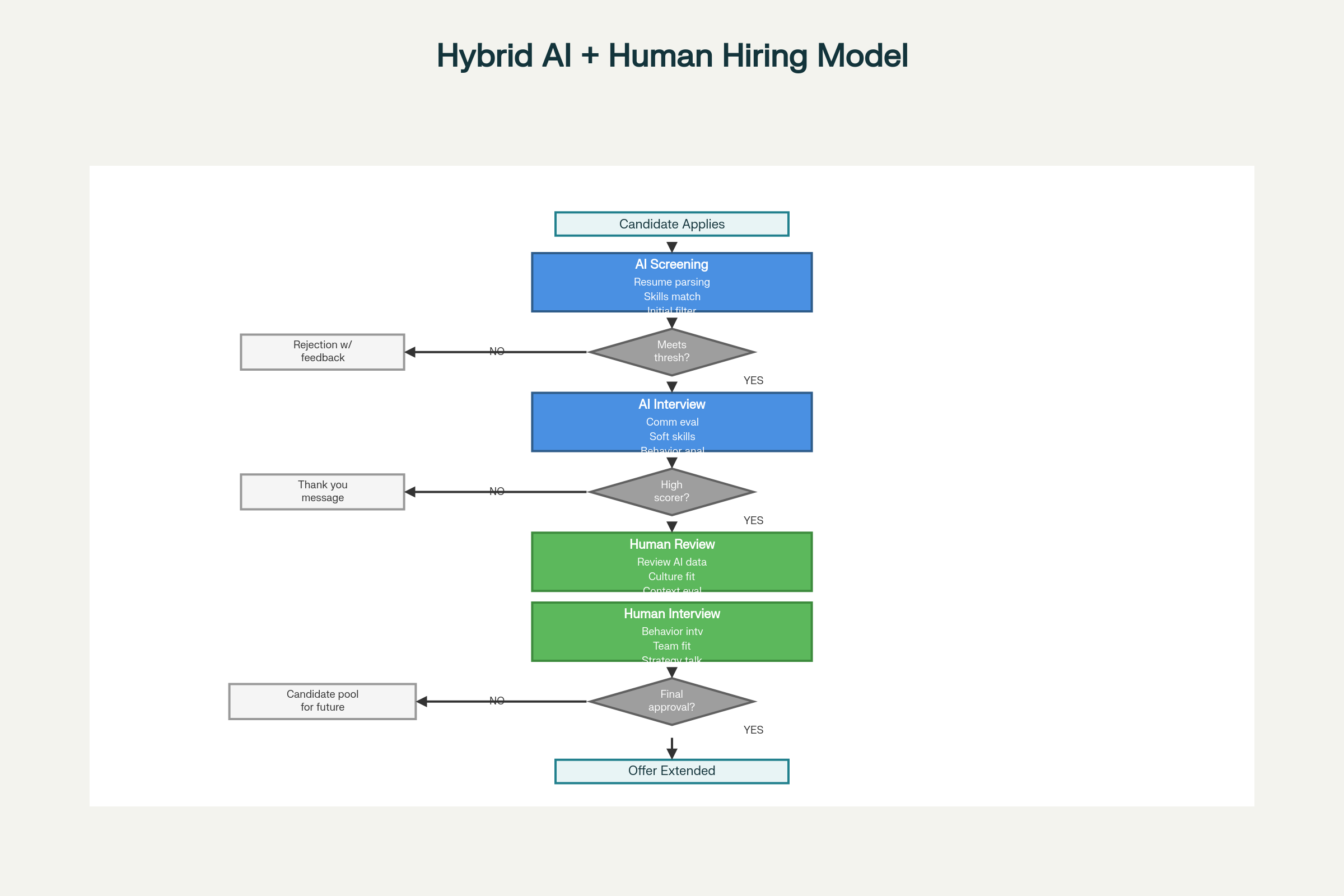
AI handles:
- High-volume initial screening based on defined soft skills criteria
- Objective scoring of communication and behavioral competencies
- Data synthesis into recruiter-friendly dashboards
- Pattern identification across large candidate pools
Human recruiters handle:
- Final decision-making on shortlisted candidates
- Cultural fit validation through nuanced conversation
- Relationship building and employer brand representation
- Complex judgment calls requiring contextual understanding
Best Practices for Implementation
Leading organizations follow proven integration strategies:
1. AI-First, Not AI-Only: Use AI for initial screening, but reserve final decisions for humans who can consider unique circumstances and organizational context.
2. Seamless Handoffs: Design workflows where AI-generated insights flow naturally into human review processes, with clear criteria determining when human intervention is needed.
3. Candidate Experience Focus: Maintain human touchpoints at critical moments—offer delivery, feedback provision, negotiation—even when AI drives screening.
4. Continuous Calibration: Regularly audit AI outputs against actual on-the-job performance to refine algorithms and ensure predictive accuracy.
5. Recruiter Upskilling: Train HR teams to interpret AI-generated data and focus on uniquely human skills like strategic advising and relationship cultivation.
Boston Consulting Group exemplifies this balance, using AI for heavy lifting while ensuring human interaction guides critical decisions and maintains premium candidate experiences.
A Compunnel client combined AI resume parsing with human contextual evaluation, achieving:
- 40% reduction in time-to-hire
- Enhanced candidate satisfaction
- Improved quality of hire through balanced assessment
How SkillSauce Enables AI Interview Assessment
SkillSauce's platform combines cutting-edge AI interview technology with recruiter-friendly workflows, delivering comprehensive soft skills evaluation without complexity.
Real-Time Scoring and Analytics
Instant performance metrics generated during or immediately after interviews provide:
- Competency-specific scores across communication, problem-solving, collaboration, adaptability, and emotional intelligence
- Comparative analytics ranking candidates against role-specific benchmarks
- Trend identification highlighting strengths and development areas
- Predictive insights forecasting on-the-job success probability
Advanced Behavioral Analysis
SkillSauce leverages NLP and machine learning to analyze:
- Speech patterns revealing confidence, clarity, and articulation
- Tone variations indicating emotional intelligence and authenticity
- Response content assessing problem-solving approach and behavioral competencies
- Linguistic markers identifying collaboration, ownership, and adaptability signals
The platform's Retrieval-Augmented Generation (RAG) technology ensures assessments remain grounded in candidate-specific context rather than generic evaluations.
Candidate Fit Scoring
Beyond individual competency scores, SkillSauce generates holistic fit ratings that consider:
- Role-specific requirements matching candidate strengths to position needs
- Team dynamics identifying complementary skill sets
- Organizational culture assessing value alignment and behavioral fit
- Growth potential predicting long-term success trajectory
Intuitive Recruiter Dashboard
Recruiter-facing interfaces present complex AI insights simply:
- Visual scorecards highlighting key findings at a glance
- Interview playback with timestamped behavioral markers
- Comparison tools enabling side-by-side candidate evaluation
- Customizable filters allowing sorting by specific competencies
Seamless ATS Integration
SkillSauce integrates with existing Applicant Tracking Systems, ensuring:
- Unified candidate records combining AI assessment data with traditional application materials
- Workflow automation moving candidates through hiring stages based on performance thresholds
- Compliance documentation maintaining audit trails for hiring decisions
- Reporting consolidation providing end-to-end recruitment analytics
This integration eliminates data silos and creates smooth handoffs between AI screening and human evaluation.
Conclusion
Soft skills matter more than ever—research confirms they drive 85% of job success and are increasingly critical as automation handles routine technical tasks.
Yet traditional evaluation methods fail to consistently measure these competencies. Human bias, inconsistent judgment, time constraints, and lack of standardized scoring create unreliable, inefficient soft skills assessment.
AI interview assessment solves these problems by providing objective, scalable, consistent evaluation of communication abilities and behavioral competencies. Through NLP, speech analysis, and machine learning, platforms like SkillSauce analyze what candidates say, how they say it, and the behavioral patterns their responses reveal.
The results speak for themselves: organizations using AI interview assessment see 90% improved diversity, 91% better retention, 81% reduced time-to-hire, and 90% fewer mis-hires compared to traditional methods.
The future of soft skills evaluation isn't human-only or AI-only—it's intelligent collaboration where AI handles objective analysis at scale and humans apply contextual judgment to final decisions. This hybrid approach delivers the best of both worlds: efficiency without sacrificing quality, consistency without losing nuance.
Ready to transform your soft skills evaluation? Discover how SkillSauce's AI-powered interview platform enables objective, scalable assessment of communication and behavioral competencies. Our conversational AI conducts natural interviews, while advanced NLP and behavioral analysis generate comprehensive candidate insights—helping you identify top talent faster, reduce bias, and build higher-performing teams.
See TESSA AI in Action
Visit SkillSauce.io today to schedule a demo and see how our AI interview assessment technology, powered by TESSA AI, revolutionizes soft skills evaluation. Stop relying on subjective judgment—start making data-driven hiring decisions that drive measurable business results.
Schedule a Demo