

If you've ever looked into pre-employment testing, the IQ exam question comes up fast. Some organizations swear by cognitive ability testing. Others have moved away from it entirely — partly because of legal exposure, partly because a candidate's score on an abstract reasoning test doesn't always predict whether they'll write clean code or manage a client relationship effectively.
This guide breaks down what an IQ exam actually measures, the different types you'll encounter in hiring contexts, what the research actually says about their predictive validity, and where they fall short compared to modern skill-based assessments. We're not here to sell you on one approach — we're here to give you an honest picture of the landscape so you can make the right call for your team.
What Is an IQ Exam?
IQ stands for Intelligence Quotient — a number derived from standardized tests designed to measure a range of cognitive abilities. The original tests, developed in the early 1900s by Alfred Binet and later refined by Lewis Terman at Stanford, were created to identify children who needed academic support. Their use in workplace hiring came later, driven by the military's need to rapidly classify recruits during World War I.
A typical IQ exam measures some combination of the following:
- Verbal reasoning — understanding language, analogies, vocabulary
- Numerical reasoning — working with numbers, sequences, data interpretation
- Spatial reasoning — visualizing and manipulating shapes and patterns
- Working memory — holding and manipulating information in the short term
- Processing speed — how quickly someone can complete simple cognitive tasks
The resulting score is normed against a population, with 100 set as the average. Roughly 68% of people score between 85 and 115. Scores above 130 are considered gifted; below 70 typically indicates cognitive impairment.
Important distinction: IQ tests measure general cognitive ability — how well someone processes and reasons with information. They do not measure domain knowledge, emotional intelligence, practical judgment, or job-specific skill.
Common Types of IQ Exams Used in Hiring
Not all IQ exams are the same. The format, length, and what they prioritize vary significantly. Here's a reference table of the most common types you'll encounter in professional contexts:
| Test Type | What It Measures | Common Use in Hiring |
|---|---|---|
| Stanford-Binet | Verbal/nonverbal reasoning, memory, processing speed | Academic institutions, executive assessment |
| Wechsler (WAIS) | Full-scale IQ across 4 domains | Clinical and high-stakes professional roles |
| Cattell Culture Fair | Fluid intelligence, minimizes language bias | International or multilingual hiring |
| Raven's Progressive Matrices | Abstract reasoning and pattern recognition | Graduate and technical candidate screening |
| Wonderlic | Quick cognitive ability snapshot (50 questions, 12 mins) | Sports recruitment, volume hiring |
| General Mental Ability (GMA) | Broad reasoning across verbal, numerical, spatial | Corporate and management hiring |
The Wonderlic is probably the most widely recognized in hiring contexts — it's been used by NFL teams for decades and by volume hiring operations in retail, logistics, and finance. The Raven's Progressive Matrices is common in technical and graduate screening because it minimizes verbal bias and focuses on pure pattern recognition.
General Mental Ability (GMA) tests are increasingly used as a broader alternative to traditional IQ exams — they measure reasoning across multiple domains without carrying the same cultural baggage or legal exposure as full IQ assessments.
Does an IQ Exam Actually Predict Job Performance?
This is where the research gets genuinely interesting — and more nuanced than most hiring content will tell you.
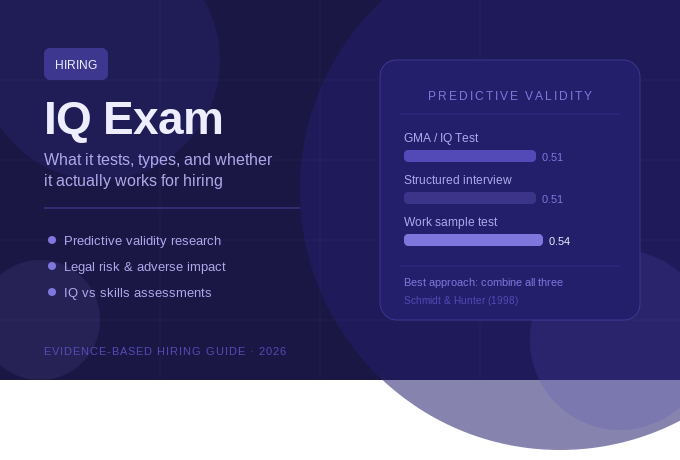
The most cited meta-analysis in this space, by Schmidt and Hunter (1998), found that general mental ability has a predictive validity coefficient of around 0.51 for job performance — meaning it's one of the strongest single predictors available. That's a real finding that serious HR practitioners don't dismiss.
But here's what that same research also shows:
- Structured interviews have a validity coefficient of 0.51 — the same as GMA tests
- Work sample tests score 0.54 — slightly higher
- Combinations of GMA + structured interview + work sample consistently outperform any single measure
- The predictive power of GMA is strongest for complex, novel roles — and weakest for highly procedural or domain-specific ones
For technical hiring specifically — developers, data engineers, DevOps — a candidate's ability to solve abstract pattern problems (what most IQ exams measure) is a weaker signal than their ability to actually write code, debug a system, or architect a solution. The skills are related, but they're not the same thing.
A candidate who scores in the 95th percentile on a cognitive ability test but can't write a basic SQL query is not the right hire for a data engineering role. The IQ exam told you something true — but not the thing that mattered most.
Is IQ Testing Legal in Hiring?
This is where organizations need to tread carefully — and where many have gotten into serious trouble.
The core legal issue in most jurisdictions is adverse impact: if a selection test disproportionately screens out candidates from protected groups (defined by race, ethnicity, national origin, sex, or disability), it can constitute unlawful discrimination regardless of intent.
The problem with IQ exams in hiring is well-documented:
- Standardized cognitive ability tests have shown consistent score gaps across racial groups in the United States, which has led to numerous EEOC enforcement actions
- The EEOC's Uniform Guidelines on Employee Selection Procedures (1978) require that any selection test causing adverse impact must be validated as job-related — a high bar that generic IQ tests rarely meet
- In the UK, the Equality Act 2010 imposes similar requirements around indirect discrimination
- India's employment discrimination landscape is evolving, but reputational risk from biased hiring is real and growing
This doesn't mean cognitive ability testing is categorically illegal — it means it requires rigorous validation, documentation, and often legal review before deployment in a hiring context. Many organizations that use GMA or cognitive assessments do so through established, validated instruments with legal defensibility built in.
The practical implication: if you're considering cognitive ability testing as part of your hiring process, consult your legal team before deploying, document your validation methodology, and make sure the test is genuinely relevant to the role requirements.
IQ Exam vs Skills Assessment: What's the Real Difference?
Here's the comparison that matters most for technical hiring teams. This isn't about which approach is philosophically superior — it's about which one gives you more accurate, defensible, actionable data for the specific decision you're making.
| Feature | IQ / GMA Test | Skills Assessment | SkillSauce |
|---|---|---|---|
| What it measures | General cognitive ability | Job-specific skills | Role-specific skills + behavior + integrity |
| Predictive validity | Moderate (0.51 correlation) | High for technical roles | High — tied to actual job output |
| Bias risk | High — documented adverse impact | Lower when well-designed | Minimized via anonymized scoring |
| Legal risk in hiring | Significant in many regions | Lower with validation | Built-in compliance (GDPR, CCPA) |
| Candidate experience | Often seen as irrelevant | Role-relevant, engaging | Transparent, feedback-driven |
| Cheating detection | Limited | Varies by platform | AI proctoring built-in |
| Cost | Low–Medium | Medium | Free trial ; ₹2,000–₹10,000 |
| Best used for | Broad screening only | Technical role validation | End-to-end technical hiring |
The key takeaway from this comparison isn't that IQ testing is bad and skills testing is good. It's that they answer different questions. An IQ exam tells you something about how someone processes information generally. A skills assessment tells you whether they can do the specific job you're hiring for.
For most technical hiring decisions, the second question matters more.
When Does an IQ Exam Make Sense — and When Doesn't It?
When it makes sense
- High-volume hiring where you need a fast initial screen across a large applicant pool and have no other structured filter
- Roles that genuinely require rapid learning across changing domains — consulting, strategy, certain management roles — where cognitive flexibility is the core competency
- Early-career hiring where candidates have limited work experience and domain skills haven't yet differentiated
- Used as one component of a multi-measure battery, not as a standalone screen
When it doesn't make sense
- Technical roles where domain skill is verifiable and directly relevant — software development, data science, cybersecurity, DevOps
- When your candidate pool is diverse and you haven't done adverse impact analysis
- When the cognitive demands of the role are average and don't require exceptional reasoning ability
- When you're already using structured interviews and work sample tests — adding an IQ test at that point adds marginal predictive value at real legal and reputational cost
The honest answer is that for most technical hiring at scale, a well-designed skills assessment does more of what you actually need — and carries less risk — than a generic cognitive ability test.
How SkillSauce Approaches Cognitive and Skills Assessment
SkillSauce doesn't offer a traditional IQ exam — and that's intentional.
The platform is built on the premise that for technical hiring, job-relevant skill is a stronger and fairer signal than general cognitive ability. Its assessment library covers hundreds of technical roles and stacks, with each assessment designed to reflect actual on-the-job requirements rather than abstract reasoning puzzles.
Where cognitive ability matters — problem-solving approach, logical reasoning under constraints, working with ambiguous requirements — SkillSauce's behavioral round AI interviews and TESSA AI interviews surface those signals in context. You see how a candidate thinks through a real technical problem, not how they perform on a pattern-matching exercise.
Key features relevant to this discussion:
- Anonymized scoring eliminates unconscious bias from the evaluation process — decisions are based on performance data, not demographic signals
- AI proctoring ensures the assessment reflects the candidate's own work, which is particularly important if you're already skeptical of how well cognitive tests capture genuine ability
- Post-assessment reports break down strengths, weaknesses, and skill-readiness per candidate — giving hiring managers concrete, role-relevant data rather than a single number
- GDPR, CCPA, and ISO 27001 compliance means the legal defensibility questions are already handled
The goal isn't to replace cognitive thinking with button-clicking exercises. It's to evaluate thinking in the domain where it actually matters for the role you're hiring for.
Conclusion
IQ exams have a real, evidence-backed place in the history of employment testing. The research supporting general mental ability as a predictor of job performance is genuine and worth understanding. But for most technical hiring teams in 2026, the practical limitations — legal risk, adverse impact concerns, distance from role-relevant skill — outweigh the benefits of deploying a standalone cognitive ability test.
The better approach is a multi-measure strategy: structured interviews, work sample assessments, and behavioral evaluation working together. Each adds something the others don't. Used in combination, they give you a more complete and defensible picture of a candidate than any single instrument — IQ exam included.
If your team is looking to build that kind of structured, evidence-based hiring process for technical roles, the tools to do it are available, accessible, and increasingly easy to deploy without a large team or budget.