


Between 60% to 80% of candidates fail their situational judgement test before ever reaching the interview stage.
Research confirms the gap is preparation: 54% to 84% of candidates who skip practice are more likely to fail these assessments, according to a study analysing the top 100 global employers. So the difference between passing and failing often comes down to one thing: preparation.
Situational judgement tests assess how you respond to workplace scenarios, and employers in industries of all types rely on them to filter candidates. Your SJT results are often combined with interviews and other assessments to determine if you move forward.
This guide covers proven strategies, situational judgement test tips, practice methods, and a worked example — everything you need to pass with confidence.
Understanding Situational Judgement Tests

Image Source: AssessFirst
"By focusing on hypothetical scenarios, SJT tests can minimize biases that might affect hiring decisions, promoting fairer evaluations based on relevant skills and behaviors." — Graduates First, Leading graduate recruitment and assessment preparation provider
A situational judgement test presents you with workplace scenarios and asks you to identify how you would handle them. These assessments assess your decision-making approach when faced with job-related challenges.
SJTs function as low-fidelity simulations. You respond to written or video-based scenarios rather than perform tasks in simulated environments. Each situation has multiple response options. You select the most effective, least effective, or rank them based on appropriateness.
These tests measure competencies in several dimensions: conflict management, interpersonal skills, problem-solving, and negotiation. They prove especially effective when you have managerial and leadership abilities to assess.
Format variations exist. Text-based questions, video scenarios with written responses, and computer-based interactive versions are common. Linear formats present similar questions in the same order to all candidates. Interactive formats adapt based on your earlier responses through branching logic.
Test developers create SJT questions using critical incidents gathered from subject matter experts. Scoring relies on expert judgements about the best and worst response alternatives. Employers use these assessments during hiring processes for administrative roles, management positions, and customer service.
Compared to traditional cognitive tests, SJTs show reduced adverse impact by gender and ethnicity — making them a more equitable screening tool while maintaining strong predictive validity for job performance. Research demonstrates they predict job performance in roles requiring strong interpersonal and problem-solving capabilities.
Situational Judgement Test Example Question
Read the following scenario and identify which response you would select as most effective and least effective before reading the explanation.
Scenario: You are a mid-level analyst working on a project with a tight deadline. A colleague approaches you and says they are struggling to complete their portion of the work and asks for your help. You are also under pressure with your own tasks. What do you do?
A) Tell your colleague you are too busy and suggest they speak to the manager.
B) Stop your own work immediately and help your colleague complete their section first.
C) Acknowledge your colleague's difficulty, briefly discuss which parts they need most help with, and agree to assist for a defined period while flagging to your manager that both workloads may need rebalancing.
D) Suggest your colleague stay late to catch up on their own time.
Most effective: C This response demonstrates collaboration, communication, and proactive problem-solving — the three competencies most SJTs are designed to measure. It neither abandons the colleague nor sacrifices your own responsibilities entirely.
Least effective: D This response avoids the problem rather than addressing it, signals poor interpersonal skills, and offers no constructive solution — exactly the pattern SJT scoring algorithms are built to penalise.
How to Prepare for Your Situational Judgement Test
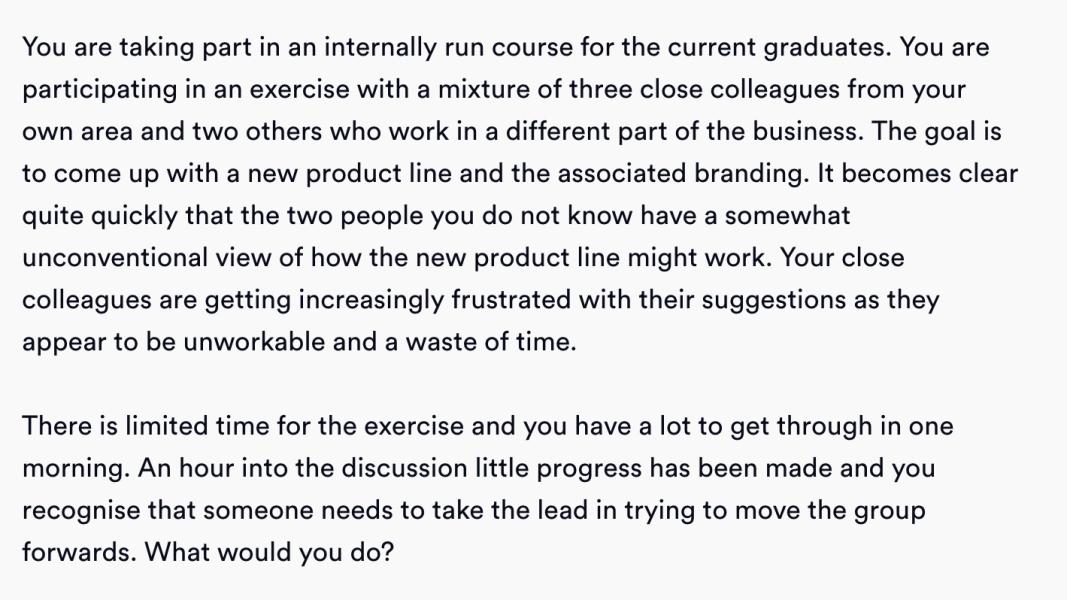
Image Source: Practice Aptitude Tests
Preparation starts with understanding what the employer values. Research the company's mission, values, and leadership approach before you take your sjt test. Organizations tailor these assessments to their specific culture, so your responses should match their stated priorities. Read the job description and identify which competencies they emphasize most.
Practice remains the most effective preparation method. Situational judgement test practice assessments familiarize you with common scenario formats and improve your judgement speed. Work through different question types: some ask you to choose the best and worst responses, others require ranking all options, and some use rating scales. You need to understand these variations to prevent confusion during the actual test.
Know the test format beforehand. Confirm whether your assessment is timed, uses video scenarios, or follows a specific publisher's style. Common providers include Pearson TalentLens, SHL, and AON. Each has distinct formats.
Practice under realistic conditions. Set time limits, ensure stable internet, and choose a quiet environment. Read each scenario and all response options before you answer. Look for nuances in the wording that signal what competency is being assessed.
Keep your answers consistent. Tests analyze patterns in your responses, so selecting very cautious options in some scenarios and aggressive choices in others signals inconsistency. Avoid defaulting to "escalate to manager" for every situation. Employers value independent problem-solving when appropriate.
Step-by-Step Strategy to Pass Situational Judgement Tests
"Do not make any decisions until you ask questions, talk to those involved in the situation, and understand where everyone is coming from. Any assumptions will only result in a lower score." — BEMO Academic Consulting, Specialized SJT and medical admissions assessment expert
Read the instructions carefully whenever you start your sjt test. Different situational judgement test questions use varying formats. Some ask for best and worst responses. Others require ranking all options, and some use effectiveness ratings. You will make unnecessary mistakes if you misread these instructions.
Analyse each scenario carefully before selecting any answer. Who are you in the situation? What does your role entail, and what authority level do you hold? A junior employee shouldn't select responses with task delegation, whereas management-level responses would include such options. This context determines which actions arrange with your position.
A practical framework for analysing any SJT scenario is the STAR method — Situation, Task, Action, Result. First, identify the specific Situation presented and what makes it a problem. Then clarify the Task — what role you are expected to play and what authority you hold. Next, evaluate the Action options against what a professional in that role would realistically do. Finally, consider the Result each action would likely produce. Responses that lead to collaborative, ethical, and constructive outcomes consistently score higher than those that are passive, escalatory, or self-serving.
Each scenario is self-contained. Answer only based on the information provided — do not introduce assumptions from experience or add context not stated explicitly.
What you think is most effective versus what you would most likely do are two different things. Knowing how to choose the most effective answer measures your judgement, whereas your most likely response reveals your behavioral tendencies.
Set milestones to manage your time. Work out how long you can spend per question as soon as the test begins. Flag the question and move forward if you find yourself stuck. Complete all questions first, then return to flagged items if time permits.
Conclusion
You now have everything you need to tackle your situational judgement test with confidence. Preparation makes the difference between passing and failing these assessments undeniably.
Start with realistic scenarios for practice and arrange your responses with company values. Stay consistent throughout. Success comes down to understanding what employers seek and showing sound judgement under pressure.
Start with one realistic practice test today. Identifying which scenario types you find hardest is the most efficient way to direct your remaining preparation time.
For Employers Using Situational Judgement Tests
Situational judgement tests are most effective when they are designed for the specific role and scored against validated benchmarks — not generic question banks. SkillSauce's assessment library includes role-specific SJT-style evaluations for both technical and non-technical positions, with structured scoring, candidate-level reporting, and AI-powered interview tools that complement your assessment results.
Key Takeaways
Master these essential strategies to significantly improve your chances of passing situational judgement tests and advancing in your career:
- Practice is crucial: 54-84% of unprepared candidates fail SJTs, while consistent practice with realistic scenarios dramatically improves success rates.
- Research company values first: Align your responses with the organization's mission and culture, as SJTs are tailored to specific workplace environments.
- Read instructions carefully: Different SJT formats require ranking, rating, or selecting best/worst options - misunderstanding costs valuable points.
- Stay role-appropriate: Match your responses to your position level - junior employees shouldn't choose delegation options meant for managers.
- Maintain consistency: Avoid mixing extremely cautious and aggressive responses across scenarios, as tests analyze patterns in your decision-making approach.
Remember, SJTs evaluate your workplace judgement through realistic scenarios, not your technical skills. Success depends on demonstrating sound decision-making that matches both the role requirements and company culture. With proper preparation and strategic thinking, you can join the minority of candidates who pass these challenging assessments.