
Introduction
The skills needed for the average job have changed by 25% since 2015. Organizations risk making decisions based on outdated assumptions without a talent development framework. While 66% of HR leaders identify skills needed for growth, only 48% know how to acquire them.
That's the gap we're here to close.
This piece will walk you through building a talent development framework that combines talent assessment with your business goals and delivers results for your organization.
What is a Talent Development Framework and Why You Need One
"The only thing worse than training your employees and having them leave is not training them and having them stay." — Henry Ford, Founder of Ford Motor Company, industrial pioneer in workforce development
### Defining a Talent Development Framework
A talent development framework is the infrastructure that defines who you invest in, how you invest in them, and why that investment connects to business outcomes. It's the practice of helping employees build the skills, experiences, and opportunities they need to grow while lining up those goals with your organization's long-term strategy.
This framework creates a repeatable process for developing capabilities in your workforce. You establish clear systems that anyone can understand and apply instead of relying on scattered training sessions or hoping employees figure out their growth paths independently.
The Business Case for Structured Talent Development
Organizations with strong talent management strategies experience 23% higher profitability and 18% higher productivity. Those numbers alone justify the investment. The benefits extend further though.
Employee retention remains a pressing concern. Research shows that 88% of organizations worry about keeping their people. Over a quarter of U.S. workers voluntarily leave their jobs each year, and the quit rate has climbed by 37% in the last decade. Top performers accept offers elsewhere if they don't see internal opportunities. Replacing them costs far more than retaining them and results in a loss of institutional knowledge.
Structured talent development addresses this by offering learning opportunities, which has become the top strategy companies use to improve retention. People stay if they see a future with you.
How It Is Different from a Talent Management Framework
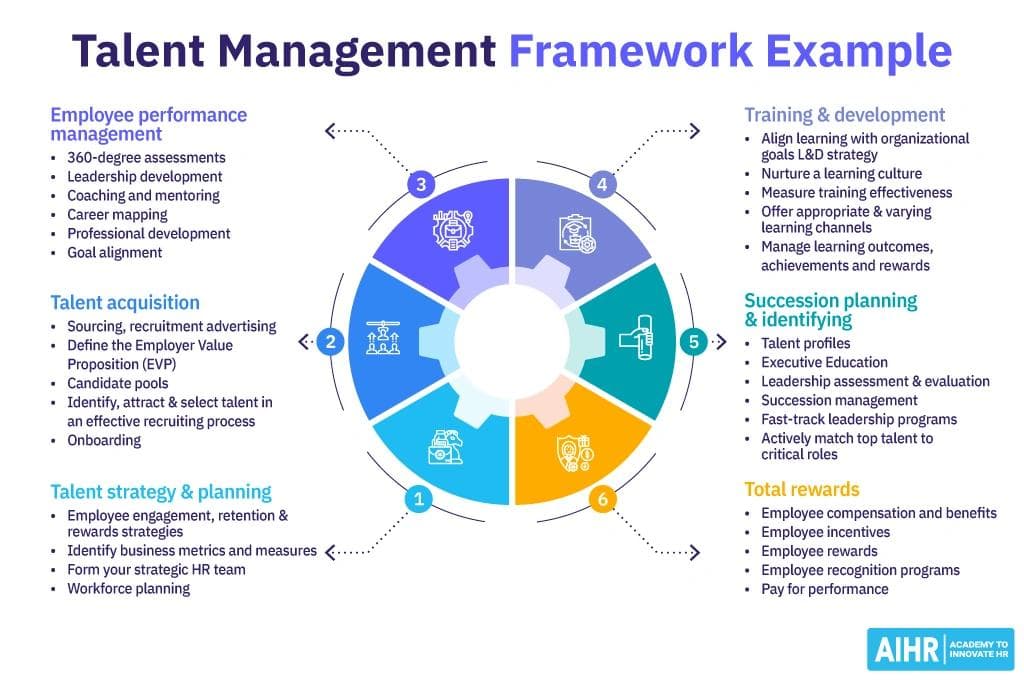
Talent management and talent development serve distinct purposes, though they work together. Talent management covers the whole employee experience from recruiting and onboarding to performance, learning, and retention. It's the overarching framework that ensures you have the right employees in the roles where they excel and contribute most.
Talent development sits inside that broader system with a focused goal: prepare your people for the roles your business needs now and in the future. Talent management provides the structure. Talent development propels growth.
The differences break down in several ways. Talent management focuses on organizational-level processes with a broader scope. Talent development emphasizes individual growth and learning. Talent management addresses immediate needs with a shorter time horizon. Talent development takes a longer-term view and builds a skilled and adaptable workforce that can meet future challenges.
Think of talent management as the wide lens on workforce planning. Talent development zooms in on how employees progress inside your company.
Key Components of an Effective Talent Development Framework
Six components work together to create a functioning talent development framework. Each one addresses a different dimension of employee growth and relies on the others to deliver results.
Skills and Competency Mapping
Competency mapping reviews candidates and employees in a structured, methodical way that identifies knowledge, skills, motives, traits and social roles, as well as gaps within these characteristics. This process is the foundation of your framework by defining what success looks like at each level.
The mapping process starts with analyzing job roles to identify core competencies required for each position. Each competency gets split into proficiency levels, with three to five levels being standard: simple, intermediate, advanced and expert. Statistics show that 80% of employee turnover stems from bad hiring decisions. Competency mapping reduces this risk by giving clear criteria to review fit.
Career Progression Pathways
Career progression pathways are structured frameworks that help employees understand the skills, competencies and milestones required for advancement. These pathways give clarity on how people can move vertically into management roles or laterally into specialist positions.
A well-defined pathway eliminates ambiguity about career opportunities. Employees can set goals and work toward them with focus. To name just one example, an entry-level employee sees the specific steps required to reach a managerial position: gaining certain skills, getting certifications, or achieving performance measures.
Learning and Development Programs
L&D programs address skill gaps identified through competency mapping. Companies in the top quartile of leadership development outperform other organizations by nearly two times on EBITDA. Organizations that invest in developing leaders during transformations are 2.4 times more likely to hit performance targets.
Effective L&D combines formal training with informal learning, including coaching, mentoring and on-the-job instruction. Individual Development Plans offer tailored learning paths that address developmental areas and prepare employees for enhanced responsibilities.
Performance and Growth Metrics
Performance metrics give quantifiable indicators to review employee effectiveness and contributions. These metrics fall into several categories: work quality metrics like performance reviews and 360-degree feedback, work quantity metrics such as task completion rates, and efficiency metrics including cost per unit of output.
The most effective approach balances quantitative data with qualitative feedback to create a detailed view of performance. Metrics should arrange with organizational goals and be customized by role.
Succession Planning Elements
Succession planning identifies and develops employees to fill critical roles when vacancies arise. The process starts by identifying business-critical roles at all levels within the organization. Modern succession planning creates talent pools for various roles rather than focusing on senior positions alone.
High-potential employees receive exclusive learning initiatives, job rotation, challenging assignments and mentorship to accelerate their development. Regular talent reviews give clarity on who can take on critical positions and what development areas need attention.
Talent Assessment Integration
Talent assessments give objective, analytical insights that reduce bias in hiring and development decisions. Assessment tools measure work behaviors, knowledge and skills, and innate abilities like cognitive capacity. These tools integrate into job descriptions, performance reviews and development planning. The integration connects competency frameworks to recruitment, onboarding, performance management and succession planning processes.
Step 1: Identify Your Organization's Development Needs
Building your talent development framework starts with understanding what capabilities you have and what you just need. This diagnostic phase determines where you'll invest development resources and prevents wasted effort on the wrong priorities.
Conduct a Skills Gap Analysis
A skills gap analysis identifies the difference between your workforce's current capabilities and what's required to meet business needs. The process follows five steps: plan your approach, identify critical skills, measure actual skills, analyze the data and take action.
Start by determining what skills your organization values and needs for current operations and future goals. Job descriptions, business objectives, industry trends and regulatory changes provide valuable input. You can conduct this analysis at multiple levels—individual employees, specific teams, departments or across the whole organization.
Measure existing skills with performance reviews, 360-degree feedback, assessments, interviews and KPI contributions. Once you collect this data, create a searchable database and assign importance ratings to each skill. This will give you the ability to address the most critical gaps first. Despite 84% of companies agreeing that continual workforce reinvention through lifelong learning is important or very important, only 16% expect to substantially increase reskilling investment over the next three years.
Arrange Development Goals with Business Strategy
Your talent development framework must connect to strategic objectives. Review your organization's goals for the next three to five years. Entering new markets, adopting new technology or changing your operating model—those changes carry specific capability requirements.
Ask what skills will be needed, which roles might be automated and what emerging competencies are rising in your industry. This forward-looking approach prepares people for what's coming, not just what exists.
Define Critical Roles and Capabilities
Not all roles deserve equal development investment. Critical roles arrange with three dimensions: strategic value measures importance to long-term objectives, business value captures immediate effect on profitability and efficiency, and role value thinks about talent scarcity and difficulty to develop internally.
Identifying these roles helps you allocate resources, focus recruitment efforts and determine where upskilling delivers the highest return.
Gather Input from Stakeholders
Working with executives, managers and employees makes your framework address real needs. Executives provide strategic direction. Managers identify operational skill gaps. Employees share practical challenges and learning barriers. This diverse input grounds your framework in reality and increases buy-in across the organization.
To simplify this entire process, many organizations now rely on AI-powered platforms like SkillSauce to automate skill gap analysis and talent assessment
Build a Data-Driven Talent Development Strategy
Identify skill gaps, assess candidates accurately, and create high-performing teams with AI-powered talent assessment tools.
Try SkillSauce FreeNo credit card required • Reduce hiring mistakes by up to 70%
Step 2: Design Your Framework Structure
Once you've identified your development needs, translate that information into a working structure. This design phase creates the actual architecture employees and managers will use.
Create Employee Development Profiles
Development profiles document each employee's current capabilities, career aspirations and growth gaps. A conversation between manager and employee about career goals, frustrations and interests should be the starting point. These aspirations need to match business needs. If you're expanding into a new market next year, identify employees with leadership potential for that initiative.
Required growth breaks down into technical skills and soft skills. For example, an employee moving from contributor to team manager needs specific competencies: budget management, delegation skills and experience leading small projects before taking on full team responsibility.
Map Learning Paths for Different Roles
Learning paths provide a roadmap from current state to desired outcome. The destination gets defined by identifying the core business challenge you're solving and establishing success metrics. The final destination then breaks into smaller, sequential milestones that build momentum.
A mix of interventions using the 70:20:10 model should be curated: 70% on-the-job experience, 20% social learning through coaching and mentorship, and 10% formal training. These experiences need sequencing so each milestone builds on the last. Different paths for varying experience levels exist, from simple to intermediate to advanced.
Establish Competency Levels and Measures
Competency levels define excellence at each stage. Each level needs developmental descriptors that indicate progression. Behavioral anchors provide concrete examples that clarify what each competency looks like in practice.
Programs should modify these measures to fit specific goals and identity. The minimal expected competence rating becomes a program decision rather than individual judgment.
Build Flexibility into Your Framework
Talent development isn't one-size-fits-all. Different contexts require different strategies. Employees should find and match with opportunities relevant to their interests while addressing skill gaps. Adaptability needs to be built into your structure so pathways can adjust as employees grow or business needs change.
Step 3: Implement and Scale Your Framework
"An organization's ability to learn, and translate that learning into action rapidly, is the ultimate competitive advantage." — Jack Welch, Former CEO of General Electric, legendary business leader on talent and learning
Execution determines whether your talent development framework becomes a working system or another abandoned initiative. Success requires a rollout you think over with clear milestones.
Pilot with High-Impact Teams
A pilot launch allows you to start small, learn what works, and refine your approach before you invest in a full rollout. Define a clear focus by narrowing in on a specific skill area, department, or group of employees. Choose participants with care—one department or a cross-functional group—and ensure they have manager support.
Set objectives and metrics upfront. Treat the pilot as an experiment with clear success criteria. A successful execution of a small pilot can lead to bigger results once you roll it out enterprise-wide, with cost per person declining as you benefit from economies of scale.
Train Managers on Framework Usage
Managers execute talent processes, but integration requires they see themselves as the main mechanism to build capability. Train them on framework usage and provide the skills and knowledge needed to implement it and support their teams. If your framework has continuous performance management, provide coaching sessions to help managers move away from annual reviews and have more frequent check-ins.
Connect to Existing HR Systems
L&D must understand major HR practices and work together with HR leaders. The best functions use united development feedback from performance reviews as input to build capability. Cloud-based learning platforms provide unlimited opportunities to access the latest functionality without lengthy implementations. Organizations using Agile-based integration strategies see a 35% increase in employee engagement scores.
Communicate the Value to Employees
Company-wide announcements from leadership underline the initiative's importance. Clarify training objectives and communicate benefits to the organization and employees. Encourage managers to allow time to learn during work hours by scheduling learning blocks on team calendars.
Roll Out Across the Organization
Rather than flipping a switch for the entire company at once, think about a phased rollout. Extend the program to one business unit or region at a time, or start with a particular job role across all departments. Executive sponsorship from a senior leader who promotes at the highest levels proves invaluable.
Step 4: Maintain and Optimize Your Framework
Your talent development framework requires ongoing maintenance to work. Talent development is a moving target, and one tactic rarely generates exact results you're looking for.
Set Up Regular Review Cycles
Quarterly review processes help you identify priority activities and bring in experts from centers of excellence as needed. Annual talent reviews provide deeper analysis where managers complete one-page talent review profiles that summarize performance evaluation, developmental needs, career interests, strengths, readiness for promotion and development action plans. Frameworks become obsolete as skills requirements change, and regular monitoring prevents this.
Measure Framework Effectiveness
You should track KPIs to measure each element of your framework. People are your biggest expense, so measuring effectiveness makes sense. Both quantitative metrics and qualitative feedback help you assess the effect. Engagement scores, performance improvement metrics, retention rates and tool adoption need monitoring. Technology helps surface immediate data on headcount, growth trends and turnover with automated calculations.
Update Based on Business Changes
Employee skills and competencies need continuous monitoring to address current and future needs. Business goals evolve, and therefore your metrics should too. Your framework needs adaptation when you enter new markets, adopt technology or change operating models.
Create Continuous Feedback Loops
Feedback and performance data help you optimize your approach. Regular check-in meetings and routine one-on-ones should be scheduled. Feedback should be bidirectional so employees can share concerns and suggestions. Analytics dashboards track feedback frequency and sentiment.
Conclusion
You now have everything needed to build a talent development framework that drives real business outcomes. We've covered the six core components, walked through the four-step implementation process, and shown you how to maintain momentum through continuous optimization.
The framework itself is a living system. Your business needs will move, roles will evolve, and employee aspirations will change. Regular reviews, feedback gathering, and quick adaptation determine success.
A pilot program is where you should begin. Measure what matters and scale what works. Connect development to business strategy rather than treating it as an isolated HR initiative. Your framework will deliver results when it serves both organizational goals and employee growth.
Key Takeaways
Building an effective talent development framework requires strategic alignment, structured implementation, and continuous optimization to drive real business outcomes.
- Start with data-driven needs assessment: Conduct skills gap analysis and align development goals with business strategy to focus investment on critical capabilities that matter most.
- Design flexible, competency-based pathways: Create clear progression routes with defined skill levels and benchmarks while allowing adaptability for different roles and career aspirations.
- Pilot before scaling organization-wide: Test your framework with high-impact teams first, train managers thoroughly, and roll out in phases to ensure successful adoption.
- Measure and optimize continuously: Establish quarterly review cycles, track effectiveness metrics, and create feedback loops to keep your framework relevant as business needs evolve.
Organizations with strong talent development strategies experience 23% higher profitability and 18% higher productivity. The key differentiator isn't just having a framework—it's building one that connects individual growth to business outcomes while remaining flexible enough to adapt as your organization evolves.