

Introduction
In an increasingly competitive talent market, hiring agencies face pressure to move faster, hire top talent, and scale without compromising fairness. A hybrid model that blends AI with human judgment offers a practical path forward. By combining the speed and consistency of artificial intelligence with the context, empathy, and strategic thinking that only humans provide, agencies can deliver superior outcomes for clients and candidates alike.
Why hybrid AI + human models win in recruitment
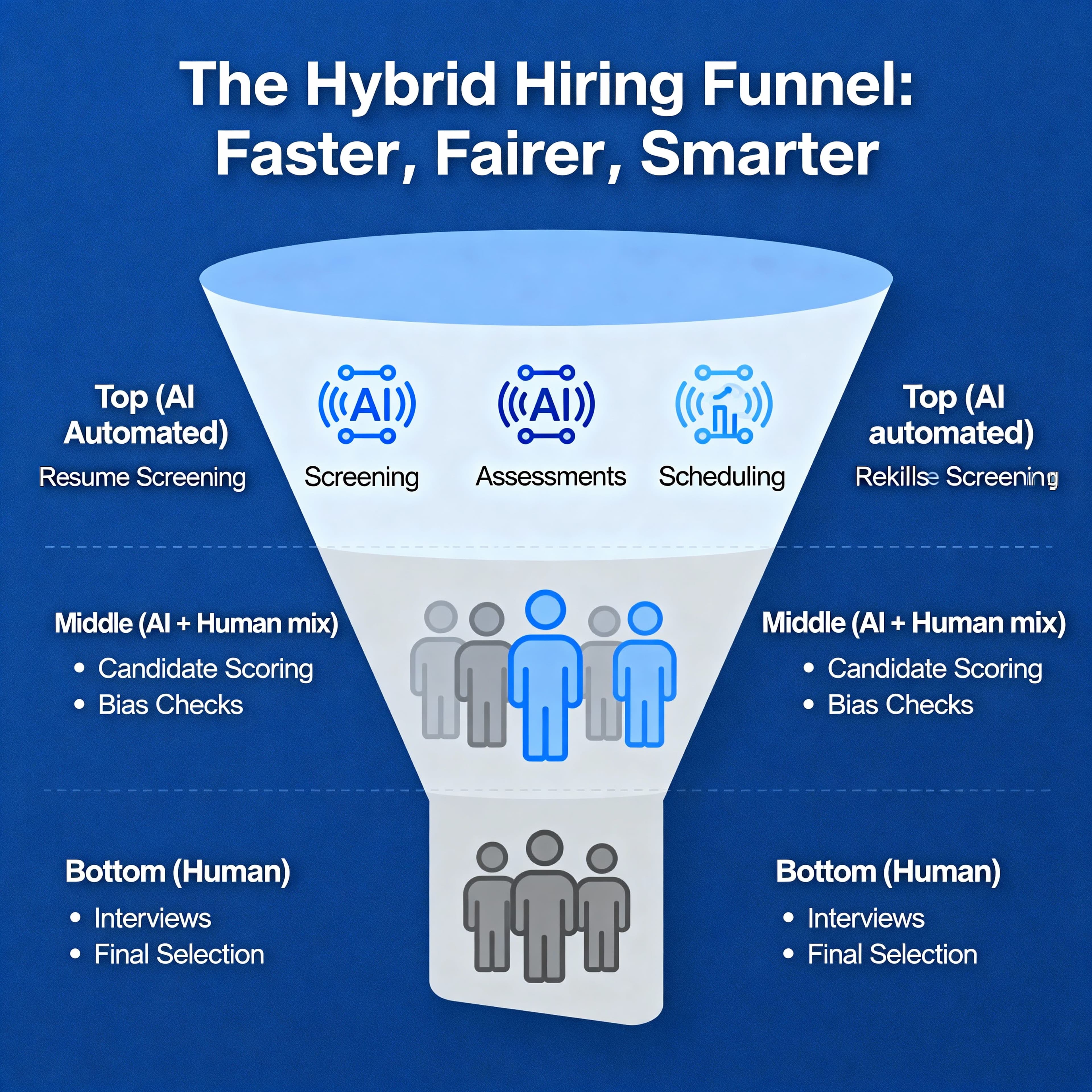
A purely human process can be slow and costly, while a fully automated approach risks missing nuance and can unintentionally propagate bias. The strongest hiring outcomes come from a deliberate collaboration between machines and people. AI handles repetitive, data-intensive tasks — parsing resumes, running standardized assessments, and coordinating scheduling — while humans make final judgments on cultural fit, team dynamics, and long-term potential.
- Faster hiring process: Automating screening, outreach, and initial assessments accelerates the early stages of the funnel. Recruiters then step in for deeper conversations and decision-making, dramatically shortening time-to-hire without compromising rigor.
- Reducing hiring bias with AI: When designed with fairness in mind and overseen by humans, AI can help standardize scoring and surface disparities that require human calibration. Bias-aware design, audit trails, and ongoing model validation are essential components of this approach.
- Improving candidate experience with AI: Candidates benefit from timely updates, transparent progress indicators, and consistent communication powered by automation, while human recruiters provide empathy, personalized guidance, and nuanced feedback.
- Scalable recruitment solutions: AI scales volume — from sourcing to initial screening — enabling recruiters to focus on strategic conversations, stakeholder alignment, and complex hiring in high-demand roles.
How hybrid models work in practice
Implementing a hybrid model doesn’t mean turning recruiting into a factory run by algorithms. It means designing decision points where AI adds the most value and where human oversight ensures fairness and context.
- Job intake and scope: Use AI to analyze job descriptions for required skills and business impact. Have humans review for nuance, ensure inclusivity, and calibrate success metrics.
- Sourcing and screening: AI surfaces candidates based on skills-based criteria, experience, and availability. Human reviewers assess cultural fit, potential for development, and alignment with the team’s operating style.
- Assessments and scoring: AI administers standardized, role-relevant assessments and provides objective scores. Humans interpret results in context—team dynamics, growth opportunities, and critical soft skills.
- Interviewing and decisioning: AI-supported ranking and bias checks guide interview planning, while interviewers probe for evidence of motivation, collaboration, and learning agility.
- Offer and onboarding: AI automates administrative steps and scheduling; humans handle negotiation, onboarding personalization, and cultural integration planning.
To operationalize this effectively, many agencies leverage an integrated platform that unifies automation with human workflow. For example, SkillSauce provides capabilities across essential pillars such as Features, an expansive Resources, and a robust Assessment Library designed for skills-based hiring. An additional pillar, AI Proctoring, helps safeguard assessment integrity while preserving human oversight.
Metrics that matter in a hybrid setup
Success in hybrid hiring requires a balanced set of metrics that reflect speed, quality, cost, candidate experience, and fairness. Common, actionable metrics include:
- Time-to-hire and time-to-interview — indicators of speed gains from automation.
- Quality of hire — measured through job performance, ramp time, retention, and manager satisfaction. Align these with role-specific targets.
- Cost-per-hire — cost reductions from automated steps and decreased cycle times.
- Candidate experience — tracked via surveys and feedback, emphasizing clarity, transparency, and responsiveness.
- Diversity and inclusion — metrics that ensure access to opportunities and monitor the impact of the process on diverse talent pools.
Industry benchmarking resources such as the SHRM 2025 Recruiting Benchmarking Report and the Criteria Corp Hiring Benchmark provide targets and context for these metrics. While external benchmarks are valuable, internal, high-quality data will drive the most actionable improvements for your agency.
Evidence from the field
Several high-profile studies and case examples illustrate the benefits of hybrid AI + human models. For instance, major brands have reported substantial time savings and improvements in candidate diversity when AI-driven assessments are paired with human review. Yale’s research also points to cost efficiencies and sustained quality through automation complemented by human calibration. It’s worth exploring official case studies such as the Unilever AI-powered recruitment revolution and corresponding industry analyses. For governance and compliance, consult the EEOC guidance on employment tests and selection procedures.
Operational blueprint: bringing hybrid to life with SkillSauce
To translate the hybrid concept into practice, a unified platform approach helps you align technology with recruiter expertise. SkillSauce offers four core pillars:
- Features — automation for screening, scoring, and scheduling, with human-ready insights. Learn more at Features.
- Resources — best-practice playbooks, benchmarks, and case studies. Explore Resources.
- Assessment Library — standardized, job-aligned tests that drive skills-based hiring. Browse Assessment Library.
- AI Proctoring — protect test integrity while preserving a fair, compliant process. See AI Proctoring.
For organizations aiming to improve fairness, transparency, and outcomes, integrating the above capabilities with evidence-based practices from industry research is essential. SHRM’s guidance, for example, emphasizes optimizing the recruitment funnel with metrics and fairness in mind.
Conclusion
The future of hiring is hybrid: AI-powered efficiency coupled with human judgment results in faster, fairer, and more scalable recruitment. Agencies that adopt this model with a trusted platform like SkillSauce can accelerate time-to-fill, improve candidate experience, and demonstrate compelling ROI for clients. Ready to pilot a hybrid approach? Contact us to schedule a demonstration or explore the Assessment Library for immediate testing capabilities.
Ready to Build Your Hybrid Hiring Engine?
Transform your recruitment process with SkillSauce’s AI-powered platform. Blend automation with human intelligence to accelerate time-to-hire, improve fairness, and deliver unmatched results for your clients.
Schedule Your Demo