

Introduction: The Human Side of Data-Driven Hiring
In the high-speed hiring world of 2025, pre-employment tests have become smarter, faster, and more data-driven—but also more intimidating. Candidates often see them not as opportunities to shine, but as judgment days that decide their professional worth.
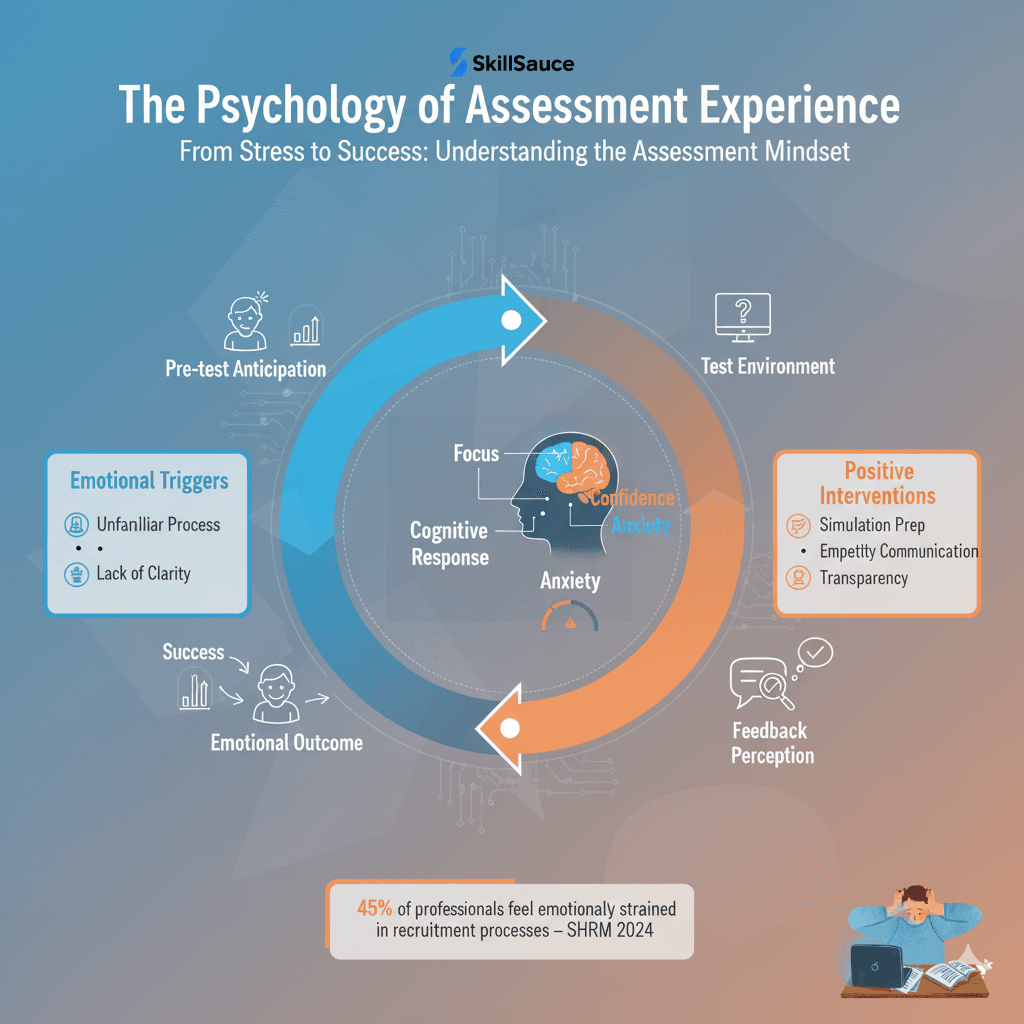
According to SHRM’s 2024 Workplace Mental Health Report, nearly 45% of professionals report emotional exhaustion or burnout, while 35% believe workplace evaluations harm their mental well-being. For many, assessments feel like psychological minefields—triggering anxiety, self-doubt, and underperformance.
To unlock their true value, HR teams must understand the psychology of assessments—how human emotions, perceptions, and stress responses affect results—and how empathy and thoughtful design can turn testing from a stressor into a fair, empowering experience.
Understanding the Scientific Pillars of Psychological Assessment
| Stage | Process Component | Psychological Factor | Candidate Impact | Best Practice |
|---|---|---|---|---|
| Pre-assessment | Test communication | Uncertainty, anticipation | Stress or confusion | Transparent instructions |
| During test | Question design & timing | Cognitive load | Reduced focus | Adaptive or gamified testing |
| Post-assessment | Feedback delivery | Perceived fairness | Satisfaction | Feedback-driven closure |
Psychological assessment tests measure cognitive ability, personality, and emotional intelligence to predict job performance. Crucially, their accuracy depends as much on the candidate’s state of mind as on the test’s scientific structure.
According to Thomas International (2024), valid assessments rest on five scientific pillars:
- Standardization
- Objectivity
- Norming
- Reliability
- Validity
However, even the most scientifically designed test can fail if psychological conditions aren’t managed. Three key psychological factors directly influence assessment outcomes and contribute to candidate assessment anxiety:
1. Test Environment and Uncontrolled Variables
Noise, poor lighting, or unclear instructions heighten stress and cognitive load, limiting focus and accuracy. For remote assessments, this is a critical factor for reducing performance validity.
2. Feedback Perception and Trust
Candidates who believe they are being judged unfairly, or are left completely in the dark post-assessment, lose motivation, confidence, and trust in the employer brand. This directly impacts the candidate experience.
3. Cognitive Load and Working Memory
Overly complex or multitasking-heavy assessments strain working memory. This can cause capable individuals to underperform, masking true skill due to unnecessary mental stress.
Modern HR platforms now use AI-driven adaptive assessments to reduce these biases—measuring implicit traits like adaptability and emotional balance rather than just right-or-wrong responses.
How Anxiety Distorts Assessment Outcomes (The "Evaluation Alienation" Effect)
Test anxiety is more than just nerves—it’s a measurable psychological state that negatively affects concentration, recall, and sound decision-making.
A TestGorilla study showed that anxious candidates routinely underperform, not due to lack of skill but due to physiological stress responses. Similarly, eSkill’s 2024 report revealed that nervous applicants often give shorter, less thoughtful answers—leading to missed potential hires.
In a 2025 Journal of Psychology study, candidates in automated or AI-based assessments reported a phenomenon called “evaluation alienation”—feeling judged by impersonal algorithms rather than human evaluators. This feeling is a major contributor to assessment stress.
Common Anxiety Biases That Impact Fairness (DEI)
Ignoring these psychological factors doesn't just reduce fairness—it actively weakens Diversity, Equity, and Inclusion (DEI) outcomes by screening out capable but anxious talent:
- Gender Differences: Female professionals often report higher pre-test nervousness, even when skill alignment is equal or superior.
- Neurodivergent Impact: Speed-based or verbal-heavy tests may disproportionately disadvantage neurodiverse individuals.
- Cultural Perception Bias: Non-native English speakers can misinterpret tone or nuance in instructions, amplifying stress and reducing performance accuracy.
5 Proven Strategies to Build Psychological Safety into Assessments
Building psychological safety in hiring requires a mix of science, empathy, and transparent communication. Here are proven strategies organizations are adopting:
1. Radical Transparent Communication
Explain every aspect of the process before testing begins:
- Test duration and specific question types
- How scores are used in the hiring decision
- Whether AI in recruitment tools are involved
Transparency reduces uncertainty—the primary fuel for anxiety—and actively builds trust.
2. Implement Simulated Assessments and Demo Environments
Offer candidates optional practice tests or demo environments. Platforms like Skillsauce.io use gamified simulations that make assessments feel like interactive experiences rather than interrogations.
3. Use Empathetic Framing and Instructions
Reword instructions to emphasize growth over perfection. For example, change "Answer all questions correctly in the fastest time" to:
"This assessment helps us understand your unique approach to challenges and problem-solving—it’s not about getting every answer right."
Such framing redefines testing as a collaborative data-gathering process, not a final judgment.
4. Personalized Feedback Loops (Even for Rejections)
Sharing performance insights post-test—highlighting strengths and specific development areas—significantly increases candidate satisfaction, even among rejected applicants. It also boosts employer brand credibility and improves the overall candidate experience.
5. Optimize the Testing Environment
Encourage calm, distraction-free environments and offer flexible scheduling. Utilizing mobile-friendly and highly accessible platforms also reduces stress by meeting candidates where they are comfortable and prepared.
The Role of AI and Behavioral Analytics in Managing Assessment Stress
Artificial Intelligence is reshaping assessments into more empathetic and behaviorally intelligent systems. Tools are now analyzing micro-signals of stress, attention, and confidence in real time—paving the way for true behavioral analytics in HR.
Examples of AI Applications in Psychological Safety
- Facial Sentiment & Vocal Analysis: Tools use these non-verbal cues to detect anxiety or fatigue patterns, allowing for automated pause prompts or flagging candidates for human follow-up.
- Neuroscience-Based Games: Platforms employ games to gather behavioral data through play, minimizing direct test pressure and reducing the perceived stakes.
- Comfort Prediction: Advanced systems track cognitive and interaction data to predict a candidate's comfort level and alert recruiters when intervention or reassurance may be necessary.
According to Gartner’s 2025 HR forecast, over 70% of global enterprises now deploy AI-based behavioral analytics to make assessments both efficient and empathetically responsive—bridging the gap between technology and the psychology of assessments.
Benefits: Why Psychological Safety Boosts Organizational Outcomes
A psychologically aware assessment process benefits both the candidate and the company:
- Enhanced Candidate Experience: Candidates who feel informed and respected are 2.5× more likely to recommend the employer (LinkedIn Talent Insights, 2024).
- Better Performance Accuracy: By reducing cognitive stress, assessments reveal true potential, leading to more accurate selections and higher job retention.
- Strengthened Employer Brand: Transparent, empathetic assessments communicate that your organization values mental well-being as much as raw performance.
- Improved DEI Outcomes: Reducing candidate assessment anxiety barriers levels the playing field for underrepresented or neurodiverse candidates—supporting inclusion goals.
- Smarter Decision-Making: AI tools track behavioral and cognitive data, giving recruiters predictive insights into future performance and cultural fit.
Conclusion: Toward Human-Centric, Science-Driven Hiring
The future of hiring lies in blending psychology and technology—in designing assessments that are not just data-accurate but emotionally intelligent.
Reducing anxiety isn’t about eliminating stress entirely—it’s about acknowledging it, managing it, and creating an environment where candidates can truly perform their best.
By viewing assessments through both a psychological and technological lens, HR leaders elevate recruitment from a transactional process into a human-centered experience—where fairness, confidence, and connection drive the metrics of success.
Key Takeaway
When empathy meets analytics, hiring becomes not just smarter—but kinder. The psychology of assessments teaches us that performance thrives in safety, and data works best when powered by understanding.