

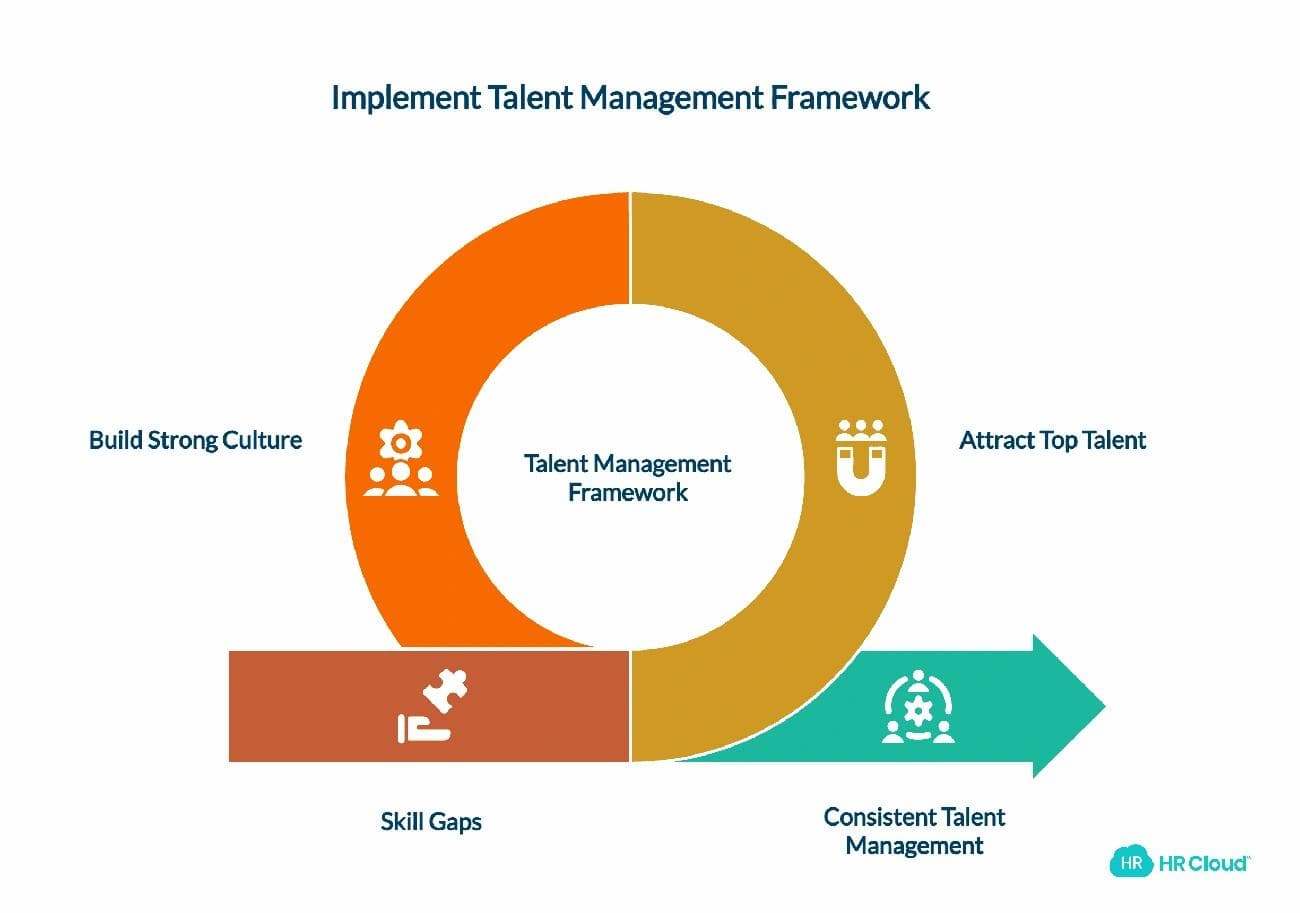
What is a talent strategy?
A talent strategy defines an organization's plan to optimize the value of talent assets by addressing how and why the organization must attract, involve, retain, and develop talent while improving continuous performance. This strategic framework helps organizations recruit, develop, and retain top performers while planning ahead for skills gaps and future workforce needs.
The fundamental purpose centers on lining up workforce capabilities with organizational goals through integrated processes and practices. This alignment spans from recruiting and onboarding to performance management, leadership development, and succession planning. These elements work together to create a cohesive system that supports both immediate operational needs and long-term strategic objectives rather than functioning as isolated HR activities.
Organizations implement talent strategies to create competitive advantages and meet the career development aspirations of present and future talent. The most effective approaches move beyond typical activities such as talent acquisition and performance management to include talent relationship management and the creation of more diverse and inclusive talent systems. This expanded scope recognizes that workforce optimization requires attention to both organizational performance metrics and individual employee growth trajectories.
A detailed talent strategy thinks about multiple organizational dimensions at once. It gets into organizational initiatives, team strengths and weaknesses, skill gaps in certain roles, talent development opportunities, and methods to boost the overall employee experience. This comprehensive viewpoint ensures that talent decisions support broader business objectives rather than serving narrow departmental interests.
The scope extends well beyond filling open positions. Organizations must think about team composition, identify skill deficiencies in a variety of roles, create development pathways, and boost the complete employee experience from recruitment through retention. Organizations learn about how workforce capabilities influence both employee satisfaction and stated business goals by analyzing these interconnected factors.
Strategic workforce planning forms an integral component of effective talent strategy. This process lines up long-term business goals with talent needs by ensuring the right people with the right skills occupy appropriate positions to meet future demands. The approach involves analyzing current workforce capabilities, forecasting future skill requirements, and identifying gaps to address potential shortages in advance. Strategic workforce planning incorporates succession planning for leadership transitions and internal mobility initiatives that enable employees to move in a variety of roles while benefiting from targeted upskilling and reskilling programs.
Organizations also employ contingent labor, such as freelancers and contractors, to adapt to changing business needs and maintain workforce flexibility in response to market fluctuations. This multi-faceted approach to workforce composition allows organizations to balance stability with agility.
Planning around skills rather than static roles enables organizations to build the agility needed to adapt quickly and focus investment where it creates the biggest effect. Organizations that look beyond immediate needs to anticipate skills and roles required not just for the present but for coming years create workforces capable of growing and adapting as business conditions change. This forward-looking orientation connects talent and skills to business goals, using workforce data to reveal organizational strengths and identify optimal areas for future investment.
Leadership involvement proves essential for successful talent strategy implementation. The entire leadership team should participate in creating and developing talent plans to ensure long-term success. Hiring and managing talent falls to Human Resources too often, but lining up talent strategy and business strategy represents the key to achieving business objectives and requires collective effort. Executive-level ownership of talent density demonstrates organizational commitment to building high-performing teams.
The strategic approach requires matching organizational talent needs with overarching business goals. This process ensures that relevant talent pools meet core strategic needs by identifying essential capabilities, prioritizing them, and determining worker sources and types. The strategy clarifies vital staff and contractor roles while outlining how these positions will be sourced in the future, informing both operational and HR decisions.
Organizations benefit from talent strategies that connect to organizational goals, offer compelling employee value propositions, and support employer brand development. Effective strategies include unbiased talent acquisition approaches, focus on learning and development opportunities for both new and existing employees, and guide the performance management process. Data and analytics inform, iterate, and improve these components over time.
Modern tools boost strategic talent initiatives by providing structured assessment frameworks and actionable insights. Platforms like SkillSauce support organizations in making informed hiring decisions through AI-powered evaluations that measure candidate capabilities without bias. These assessment solutions help identify skill gaps, review talent fit, and ensure alignment between individual competencies and organizational requirements, strengthening the foundation of detailed talent strategies.
Organizations maximize workforce potential by placing the right people in appropriate roles and providing ideal development opportunities for growth over time. This optimization boosts employee satisfaction and loyalty while driving sustainable performance and organizational growth. The strategic placement of talent creates value that compounds as employees develop expertise and deepen their organizational knowledge.
Organizations progress through maturity levels in their talent strategy sophistication. Talent strategy at the core level involves matching current job roles with available skills to meet immediate needs. Organizations adopt more comprehensive approaches by integrating skills assessments, predictive analytics, succession planning, and lining up talent plans with long-term business strategies as they transition to advanced levels. Organizations push boundaries further by incorporating futuristic trends, leveraging advanced AI and data analytics for talent forecasting, and ensuring adaptability to fluid business landscapes at emerging maturity levels. These organizations often venture beyond traditional talent pools to explore diverse, global, and alternative workforce sources.
The talent strategy addresses significant organizational questions about workforce composition and deployment. It determines how capabilities needed to achieve business objectives will be sourced and filled in the future. This forward-looking orientation distinguishes strategic talent management from reactive hiring practices that respond to immediate vacancies.
Organizations invest in talent strategies to create sustainable and robust workforces that provide competitive advantages from both workforce and business operations viewpoints. The strategy informs numerous operational and HR decisions by clarifying staff and contractor capabilities most needed for business objective achievement. This clarity enables more precise resource allocation and investment decisions.
Workforce planning ensures organizations maintain the right people with appropriate skills in suitable roles at optimal times. Strategic workforce planning extends this concept by anticipating skills and roles needed not just now but in coming years. Organizations analyze talent needs, measure against competitors, anticipate industry moves, and line up workforce capabilities with future goals. This detailed approach helps companies support ever-changing workforces while solidifying competitive edges.
The strategic framework connects talent to business strategy, enabling organizations to understand current workforce composition, anticipate future gaps, and determine how to close those gaps faster. Talent needs change over time becomes more predictable with deep understanding of organizational strategy. Organizations identify key talent drivers of business outcomes, pinpointing significant roles and skills essential for success and determining how to line up systems to adapt.
Skills gap identification and resolution form central components of talent strategy. Organizations analyze and forecast needs to line up resources and upskill, redeploy, or hire talent to solve gaps before they affect performance in advance. This proactive stance prevents capability shortfalls from constraining business growth.
The detailed nature of talent strategy includes understanding current and future states of roles, skills, and job families needed to deliver maximum performance. Organizations bring structure and granularity to internal taxonomies, forecast labor pool moves, and understand future needs and implications on specific talent pools over extended timeframes. These long-range viewpoints enable strategic investments in workforce development that pay dividends in multiple business cycles.
Talent strategy lines up human capital with organizational vision, ensuring sustained growth, adaptability, and success. This alignment creates coherent, motivated workforces that deliver results through strategic hiring, upskilling initiatives, and strong organizational culture development. Organizations stay competitive and grow in a sustainable way by coordinating these talent elements.
What are the 4 pillars of talent strategy?
The four pillars form the structural foundation through which organizations execute comprehensive talent management initiatives. Each pillar addresses distinct workforce dimensions while interconnecting to create integrated systems that support organizational performance and employee development objectives.
Talent acquisition strategy
Talent acquisition represents the strategic process of identifying, attracting, and hiring individuals who possess capabilities aligned with organizational success requirements. The core functions include developing strong candidate pipelines, establishing employer branding initiatives, identifying and assessing qualified candidates, planning future resource needs, and diversifying the labor force. This approach differs fundamentally from reactive recruitment by focusing on long-term human resources planning, workforce forecasting, and building talent pools that address anticipated needs rather than immediate vacancies.
The strategic dimension encompasses multiple interconnected activities. Organizations actively seek top talent through social media channels, online forums, industry events, conferences, and professional communities where specialists congregate. Rather than posting positions and waiting for applications, talent acquisition involves networking to identify qualified candidates and nurturing relationships over extended periods. This proactive engagement develops pipelines of candidates highly suited to organizational culture and technical requirements.
Employer branding creates competitive advantages in attracting desired talent. Organizations differentiate themselves through strong value propositions that communicate workplace culture, current employee satisfaction levels, and career advancement opportunities. Job seekers apply predominantly to organizations they want to work for, making employer brand strength a critical determinant of application volume and candidate quality. Clear mission and vision statements, transparency about company culture, competitive compensation packages, well-defined career paths, and positive employee testimonials form essential components of effective employer brands.
The selection process emphasizes both person-job fit and person-organization fit. Once candidates apply, organizations must select individuals who align with role requirements and organizational characteristics. This dual focus ensures that hired talent possesses necessary technical capabilities while demonstrating cultural compatibility that supports long-term retention.
Targeted sourcing extends beyond traditional job boards. Effective approaches identify where qualified candidates spend time and engage them with appropriate messaging. Building talent pipelines ensures readiness for future hiring needs by maintaining relationships with potential candidates, enabling organizations to fill roles faster and reduce reliance on reactive hiring practices. Employee referral programs leverage existing staff networks to identify candidates with high organizational fit.
Modern assessment platforms enhance talent acquisition effectiveness through structured evaluation frameworks. SkillSauce supports organizations in making data-driven hiring decisions through AI-powered evaluations that measure candidate capabilities objectively. These assessment solutions help identify skill gaps, evaluate talent fit, and ensure alignment between individual competencies and organizational requirements, strengthening the foundation of acquisition strategies.
Internal mobility and succession planning function as talent acquisition methods focused on internal talent pools. Organizations can improve retention rates and reduce hiring costs by promoting employees to new roles within existing structures. According to LinkedIn's Workplace Learning Report, companies with strong learning cultures enjoy a 57% higher retention rate than those without. Succession planning identifies high-performing employees who embody company culture and earmarks them for senior roles through training and leadership development opportunities over extended periods.
Talent development and learning
Talent development encompasses the organizational process of positioning employees for career advancement in alignment with company mission and objectives. This pillar includes identifying worker aptitudes and goals while helping them develop knowledge and skills necessary to achieve individual objectives and fulfill organizational needs. Development activities range from mentoring and coaching to formal training programs, leadership development, on-the-job learning, and structured skill-building initiatives.
Research demonstrates that the most effective organizational talent development programs place experience at the center of the learning process. The widely recognized 70-20-10 framework indicates that approximately 70% of learning derives from on-the-job experiences and challenges, 20% comes from interactions with other people, and only 10% results from formal coursework and professional training. This distribution emphasizes the importance of experiential learning opportunities and peer-to-peer knowledge transfer.
The economic advantages of developing existing employees prove substantial. Training existing employees costs significantly less than recruiting and training new hires. According to Glassdoor, the average U.S. employer spends $4,000 and 24 days to find and train a single new hire. Executive-level position recruitment costs exceed three times this amount, approaching $15,000 per hire. In contrast, U.S. companies spend an average of $1,111 per year per employee on training according to the 2020 Training Industry Report. Companies that invest in employee training experience a 24% increase in profit margins compared to those that do not. Organizations with robust training programs see 218% higher income per employee compared to competitors.
Development programs serve multiple organizational purposes. Participants tend to understand their roles better and actively work to gain necessary skills for success. Employees develop better-defined goals and clearer understanding of skills and experience required for future career progression. Enhanced engagement results from clear career paths, leading to improved performance and higher productivity as employees gain motivation, understanding, skills, and tools to maximize impact.
Mentoring programs create opportunities for employees to learn from seasoned professionals, facilitating transfer of institutional knowledge and best practices. These relationships enhance individual skills while fostering belonging and purpose within organizations. Sponsorship extends beyond mentoring by actively advocating for employee advancement, providing visibility and access to high-stakes projects and leadership opportunities.
Cross-training builds versatile workforces by encouraging employees to learn roles outside immediate responsibilities. This approach enhances adaptability while breaking down organizational silos and promoting collaboration and innovation. Microlearning modules deliver education in concise, targeted segments that integrate easily into daily routines. By focusing on specific skills or knowledge areas, these modules ensure learning remains practical and immediately applicable.
Workshops offer immersive, interactive experiences enabling collaborative skill development. Tailored to address organizational priorities, workshops range from technical training to leadership development. Courses provide structured, comprehensive education designed to deepen expertise in specific areas through in-house programs or external partnerships with educational institutions.
Apprenticeships blend practical, hands-on experience with formal education, making them valuable for developing specialized expertise. Project-based learning allows employees to tackle real-world business challenges, fostering innovation and critical thinking while developing skills directly aligned with organizational performance.
Performance management and evaluation
Performance management functions as a continuous process encompassing collaborative goal setting, ongoing feedback and coaching, and performance evaluation to meet strategic organizational goals. This process aims to facilitate open conversations between HR professionals, managers, and employees regarding job responsibilities, expectations, performance levels, and developmental goals. Discussions clarify current employee positioning, growth aspirations, and alignment of individual development with business objectives.
The evolution from annual reviews to continuous feedback represents a significant shift in performance management approaches. Traditionally, performance management occurred once annually through formal meetings between employees and managers. Modern organizations employ a mix of formal and informal strategies throughout the year to provide continuous feedback. Internationally recognized organizations including Adobe, Deloitte, General Electric, and Microsoft have eliminated traditional performance appraisal processes entirely.
Performance management strategies primarily focus on teams and departments within organizations through systematic procedures ensuring business objective achievement. Methods typically include goal-setting, continuous feedback, employee development, and performance evaluation. Setting SMART goals helps employees understand expectations and how their work contributes to organizational goals, motivating achievement.
Managers meet with employees regularly to discuss performance and goals, providing real-time feedback and ensuring accountability. This practice helps resolve issues before escalation, improves relationships and communication among HR, managers, and employees, and creates growth cultures that help employees maximize potential.
The primary goals of performance evaluation systems include providing equitable measurement of employee contributions to the workforce, producing accurate appraisal documentation to protect both employees and employers, and obtaining high levels of quality and quantity in work produced. Performance evaluations enforce acceptable performance boundaries, promote staff recognition and effective communication, and motivate individuals to perform optimally for themselves and organizations.
A systematic performance evaluation system operates as a planned framework allowing feedback delivery in formal rather than informal contexts. The process should encourage positive performance and behavior, satisfy employee curiosity regarding performance levels, serve as a development tool, and provide a basis for pay raises, promotions, and legal disciplinary actions.
Performance measures function as data points teams use to evaluate progress, while performance management measures represent sets of proactive methods and practices organizations employ to track production. Management, staff members, and stakeholders agree upon specific performance measures or objectives, then management teams measure progress toward those goals.
Self-evaluation represents a critical measurement method involving objective criteria creation that organizations use to determine proximity to reaching performance measurements. Facilitating peer reviews to assess performance management provides forums for direct colleague feedback in design and implementation of performance management measures.
Establishing clear, authoritative checklists of duties and functions ensures accountability and efficiency. By detailing which team members bear responsibility for which activities, organizations create transparency in management processes. Involving employees in creating personal performance measures generates dynamic, goal-oriented work environments that empower staff to maintain ownership stakes in evaluation criteria.
Retention and succession planning
Succession planning identifies critical positions within organizations and develops action plans ensuring the right people occupy the right jobs currently and in the future. Strong succession plans identify future staffing needs and particular employees with skills and potential to perform in future roles. This preparation strategy strengthens overall organizational capability by identifying key positions, highlighting potential vacancies, choosing critical skills necessary for organizational continuity, and focusing on developing individuals to meet overall goals.
The retention imperative grows more urgent as workforce mobility increases. In Canada, the average young professional switches jobs every 2.7 years. Based on data in WorkInstitute's 2021 MidYear Retention Report, more than one in five individuals who left jobs did so because they saw opportunities for advancement and professional development elsewhere. This trend increased 17.2% higher than in 2020 and 7.6% higher than in 2019, indicating rising demand for talent development and promotion opportunities.
Research demonstrates that the top reason employees remain with companies is feeling challenged by their work. Thirty-four percent reported staying with current employers because they foresee opportunities to participate in future company growth. Studies show that having a succession planning process significantly improves staff job satisfaction, which positively affects employee retention.
Organizations demonstrate willingness to invest in employees by planning for succession proactively. Creating and communicating succession plans advertises internal opportunities for advancement. When employees perceive potential for promotion, pay raises, competitive benefits, networking, skill development, or experience acquisition inside organizations, they become far less likely to seek and accept external alternatives.
Despite recognized importance, many organizations neglect succession planning. A SHRM survey found that only 21% of HR professionals reported having formal succession plans in place. More than half, specifically 56%, had no plan at all, most often because of lack of time and resources. This oversight proves costly, as effective succession planning could boost company valuations and investor returns by 20-25% per year according to Harvard Business Review.
Succession planning represents a focused, future-oriented process for keeping talent in organizational pipelines. The strategic practice identifies knowledge, skills, and abilities required to perform critical functions, then develops plans to prepare individuals to potentially perform those functions. This typically constitutes a 12-to-36-month process of preparation rather than pre-selection, ensuring seamless talent movement and safeguarding organizational continuity.
The process articulates necessary skill sets and competencies for key positions, providing valuable benefits of identifying skills gaps within existing workforces. This diagnostic function allows for targeted interventions, such as cognitive and behavioral training programs developed and customized to specific learning needs of employee populations.
Succession planning facilitates transfer of tacit knowledge, the wisdom gained through experience, from one generation of workers to the next. Visible investment in human capital drives employee engagement and morale. By providing clear developmental pathways, organizations demonstrate commitment to their people, fostering loyalty and retention.
Strong succession plans include developing employees from all groups while keeping diversity and inclusion at the forefront. Identifying positions and individuals using equitable practices ensures organizational growth does not disproportionately and unfairly impact
How to implement a talent management strategy
Implementation begins by connecting talent objectives directly to business strategy rather than treating workforce planning as an isolated function. Hiring and development initiatives must line up with company priorities, growth plans, and competitive pressures. Business plans need review and conversations with leadership help understand what upcoming initiatives require from the workforce. Strategic conversations should include recruiters and hiring teams alongside executives. This will give talent plans that support business growth. Alignment fails to materialize without clear connections between broader business goals and recruiting team activities.
Strategic drivers are the foundations where talent management groups determine how best to support explicit business strategy. Specific strategic planks should translate into deliverable outcomes that talent teams can provide, and organizations need to discuss this. To cite an instance, if company strategy emphasizes product innovation within each brand, talent teams identify corresponding big deliverables to support that objective. Talent work lines up with actual business needs rather than existing as supplementary activity through this approach.
Workforce capability audits provide baseline understanding before planning future initiatives. Hard data such as headcount and performance ratings combine with insights from employee feedback and manager input. Organizations get detailed pictures of current capabilities and future risks this way. Platforms that map existing skills against future needs using customizable boards and dashboards aid this analysis. Talent gaps within HR departments themselves must be identified at the same time. Even optimal plans fall short when recruitment teams lack skills and strategic insight for execution.
Critical role identification requires focus on positions directly affecting revenue, operations, or those difficult to replace. Three key dimensions need analysis: how closely roles support strategic priorities, how much difference high performers make in those positions, and replacement difficulty if someone departs. Leaders can look beyond job titles and team size with this method. Investment focuses where talent decisions create biggest effect. Core abilities get grouped into skills needed for all employees and functional expertise required for particular teams. Strategic capabilities creating long-term advantages form the third category.
Cross-departmental talent processes demand input from finance, operations, and leadership alongside HR. Accuracy and actionability depend on this. Clear responsibilities, communication flows, and accountability across teams prevent the isolation that causes decisions to slow and gaps to appear. Diverse steering teams comprising leaders from key functions like Finance, Operations, Marketing, and Technology bring multiple viewpoints to strategy design. Individual contributors and junior managers beyond C-Suite representation provide insights into ground reality.
Technology selection supports rather than shapes strategy. Current gaps need identification, then platforms get reviewed based on functionality, integration capabilities, and ease of use. Systems providing visibility and supporting collaboration deliver the greatest value. They make informed decisions possible quickly. Modern assessment solutions like SkillSauce improve implementation through AI-powered evaluations that measure capabilities objectively and identify skill gaps. Evidence-based findings make sure individual competencies and organizational requirements line up.
Dashboards give up-to-the-minute visibility into key metrics. These include hiring speed across roles and departments, employee satisfaction and feedback trends, internal mobility showing movement across roles and career progression, and succession readiness for key leadership positions. Time-to-hire, employee satisfaction, successful implementations, and whether talent plans continue lining up with organizational needs all get tracked.
The continuous improvement, continuous delivery approach applies beyond software development to all HR departments. Processes need constant integration, performance monitoring, and strategy adjustments based on results. This proves as important as building original strategy. Frameworks get revisited quarterly by re-scanning trends, auditing progress on goals, gathering stakeholder feedback, and re-prioritizing actions based on new information. Rigidity gets prevented and foresight with agility maintained.
Resource determination brings draft strategies closer to reality through accurate assessment of additional resources needed to accomplish each strategic promise. Main barriers must be identified and mitigation plans established. Obstacles get overcome this way. Socialization with key business and HR leaders generates preferred changes and additions. Monthly status reviews track team progress against strategic plan timelines. Corrective action becomes possible where deliverables fall behind or fail to produce intended results.
Key Takeaways
Master these four foundational pillars to build a comprehensive talent strategy that drives organizational success and employee growth.
- Align talent strategy with business goals - Connect workforce planning directly to company objectives rather than treating HR as an isolated function for maximum impact.
- Focus on the four core pillars - Build your strategy around talent acquisition, development & learning, performance management, and retention & succession planning.
- Invest in employee development over external hiring - Training existing employees costs significantly less ($1,111/year) than recruiting new hires ($4,000+ per hire).
- Implement continuous performance feedback - Replace annual reviews with ongoing coaching and real-time feedback to improve employee engagement and productivity.
- Plan succession proactively - Only 21% of organizations have formal succession plans, yet this practice can boost company valuations by 20-25% annually.
- Use data-driven assessment tools - Leverage AI-powered platforms to objectively measure capabilities, identify skill gaps, and ensure talent-role alignment.
The most successful organizations treat talent strategy as a continuous, integrated system rather than separate HR activities. By connecting these four pillars to business objectives and maintaining ongoing measurement and adjustment, companies create sustainable competitive advantages through their workforce.
FAQs
Frequently Asked Questions
What are the four pillars of talent strategy?
The four pillars include talent acquisition, talent development, performance management, and retention with succession planning. Together, they create a structured system that supports both business goals and employee growth.
How does talent acquisition differ from regular recruitment?
Talent acquisition is a long-term, strategic approach focused on building pipelines and employer branding, while recruitment is typically short-term and focused on filling immediate roles.
Why is employee development more cost-effective than hiring externally?
Training existing employees costs less than hiring new ones and improves retention. Organizations that invest in development also benefit from higher productivity and stronger profit margins.
What is the purpose of succession planning in talent strategy?
Succession planning ensures critical roles are filled by prepared internal talent. It maintains business continuity, supports knowledge transfer, and increases employee engagement and retention.
How should organizations implement a talent management strategy effectively?
Organizations should align talent strategy with business goals, assess workforce capabilities, identify key roles, define clear metrics, and review progress regularly to ensure continuous improvement.