


The screening process in recruitment is a critical gatekeeper. It’s where time-to-hire either accelerates or stalls. Up to 70% of recruiters reportedly spend time chasing candidates who aren’t a fit, wasting effort that could be spent on high-potential talent. In this post, you’ll discover practical, bias-aware strategies to tighten your screening process in recruitment, leverage AI in hiring, and reduce bad hire costs without sacrificing candidate quality.
The true cost of a bad hire and wasted screening time
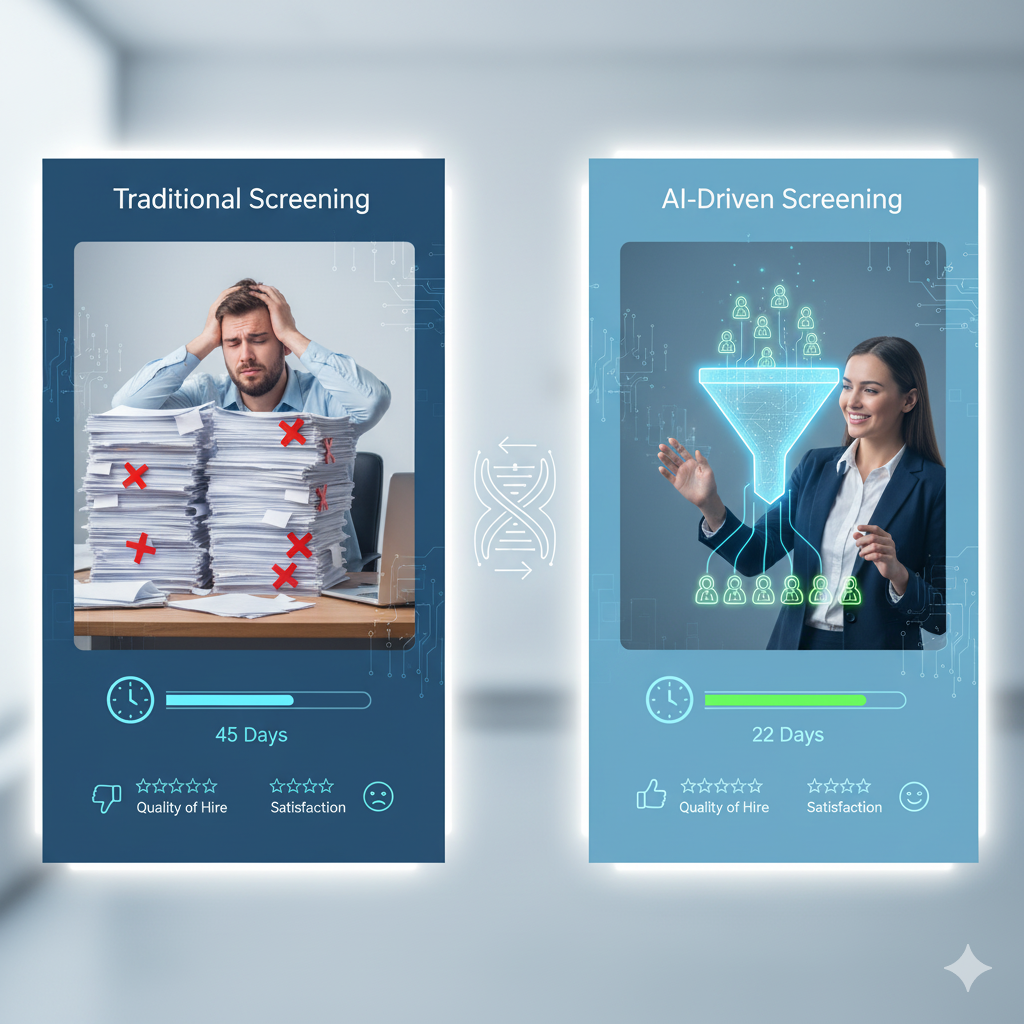
A bad hire is more than a misstep; it’s a hit to productivity, morale, and budget. Ramp-up delays, lost project momentum, and the expense of re-hiring are real and measurable. Industry benchmarks and case studies show the economic impact of poor screening decisions.
- Time-to-hire tends to increase when recruiters sift through ill-suited candidates. See the nearly 50%+ time-to-hire reduction in the Criteria Corp case study for a data point you can aim for. Case study: near-cuts time-to-hire by over 50%.
- Quality of hire correlates with business outcomes and longer-term performance. See practical insights on quality of hire in external resources. Quality of hire insights.
Where candidate shortlisting goes wrong
Common missteps in the screening process in recruitment lead to wasted time and mis-hires. Here are frequent culprits with practical fixes:
- Over-reliance on resume signals. Resumes and keywords don’t reliably predict on-the-job performance. Prefer explicit skills verification and structured assessments.
- Unstructured interview bias. Inconsistent questions and subjective judgments invite bias. Use standardized interview rubrics.
- Poor prioritization of roles. Focus on essential skills and business impact rather than “nice-to-haves.”
- Fragmented tech stack. Siloed tools slow review and handoffs. Consider a unified screening pipeline.
Industry voices advocate skills-based hiring and transparent assessment practices to improve both speed and fit. See Deloitte’s findings on organizational skill-based hiring and SHRM’s resources on scaling skills-based hiring.
AI in the hiring process: a force multiplier for screening
Artificial intelligence in hiring can drastically improve screening efficiency when used responsibly. AI can:
- Filter candidates using validated skills-based criteria early in the funnel.
- Standardize shortlisting with structured rubrics and scoring models.
- Automate routine screening tasks, freeing recruiters to focus on deeper assessment and candidate experience.
- Identify signals of potential performance beyond resume excerpts, reducing time-to-hire without compromising quality.
Audit AI use for bias and fairness; AI should augment human judgment, not replace it. For a broader view of bias considerations, see external resources and policy discussions.
What to measure when you deploy AI in screening
- Time-to-screen versus time-to-hire reductions
- Candidate conversion rates at each stage
- Quality of hire signals after ramp and 90 days
- Fairness and bias indicators in model outputs
Combining AI-driven screening with structured human review yields the best outcomes, with many industry benchmarks showing faster time-to-hire and improved quality of hire.
Best practices to improve recruitment efficiency
To turn the tide, tighten your screening process in recruitment with these steps:
- Define the core competencies up front. Build a KPI map for each role focused on essential skills and business impact.
- Adopt a skills-first evaluation framework. Move beyond titles to measure capabilities, proficiency, and potential. See Deloitte’s guidance on skill-based hiring.
- Standardize the screening rubric. Use a scoring rubric for resumes, tests, and interviews to reduce bias and variability.
- Use validated assessments. Choose assessments with evidence of predictive validity and ROI. Case studies show near-term improvements with validated tools.
- Leverage AI to triage early. Let AI pre-screen using objective criteria, then escalate the best fits to humans.
- Streamline the candidate experience. Communicate clearly, provide quick feedback, and minimize stage delays.
These steps align with the latest industry guidance on screening efficiency, time-to-hire reduction, and the financial impact of hiring decisions. See employer perspectives on time-to-hire, cost of bad hires, and process improvements in linked sources.
Tech you can use today (with SkillSauce.io)
For organizations ready to modernize their screening process in recruitment, SkillSauce offers practical capabilities that align with these best practices:
- SkillSauce Features to standardize screening rubrics and enable structured interviewing.
- SkillSauce Resources that include guides on skills-based hiring and candidate shortlisting strategies.
- Assessment Library with validated tools to predict job performance.
- AI Proctoring for secure, scalable screening and remote assessments.
When you combine a robust assessment strategy with AI-driven triage, you shorten the screening cycle and reduce the cost of a bad hire.
Measuring success: how to know you’re winning the screening game
Track these indicators to validate improvements in the screening process in recruitment:
- Time-to-fill and time-to-screen metrics
- Quality of hire, measured by performance reviews and retention
- Candidate experience scores and offer-acceptance rates
- Cost-per-hire and cost-of-bad-hire metrics
Industry benchmarks show that improving screening accuracy and speed goes hand in hand with lower overall hiring costs and better business outcomes. For example, organizations report notable reductions in time-to-hire after adopting structured screening and skills-based methods.
Real-world insights and case studies
Industry reports and case studies illustrate the economic rationale for upgrading the screening process in recruitment. Notable findings include:
- Skills-based hiring reduces mis-hires and aligns closely with business goals.
- A clear, validated assessment strategy lowers time-to-hire and improves predictability of performance. See Criteria Corp case studies and related sources.
- Quality of hire correlates with long-term business outcomes; benchmarks exist to measure this KPI.
For deeper exploration, you can review the live sources cited in this guide: GradsofLife State of the Business Case, Criteria Corp near-cuts time-to-hire by over 50%, SHRM on skills-based hiring, Deloitte’s organizational skill-based hiring, and more.
- Audit your current screening rubric. Identify what truly predicts success in the role.
- Transition to a skills-first interview approach and add validated tests where appropriate.
- Introduce AI triage to pre-screen candidates using consistent criteria.
- Publish clear timelines for each stage to reduce the drop-off rate.
- Align hiring goals with business outcomes to avoid over-emphasizing “nice-to-haves.”
Ready to shorten your screening cycle and improve hit rates?
Try SkillSauce AI-proctoring and assessment tools today.
Get Started