

Introduction
If you've ever shortlisted a candidate who aced the interview but struggled on the job — or passed over someone who turned out to be exceptional — you already know the problem. Most hiring decisions rely on too little signal. A career assessment aptitude test exists to fix that.
This guide covers everything: what these tests actually measure, the different types, where they work, where they fall short, and how modern AI-powered platforms like SkillSauce are changing what "aptitude assessment" can mean in 2026.
What is a career assessment aptitude test?
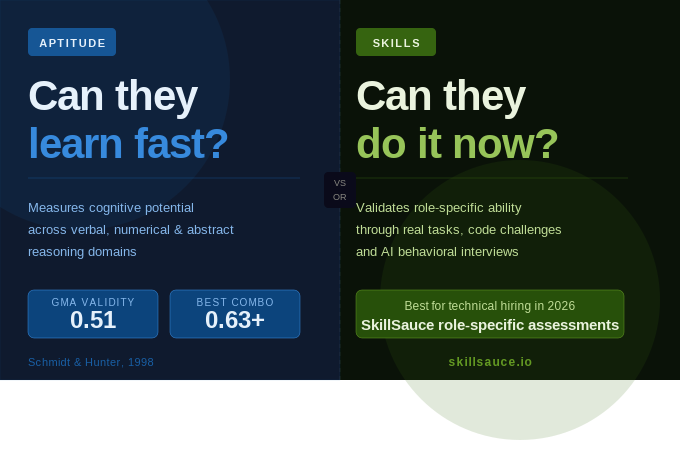
A career assessment aptitude test is a structured evaluation that measures a person's underlying cognitive abilities, reasoning patterns, and potential to learn and perform in a specific role or field. Unlike a skills test — which checks what someone already knows — an aptitude test checks how well they can think, process information, and adapt.
The term "aptitude" comes from the Latin aptus, meaning fit or suited. That's the core idea: can this person fit the demands of this role, even if they haven't done it before?
Aptitude assessments are used at multiple stages of a career journey:
- By job seekers to identify which careers align with their natural strengths
- By students making higher education or vocational decisions
- By employers as part of pre-employment screening and structured hiring
- By L&D teams for internal mobility and succession planning
The format ranges from timed online tests to in-depth behavioral evaluations. What matters most is whether the test actually predicts the thing you care about — performance in the role.
What does a career aptitude test measure?
Most career assessment aptitude tests measure some combination of the following cognitive and behavioral dimensions:
Verbal reasoning
The ability to understand written information, identify logical relationships between words and concepts, and draw conclusions from text. High verbal reasoning correlates with roles requiring communication, analysis, and documentation.
Numerical reasoning
Working with numbers, interpreting data, identifying patterns in sequences. Critical for finance, operations, data, and analytical roles.
Abstract/logical reasoning
Identifying patterns in shapes, symbols, or sequences without relying on language or numbers. This is often the closest proxy for raw problem-solving ability and learning agility.
Spatial reasoning
Mentally manipulating shapes and visualizing objects in three dimensions. Particularly relevant for engineering, architecture, design, and technical roles.
Verbal and numerical critical thinking
Going beyond basic comprehension to evaluate arguments, identify assumptions, and assess the strength of evidence. Used for roles requiring strategic thinking or complex judgment.
Personality and behavioral dimensions
Many modern career assessments layer in behavioral indicators — how someone approaches challenges, collaborates under pressure, or handles ambiguity. This isn't aptitude in the classical sense, but it's increasingly bundled into what platforms call "career assessment."
Types of career assessment aptitude tests
Not all aptitude assessments are the same. Here's a breakdown of the main categories you'll encounter:
1. General mental ability (GMA) tests
The broadest category. These measure cognitive ability across verbal, numerical, and abstract dimensions. The research backing GMA as a predictor of job performance is strong — Schmidt & Hunter's 1998 meta-analysis found a validity coefficient of 0.51, placing it among the most predictive single hiring tools available.
Well-known instruments include the Raven's Progressive Matrices, the Wonderlic, and Cattell's Culture Fair Test.
Relevant read: Our full breakdown of IQ exams and their predictive validity in hiring →
2. Role-specific aptitude tests
Rather than measuring general cognitive ability, these tests are designed around the specific demands of a job family — numerical reasoning for finance analysts, spatial reasoning for engineers, verbal reasoning for legal or communications roles. They carry stronger predictive validity for those roles because the construct being measured is closer to actual job requirements.
3. Career interest inventories
Popularized by Holland's RIASEC model and instruments like the Strong Interest Inventory, these assessments identify which broad career families align with a person's natural interests and personality. They're best suited for career exploration rather than hiring — they tell you what someone is drawn to, not what they're capable of.
4. Work sample and situational judgment tests
A hybrid category that's gaining traction. Rather than testing abstract reasoning, these assessments present candidates with realistic scenarios from the actual job and evaluate how they respond. Work sample tests have a validity coefficient of 0.54 — slightly higher than GMA alone — and carry significantly lower legal risk because the link to job requirements is explicit and documented.
5. AI-powered behavioral assessments
The newest category. These go beyond static question formats to evaluate candidates through dynamic interviews, coding challenges, written responses, and scenario-based tasks — then use AI to score responses against validated criteria. SkillSauce's TESSA AI interview engine is built on this model.
Do career aptitude tests actually predict job performance?
Yes — but with important nuance.
The research is clearest for GMA tests in complex, cognitively demanding roles. The 0.51 validity coefficient from Schmidt & Hunter is real, often cited, and hard to dismiss. For roles that require rapid learning, abstract problem-solving, or managing novel situations, cognitive aptitude is a genuinely useful signal.
But that's not the full picture.
Aptitude alone isn't sufficient for technical roles. A candidate who scores in the 90th percentile on abstract reasoning but can't write a working SQL query is not ready for a data engineering position. The cognitive ability and the domain skill are correlated — but they're not the same thing, and hiring on the former as a proxy for the latter is a common and costly mistake.
The combination outperforms any single measure. The same research that validates GMA also shows that structured interviews add incremental validity, and work sample tests add more still. The most predictive hiring process combines multiple measures rather than relying on any one.
Legal and fairness considerations matter. Standardized cognitive ability tests have documented score disparities across demographic groups in the United States and several other jurisdictions. Under the EEOC's Uniform Guidelines on Employee Selection Procedures, any selection test that causes adverse impact must be validated as job-related — a bar that generic aptitude tests often fail to meet. In the UK, the Equality Act 2010 imposes similar requirements.
This doesn't make aptitude testing illegal — it makes it something that requires careful validation, documentation, and often legal review before deployment.
Career assessment aptitude test vs skills assessment: which one do you need?
This is the question that matters most for hiring teams. The honest answer is: they're not competing tools — they answer different questions.
| What you want to know | Best tool |
|---|---|
| Can this person learn quickly in a new domain? | GMA / aptitude test |
| Can they do this specific job today? | Skills assessment |
| How do they think through real problems? | Work sample / AI interview |
| What careers suit their personality? | Interest inventory |
| Are they the right fit across all dimensions? | Multi-measure battery |
For most technical hiring — software engineers, data analysts, DevOps engineers, product managers — the second question is the one that matters most. You can verify domain skill directly. There's no need to use cognitive ability as a proxy when you can assess the actual thing.
For early-career hiring, volume hiring, or roles with limited domain requirements, aptitude testing earns its place as a fast initial filter.
For end-to-end technical hiring at scale, the strongest approach combines a role-specific skills assessment with a structured behavioral interview — which is exactly what SkillSauce is built to deliver.
See the full assessment library → SkillSauce assessments for 300+ technical roles
How to choose the right career aptitude assessment
Whether you're a job seeker trying to understand your strengths or a hiring team building a structured process, these criteria apply:
For individuals
- Pick tests validated for career guidance, not just academic selection. The SAT and GRE were built for admissions, not career fit.
- Use interest inventories alongside aptitude tests. Aptitude tells you what you're capable of; interests tell you what you'll sustain motivation for. The intersection is your career zone.
- Treat results as direction, not destiny. Aptitude tests measure current ability, not fixed potential. Skills can be built.
For employers
- Match the test to the role. A spatial reasoning test for a content marketing hire is a non-sequitur. Use assessments that measure what the job actually demands.
- Validate before you deploy. Any assessment used as a selection tool should have documented evidence of job-relatedness. Don't use a generic consumer aptitude test as a hiring filter.
- Use multiple measures. No single assessment gives you the complete picture. Aptitude + skills + behavioral interview is the standard that the research supports.
- Audit for adverse impact. Run regular analysis on whether your assessment process is disproportionately filtering out protected groups. Most enterprise hiring platforms, including SkillSauce, include this as part of their compliance toolset.
- Prioritize candidate experience. An assessment that feels irrelevant or opaque damages your employer brand. Candidates should understand what they're being evaluated on and why.
What a modern career aptitude assessment looks like in 2026
The static 50-question multiple-choice aptitude test hasn't disappeared — but it's no longer the standard for high-quality technical hiring.
The shift is toward assessments that evaluate candidates in realistic, job-adjacent contexts:
Scenario-based problem solving replaces abstract pattern matching with actual problems from the role — a bug to fix, a dataset to analyze, a brief to respond to.
AI behavioral interviews use dynamic questioning to probe how a candidate thinks through ambiguous situations, not just whether they know the right answer.
Anonymized scoring removes demographic signals from the evaluation loop, letting performance data drive decisions rather than unconscious bias.
Post-assessment intelligence gives hiring managers not just a score but a breakdown — where the candidate is strong, where the gaps are, and how they compare to role benchmarks.
SkillSauce is built around all four of these. The AI-powered TESSA interview engine surfaces reasoning ability and behavioral fit in the context of real role requirements — giving you the signal that aptitude tests were always trying to approximate, but from the actual job rather than from an abstract proxy.
| Category | Tools / Platforms | Best For | Limitations |
|---|---|---|---|
| Free Tools | 16Personalities, O*NET Interest Profiler, CliftonStrengths (free version) | Personal exploration, broad career direction | Lack psychometric rigor; not suitable for hiring or selection decisions |
| Mid-Range Platforms | Criteria Corp, TestGorilla, Vervoe | Validated assessments with moderate predictive value | Quality varies; legal defensibility depends on role-specific validation |
| Enterprise Platforms | Hogan, SHL, Korn Ferry | High-stakes hiring, psychometric accuracy, legal defensibility | High cost, complex implementation; not ideal for SMBs |
| SkillSauce | AI-powered skill assessments + behavioral interviews | Technical hiring, role-specific evaluation, end-to-end screening | Purpose-built for hiring; Start free |