


Types of Feedback: 4 Key Methods to Improve Team Growth
Feedback is one of the most powerful tools for improving team performance — yet most organizations struggle to use it effectively.
Research shows that 72% of employees believe better feedback would improve their performance, but over half say they don’t receive useful guidance.
The problem isn’t the lack of feedback — it’s the lack of structured, effective feedback.
Understanding the different types of feedback and when to use them can help teams improve performance, build trust, and create a culture of continuous growth.
Understanding Feedback in the Workplace
Workplace feedback is a structured way of sharing information about performance, behavior, and outcomes to help individuals improve and grow.
It goes beyond simple praise or criticism. Effective feedback:
- Guides employees toward clear goals
- Reinforces positive behaviors
- Identifies areas for improvement
- Builds stronger team communication
When used correctly, feedback becomes a continuous loop of improvement rather than a one-time event.
What feedback really means in a team setting
Team feedback is more than praise or criticism. It works as a communication process where managers and employees look at situations and behaviors to spot areas for improvement and build on strengths. The transfer of specific insights helps people understand their capabilities and opportunities to grow.
A feedback system works like a compass for professional development. Teams stay in sync with company goals while getting better. My experience shows that good feedback creates an environment where team members feel heard and valued, which builds trust and respect.
Teams use feedback in several ways:
- It directs team members toward desired outcomes
- It motivates people by recognizing their contributions
- It reinforces good behaviors and practices
- It shows the right direction when needed
On top of that, it creates a two-way street in teams. Information flows between managers and employees, peers, and even from employees to leadership. This cycle starts with giving feedback, moves to receiving it, and ends with acting on new insights—building a foundation to improve.
Why feedback is essential for team growth
Feedback drives team development forward. Teams might change without it but can't learn because they need feedback to check and adjust how they work. Companies that ask for and use employee feedback can boost engagement by up to 35%, creating a space where people feel valued.
Regular feedback offers significant advantages to teams:
- Enhanced performance and productivity - Employees who understand expectations can focus their work better, which reduces mistakes and saves time.
- Stronger working relationships - Open talks about performance create bonds where people feel safe to be honest and share their struggles.
- Continuous learning and adaptability - Small issues get fixed before they become big problems, which keeps teams flexible.
- Psychological safety - Regular feedback creates psychological safety that promotes employee well-being and helps them handle challenges.
Feedback makes both people and organizations better. People get a map for growth while organizations find ways to work smarter and make everyone happier.
Teams get better at talking to each other, working together, and solving problems when feedback flows freely. Research shows 40% of workers will disengage if they don't get enough feedback. Teams that receive good feedback develop a growth mindset and turn setbacks into chances to learn.
Clear expectations come from good feedback, which helps teams avoid confusion and reach their goals. We used feedback as both a way to manage performance and shape culture, creating an environment where everyone wants to improve.
Now that we know what feedback means at work and how it helps teams grow, let's look at different types of feedback and how to use them—I'll cover that next.
The 4 Main Types of Feedback
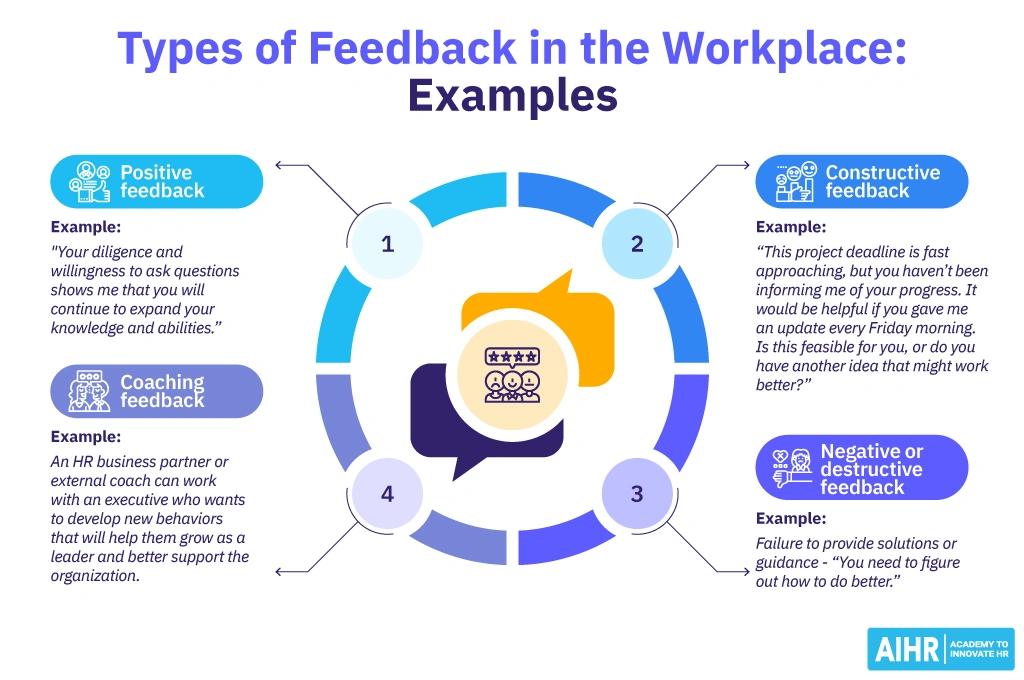
Image Source: AIHR
Different types of feedback play a vital role in creating a balanced approach to team development. Each type helps build stronger teams and promotes professional growth in its own way.
Positive feedback
Positive feedback recognizes behaviors that create desired results and reinforces actions you want team members to continue. Team members receive acknowledgment for their achievements, celebrate successes, and learn about their strengths.
Positive feedback works as a form of positive reinforcement. B.F. Skinner's research shows that people learn faster, improve their skills, and stay motivated when good behavior gets rewarded. Studies reveal that employees who receive positive feedback stay more engaged—all but one percent of workers who got positive feedback stayed actively involved.
Good positive feedback changes organizations in several ways:
- It lifts performance and strengthens relationships
- Teams come up with more breakthroughs and work independently
- Employees see the person giving feedback in a better light
Body language matters just as much as words. Research shows that positive feedback with negative body language (like frowning) upset recipients more than negative feedback delivered with positive expressions.
Constructive feedback
Constructive feedback highlights areas for improvement while providing actionable suggestions.
It should be:
- Specific
- Timely
- Focused on behavior, not personality
Example: “Your presentation had strong insights, but adding more data could make your argument more convincing.”
Coaching feedback
Coaching feedback focuses on long-term development rather than immediate correction.
It involves:
- Asking questions
- Encouraging reflection
- Guiding improvement
This type of feedback is ideal for:
- Skill development
- Career growth
- Leadership training
Destructive or negative feedback
Destructive feedback criticizes without showing ways to improve. While constructive feedback builds confidence, destructive feedback breaks spirits by focusing only on mistakes.
Intent separates constructive from destructive feedback. Destructive feedback comes across as a personal attack with harmful intentions. You'll notice these signs:
- No specific tips for improvement
- Personal attacks instead of behavior focus
- Zero recognition of positives
- Sweeping statements ("you never" or "you always")
- No solutions or guidance
Destructive feedback hurts employee performance. Harvard Business School found that workers who got negative feedback avoided critical colleagues instead of changing their behavior. Research in the Journal of Organizational Behavior shows that employees who received negative feedback from supervisors felt personal shame and ended up emotionally exhausted.
Knowing these four types of feedback helps you pick the right approach for each situation. Teams grow stronger and more resilient through thoughtful communication.
When and How to Use Each Type of Feedback
The right feedback at the right time can boost team performance and morale. Each type of feedback has its own purpose and needs a specific approach to make the biggest effect.
Using positive feedback to reinforce strengths
Positive feedback works best right after you see laudable behavior or achievements. The timing matters a lot—give positive feedback as soon as possible to connect the action with recognition.
To make positive feedback work:
- Specific and detailed feedback helps people repeat success in future situations
- Linked to business outcomes shows real results whenever possible
- Public when appropriate lets others learn from and get inspired by success
In spite of that, too much positive feedback or praise for small things can make it less meaningful. Finding the right balance is essential—companies with good recognition programs see 31% lower voluntary turnover rates.
Applying constructive feedback to guide improvement
Good constructive feedback points out specific behaviors that need work while suggesting solutions. Unlike negative feedback, it offers both areas to improve and ways to get better.
Here are the key principles for constructive feedback:
- Act quickly—don't wait for formal reviews to address issues
- Talk about behaviors instead of personality traits
- Point out strengths along with areas to improve
- Give feedback in private to protect dignity and psychological safety
The way you deliver feedback matters too. Face-to-face talks are better than written messages because tone and facial expressions help avoid misunderstandings.
Making coaching feedback work for long-term growth
Coaching feedback is different because it looks toward the future. While other feedback types look at past performance, coaching feedback creates paths for growth and development.
This approach works great for:
- New employees learning company systems
- Team members picking up new skills
- Employees who want to advance
Good coaching feedback uses proven frameworks like SBI (Situation-Behavior-Impact) or GROW (Goal-Reality-Options-Will). These structures keep conversations on track and guide them toward actionable plans.
Coaching works best as a two-way conversation. This shared approach recognizes how complex human relationships are and makes people more likely to accept and use the feedback. Employees who get coaching feedback show much higher engagement—four times more likely than those without ongoing feedback.
Stopping destructive feedback and its effects
Destructive feedback helps no one and hurts everyone. Research in the Journal of Applied Psychology shows that people who get negative criticism without specifics feel angrier, set lower goals, and lose confidence.
You can avoid giving destructive feedback by:
- Taking time to calm down before discussing performance issues
- Looking at work results instead of personal traits
- Explaining your feedback's purpose to make it less personal
- Listening well to get the employee's view
The "feedback sandwich" method offers a better way—start with strengths, discuss improvements, and end with encouragement. This helps keep employee confidence while addressing needed changes.
Learning to use each type of feedback the right way creates an environment where team members feel supported and challenged to grow. This builds stronger, more resilient teams.
Feedback Techniques That Actually Work
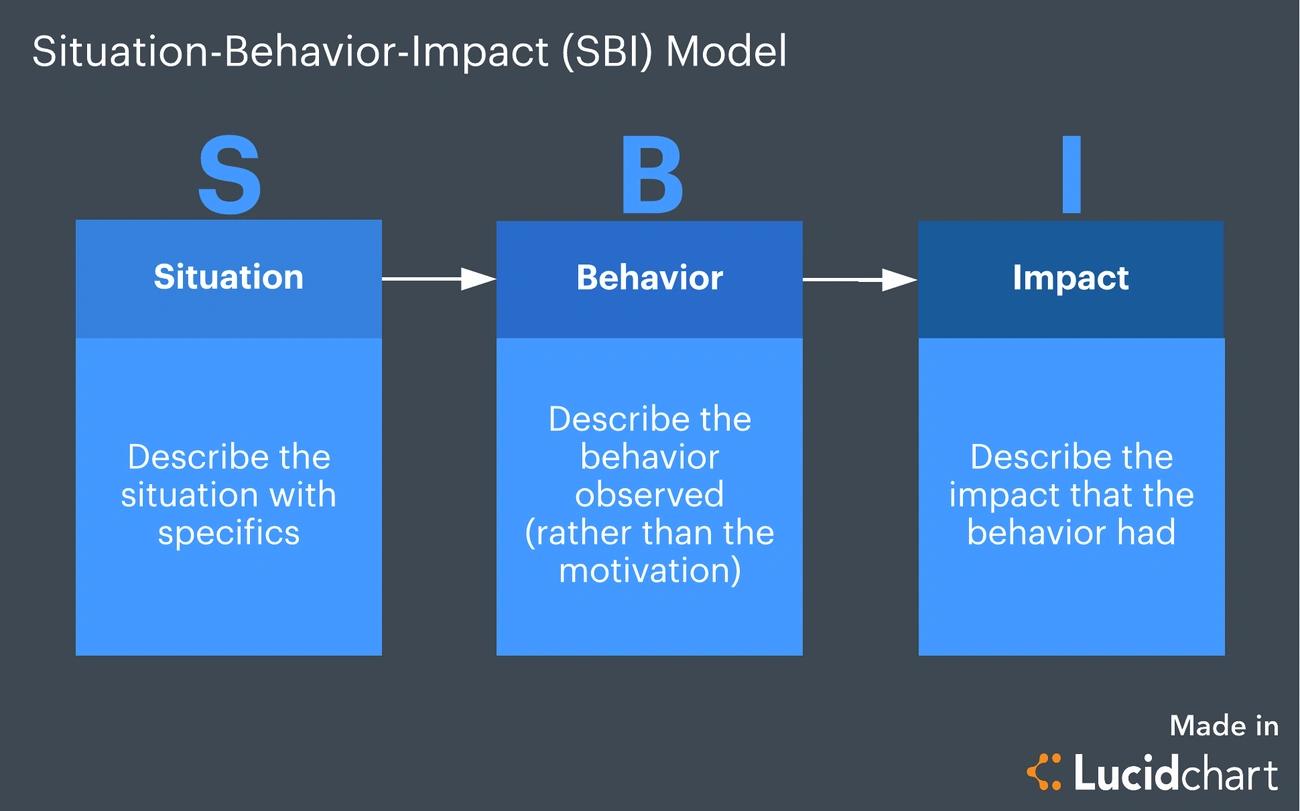
Image Source: Lucidchart
Feedback needs proper structure to work. Now that we've looked at different types of feedback, let's get into proven models that help you deliver feedback that gets results.
SBI (Situation-Behavior-Impact)
The SBI model gives you a simple way to deliver clear, objective feedback. This three-part structure starts by describing the specific situation where the behavior happened, then covers the observable behavior without judgment, and ends by explaining the impact that behavior had on you, the team, or organization.
SBI delivers great results because it sticks to facts rather than emotions. To cite an instance, instead of saying "you were rude," you might say, "During this morning's team meeting (situation), you interrupted me while I was speaking (behavior), which broke my train of thought and made me feel frustrated (impact)".
The model becomes even more powerful when you ask about intent afterward, which turns one-way feedback into a conversation.
STAR (Situation-Task-Action-Result)
The STAR method, which started as an interviewing tool, now serves as a great feedback framework. It builds on SBI by adding a task component:
- Situation/Task: Set the context
- Action: Explain what happened
- Result: Show what was achieved and why it worked or didn't
You can expand this to STAR/AR for development by adding:
- Alternative Action: Other possible approaches
- Alternative Result: How different choices could have led to better outcomes
This approach works well because it shows how actions directly link to results, which helps people understand how they affect important outcomes.
AID (Action-Impact-Desired outcome)
The AID model focuses on performance-based feedback and fits both positive and constructive feedback scenarios. It includes:
- Action: Point out specific behaviors
- Impact: Show their effects
- Desired outcome: Explain what should stay the same or change
AID's strength lies in making future expectations clear. Here's an example: "You were 10 minutes late to this morning's meeting (action). We couldn't cover all agenda points (impact). Please arrive on time or let someone know if you'll be late (desired outcome)".
GROW (Goal-Reality-Options-Will)
GROW helps structure feedback conversations that lead to action:
- Goal: Identify what someone wants to achieve
- Reality: Look at where things stand now
- Options: Find possible solutions
- Will (or Way Forward): Get commitment to specific actions
GROW stands out because it lets people find their own solutions instead of being told what to do. This matches perfectly with coaching feedback as it promotes self-reflection and ownership.
The Feedback Sandwich
This technique puts criticism between two layers of positive feedback. The steps are:
- Open with praise to ease into the conversation
- Deliver constructive criticism
- Close with positive feedback to maintain confidence
The sandwich method has its limits. While it makes tough conversations easier and ends them on a high note, some people see through it and miss the actual feedback. Only 26% of employees think it works, usually because they aren't looking for feedback.
The sandwich approach works best when you adapt it to each person's communication style rather than using it as a standard solution.
How to Give Good Feedback to Colleagues

Image Source: Indeed
To make feedback more impactful:
- Be specific and clear
- Focus on behavior, not personality
- Deliver feedback at the right time
- Encourage two-way communication
- Adapt tone and setting based on context
Effective feedback should always aim to support growth, not criticize individuals.
Building a Feedback Culture in Your Team

Image Source: Radical Candor
A strong feedback culture turns everyday conversations into organizational strengths. Research shows that 65% of employees need more feedback than they get. This highlights why we need better ways to share feedback.
Encouraging peer-to-peer feedback
Colleagues can fill the feedback gap when managers have too much on their plate. Manager workloads keep growing, with 81% now handling more direct reports. Team members often notice things others miss and can give valuable input. Once people feel comfortable sharing feedback with their peers, performance improves by 14%.
Making feedback a regular habit
Daily feedback helps continuous improvement become second nature. Companies that give regular feedback see 50% better participation and 17% happier employees. You should look beyond scheduled reviews. "Micro-coaching" moments throughout your week help turn feedback from something feared into something valued.
Training managers on feedback delivery
Most managers struggle with feedback - only 37% feel confident giving direct input. Good training should focus on:
- Building empathy and emotional intelligence
- Real-world practice in safe environments
- Ways to improve self-awareness through reflection
Using tools to collect and act on feedback
The right tools make feedback work better. Look for systems that offer:
- Multiple ways to gather input (surveys, quick checks, 360-degree feedback)
- Options to customize
- Analytics that spot patterns
- Safe spaces for anonymous feedback
Remember to share what changes you made based on people's input. This shows that feedback matters and creates a positive cycle where people's suggestions become more valuable.
Conclusion
Proper feedback implementation can revolutionize team dynamics. Different feedback types serve distinct purposes. Positive feedback celebrates excellence, constructive feedback drives improvement, and coaching feedback stimulates growth. Teams should avoid destructive feedback.
The way you deliver feedback matters just as much as what you say. Methods like SBI, STAR, or GROW give clear direction instead of vague criticism. Team members feel psychologically safe and receptive to suggestions when feedback focuses on specific behaviors rather than personal traits.
Teams excel with open feedback between all members, not just top-down communication from managers. This remains a challenge for many organizations. 72% of employees say better feedback would boost their performance, but more than half don't get enough guidance.
Leaders must set an example with excellent feedback practices. You can start by adding regular check-ins and training managers effectively. Make use of information tools to gather and analyze feedback. Your team needs to see you taking action on their input to understand its value.
Feedback combines both art and science. You'll get better with practice, so put these techniques to work now. Your team's communication, performance, and involvement will improve significantly as you strengthen your feedback skills. Building exceptional teams requires consistent, thoughtful feedback - a worthwhile experience.
Key Takeaways
Master these essential feedback strategies to transform your team's performance and create a culture of continuous growth and improvement.
• Use the four feedback types strategically: Positive feedback reinforces strengths, constructive feedback guides improvement, coaching feedback drives long-term growth, while destructive feedback should be completely avoided.
• Apply proven frameworks for clarity: Use SBI (Situation-Behavior-Impact), STAR, or GROW models to structure feedback conversations that focus on specific behaviors rather than personality traits.
• Deliver feedback promptly and specifically: Address behaviors immediately after observing them, using clear examples and actionable suggestions to maximize impact and understanding.
• Build two-way communication: Transform feedback from monolog to dialog by asking open-ended questions, listening actively, and encouraging peer-to-peer feedback exchanges.
• Create systematic feedback habits: Make feedback a regular practice through daily micro-coaching moments, proper manager training, and tools that collect and act on input consistently.
The most successful teams don't wait for annual reviews—they embed feedback into their daily operations, creating psychological safety where growth conversations become natural and valued. When 72% of employees believe better feedback would improve their performance, yet over half feel inadequately guided, the opportunity for competitive advantage through superior feedback practices becomes clear.