


Introduction: The End of the Resume Era
Recruitment is shifting away from resumes and standardised personality assessments. The most reliable indicators of workplace performance are not buried in bullet points — they are revealed through structured, skill-based assessments that show how candidates actually think and perform under realistic conditions. Gamification in recruitment is one of the fastest-growing frameworks for creating exactly this kind of evaluation. Contemporary research consistently shows that the most reliable indicators of workplace performance and potential aren't buried in bullet points on a CV—they're revealed through sophisticated gamified assessments.
Gamification in recruitment — integrating game mechanics into the hiring process — is reshaping how candidates demonstrate capabilities and how employers evaluate talent pools. From sophisticated coding challenges and problem-solving simulations to immersive virtual reality assessments, this paradigm shift delivers enhanced trust metrics, dramatically improved candidate experiences, and most crucially, hiring decisions that are both more precise and inherently less biased.
This guide examines how gamified hiring works, what the adoption data shows, and how to implement game-based assessments without sacrificing evaluation quality, and provides actionable frameworks for implementing gamification in recruitment to build and sustain high-performing teams.
Decoding Gamified Assessments in Hiring
What exactly constitutes a gamified assessment? These are cutting-edge evaluation tools that seamlessly incorporate sophisticated game design elements including points systems, progressive difficulty levels, strategic challenges, competitive leaderboards, and instantaneous feedback mechanisms into the recruitment process. Rather than relying on theoretical questions, candidates are immersed in interactive scenarios that authentically replicate real-world job challenges and responsibilities.
These next-generation assessments deliver profound, actionable insights across three fundamental competency domains:
- Technical Skills: Rigorously validating specific technical competencies such as programming proficiency, advanced data analysis capabilities, or specialized domain expertise through dynamic, hands-on challenges.
- Soft Skills & Cognitive Abilities: Comprehensively evaluating critical professional traits including advanced logical reasoning, rapid decision-making capabilities, strategic resource management, and adaptive problem-solving skills.
- Cultural Fit: Systematically assessing a candidate's alignment with organizational values, ethical decision-making frameworks, and collaborative capabilities within sophisticated team-based simulations.
By effectively combining rigorous skill evaluation methodologies with engaging, game-inspired design principles, gamification creates a more equitable, data-driven, and genuinely engaging recruitment experience.
How Gamification Drives Engagement and Equity
Gamified hiring transcends mere entertainment value; it represents a strategic solution proven to address two of the most persistent challenges in modern HR: declining candidate engagement and persistent hiring biases.
1. Exponentially Boosts Candidate Engagement
Interactive, game-based assessment formats have been demonstrated to increase candidate motivation and assessment completion rates by up to 40% compared to conventional evaluation methods. Candidates consistently demonstrate higher levels of investment and effort when participating in immersive, enjoyable assessment processes. This enhanced engagement directly correlates with a more qualified and committed talent pool.
2. Enhances the Employer Brand and Experience
Gamified hiring transforms the traditional assessment experience into an engaging journey of skill demonstration. Instead of feeling like they're being subjected to an impersonal examination, candidates experience recruitment as an interactive opportunity to showcase their authentic capabilities. Recent studies indicate that candidates report not just reduced anxiety levels, but a remarkable 25% higher positive perception of employer brands that implement gamification in recruitment. This enhanced brand perception is particularly crucial for attracting and retaining Millennials and Gen Z talent pools, who consistently demonstrate a strong preference for innovative, transparent, and experiential recruitment processes that align with their digital-native sensibilities.
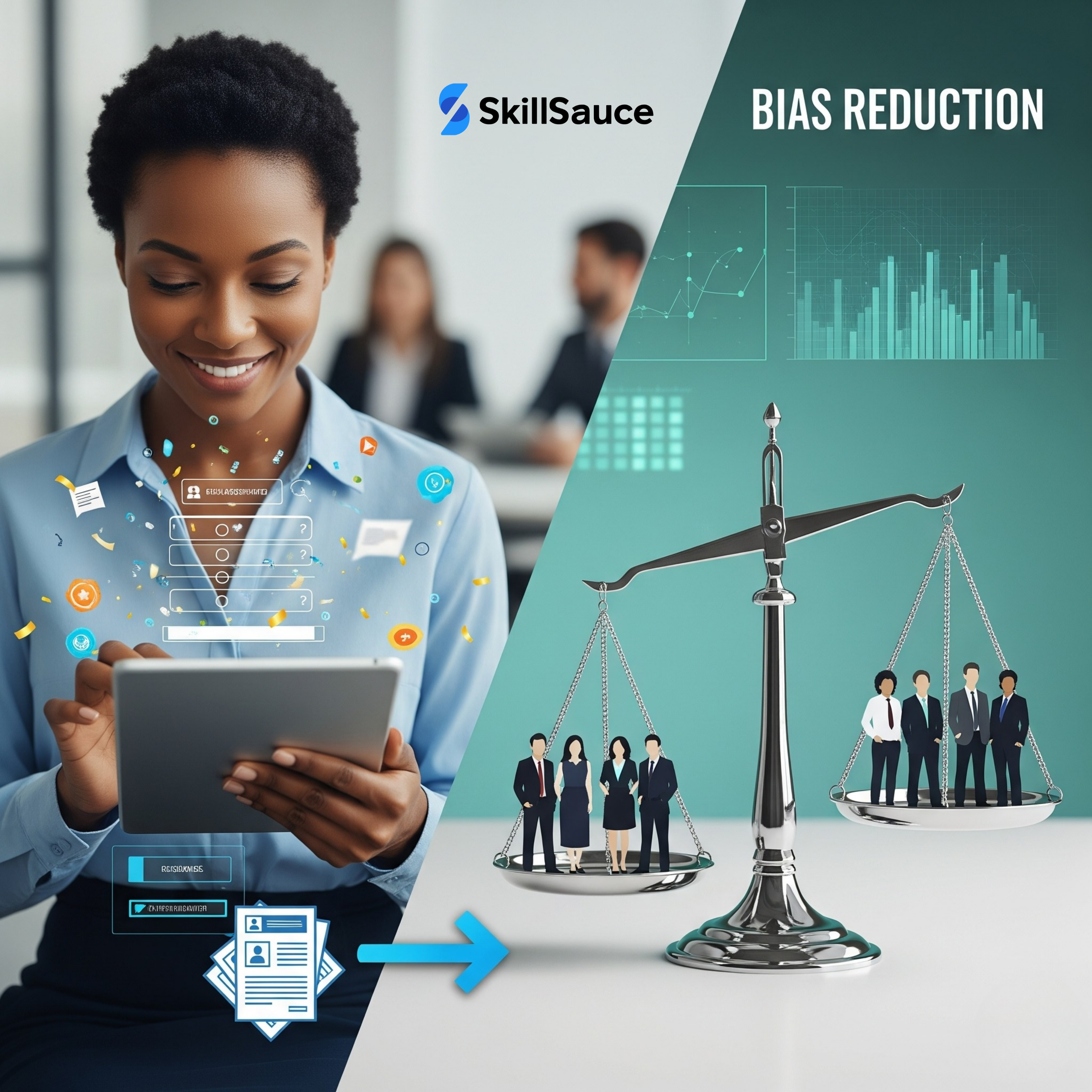
3. Significantly Reduces Unconscious Bias
Perhaps the most transformative impact of gamification in recruitment lies in its ability to minimize unconscious bias. Through sophisticated automated scoring systems and standardized evaluation metrics, the process substantially reduces human subjectivity in hiring decisions. Rather than being influenced by traditional bias triggers such as a candidate's name, educational background, socioeconomic status, or demographic characteristics, decisions are anchored purely in objective performance data derived from skill-based challenges. This systematic approach to assessment has demonstrably improved diversity outcomes while simultaneously expanding access to previously overlooked talent segments, creating a more inclusive and equitable hiring ecosystem.
- Adoption, Statistics, and Trends (2023–2025)
Gamified recruitment adoption accelerated significantly through 2025-2026. 67% of companies now use some form of gamified assessment in their hiring process, up from 26% in 2023, according to TalentTech's 2026 HR Innovation Report. The shift reflects growing evidence that game-based formats predict performance more accurately than traditional screening at equivalent candidate experience investment. The global gamification market in HR reached $30.7 billion in 2025 and is projected to continue growing at a CAGR of 27.4% through 2030. 83% of HR leaders have positioned gamified assessments as a key strategic investment for their recruitment technology roadmap — reflecting how rapidly the category has moved from experimental to mainstream. This rapid growth reflects the increasing recognition of gamification's transformative potential in talent acquisition.
- Candidate Preference: An overwhelming 78% of job seekers now actively prefer gamified assessment formats over conventional evaluation methods, citing increased engagement, reduced stress, and more authentic skill demonstration opportunities.
- Faster & Better Hiring: Organizations implementing gamification in recruitment consistently report 30% faster hiring cycles and achieve a 15–25% higher retention rate, primarily due to the enhanced accuracy in matching candidate capabilities with role requirements.
- Strategic Priority: A compelling 83% of HR leaders have positioned gamified assessments and AI-powered evaluation tools as key strategic investment priorities for their recruitment technology roadmap over the next few years.
Real-World Impact: Case Studies in Game-Based Hiring
Leading organizations across sectors are already demonstrating the tangible benefits of gamified recruitment approaches:
- Deloitte: Successfully implemented VR-based gamified simulations for entry-level recruitment, achieving an impressive 87% reduction in assessment-related anxiety while simultaneously recording a 30% improvement in applicant diversity—particularly significant in high-volume hiring scenarios.
- Global Brands (Nestlé, Coca-Cola): Effectively deployed gamified skill-based assessments to evaluate crucial non-technical competencies including team collaboration, strategic decision-making, and cultural alignment at scale.
- SuperAGI (AI Platform): Integrated gamified assessments with AI-powered scoring mechanisms to reduce hiring bias by 40%, enhance success rates by 25%, and substantially improve workforce diversity metrics.
Tools, Methods, and Platforms for Implementation
Gamified Hiring Platforms Comparison
| Platform Category | Competitor Examples | Core Function & Focus | SkillSauce Advantage |
|---|---|---|---|
| Cognitive / Soft Skills | Pymetrics, TalentLitmus | Neuroscience-based gamified assessments focused on emotional intelligence, adaptability, and behavioral profiling. | AI-powered soft skill evaluation integrated directly into the hiring workflow — combining behavioral insights with role-specific assessments and structured decision analytics instead of standalone tests. |
| Technical Skills | Codility, HackerEarth | Coding challenges and technical simulations designed to measure programming ability and problem-solving skills. | Technical testing combined with AI interviews, proctoring, and automated candidate ranking — ensuring real-world job fit, not just isolated coding performance. |
| Employer Branding | Talent Games | Branded gamified experiences that showcase company culture and attract candidates. | Customizable candidate journeys embedded within an end-to-end hiring system, connecting employer branding directly to screening, evaluation, and hiring outcomes. |
| AI-Enhanced Scoring | SuperAGI, ValueMatrix.ai | AI-driven evaluation tools focused on predictive scoring and candidate analytics. | Unified AI scoring engine integrated with assessments, interviews, and hiring dashboards — delivering bias-reduced, explainable decisions at scale. |
| End-to-End Hiring Platform | — | Most platforms specialize in one part of the hiring funnel and require multiple tools to complete recruitment. |
SkillSauce provides a complete end-to-end hiring ecosystem:
|
Addressing the Challenges: Safeguarding Integrity
For gamification in recruitment to deliver optimal results, organizations must proactively address potential challenges while maintaining assessment integrity:
| Challenge | Impact on Recruitment | Practical Solution for Integrity |
|---|---|---|
| Over-Gamification | Risk of diminishing assessment credibility and compromising hire quality through excessive focus on entertainment elements. | Solution: Implement purposeful game design that directly correlates with job competencies; maintain professional standards while balancing engagement. Ensure each gaming element serves a clear assessment purpose aligned with role requirements. |
| Cost & Complexity | Significant initial investment requirements for custom development, potentially limiting accessibility for small and medium enterprises. | Solution: Leverage scalable Software-as-a-Service (SaaS) platforms like Pymetrics that provide validated, ready-to-use assessment modules at competitive price points. Consider phased implementation starting with critical roles. |
| Cheating & Integrity | Growing concern with 17% of candidates admitting to using unfair means or AI assistance during assessments. | Solution: Deploy comprehensive proctoring systems with advanced monitoring capabilities. Implement adaptive challenge algorithms that dynamically adjust difficulty based on performance patterns. Utilize question banks with rotating content to prevent memorization. |
| Accessibility | Potential exclusion of candidates who may be less familiar with gaming interfaces or have different technological comfort levels. | Solution: Ensure universal design principles with WCAG compliance. Provide comprehensive onboarding tutorials and practice sessions. Offer multiple assessment format options to accommodate diverse user preferences and abilities. |
The Future Outlook: The Default Hiring Model
Industry experts project that by 2030, gamification in recruitment will evolve from an innovative approach to the established global standard. The integration of gamified assessments with artificial intelligence is expected to revolutionize talent acquisition, creating a more efficient, engaging, and equitable hiring ecosystem. This transformation will be characterized by personalized assessment experiences, real-time feedback mechanisms, and predictive analytics that significantly enhance hiring outcomes.
The emerging blended assessment model, combining technical evaluations, soft skills measurement, and situational judgment tests within an AI-powered gamified framework, is anticipated to become the predominant hiring methodology within the next five years. This evolution prioritizes fairness, candidate experience, and predictive accuracy while maintaining high engagement levels.
Conclusion: Win the Talent War with Innovation
The strategic implementation of gamification in recruitment represents a fundamental shift in talent acquisition methodology. By focusing on engagement, accuracy, and fairness, organizations can leverage these innovative assessment tools to build stronger, more diverse teams while delivering superior candidate experiences. The ROI extends beyond immediate hiring outcomes to long-term organizational success through improved retention and performance metrics.
As competition for top talent intensifies, organizations that embrace these forward-thinking assessment methodologies position themselves as employers of choice, building trust and credibility in an increasingly competitive talent marketplace. The future of recruitment lies in creating assessment experiences that are both engaging and predictive, ensuring sustainable competitive advantage through superior talent acquisition strategies.
SkillSauce's assessment platform combines the gamified, skills-based evaluation approach this guide describes with the end-to-end hiring infrastructure that most standalone gamification platforms lack — connecting candidate performance scores to AI interview data, assessment reports, and hiring decisions in a single workflow.