

Building Candidate Trust With Transparent Skill Testing
Introduction
93% of recent job seekers have embellished or lied during the hiring process, according to GCheck's 2026 Trust in Hiring Report. At the same time, 46% of job seekers say their trust in the hiring process has declined in the past year — many linking that decline directly to AI use.
Both numbers point to the same problem from opposite directions. Candidates don't trust that employers evaluate them fairly. Employers can't trust that candidate credentials are accurate. Transparent skill testing addresses both — replacing subjective judgment and unverifiable claims with objective, verifiable performance data that candidates understand and employers can defend.
This guide covers why transparent skill testing has become central to fair hiring practices, what the 2026 data shows about candidate preferences, and how to implement it without sacrificing hiring quality.
What Are Fair Hiring Practices?
Fair hiring practices are recruitment strategies designed to ensure equal opportunities for all applicants. They focus on:
- Eliminating discrimination based on gender, ethnicity, or socio-economic background
- Reducing unconscious bias in evaluations
- Complying with equal opportunity and anti-discrimination laws
- Promoting workplace diversity and inclusion
Why Transparent Skill Testing Matters
Skill-based and transparent assessments are tools like coding challenges, psychometric tests, or scenario-based tasks that directly measure a candidate’s abilities.
Key Benefits:
- Bias Reduction: Moves focus away from resumes and past job titles.
- Trust Building: Candidates know exactly how they’re being evaluated.
- Legal Compliance: Helps employers demonstrate fairness under labor regulations.
- Better Hiring Accuracy: Reduces the risk of mis-hires by aligning skills with role requirements.
Candidate Perceptions: The Data (2023–2025)
Recent studies reveal just how much candidates value transparent evaluations:
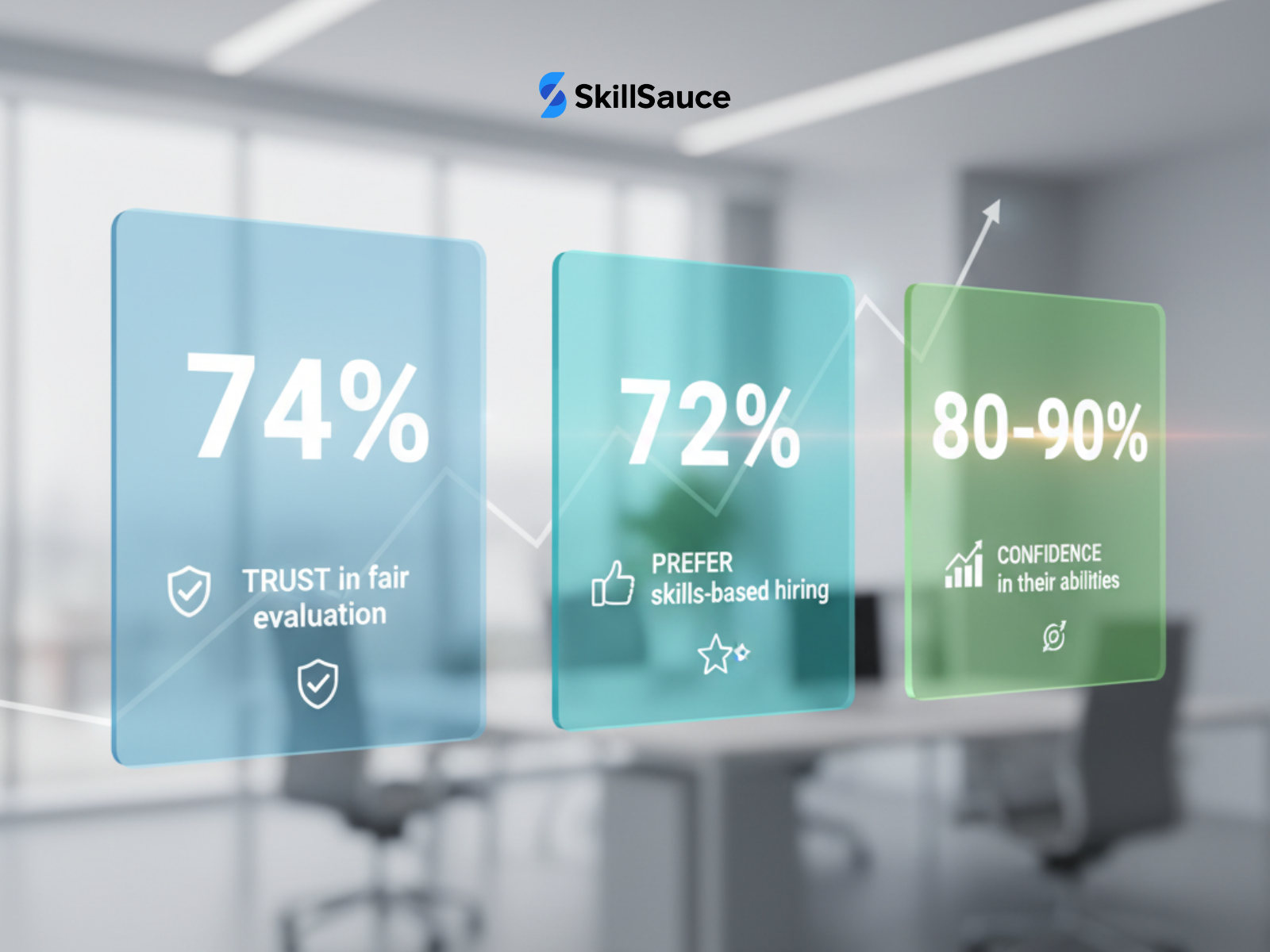
- 74% of job seekers completed skill-based tests in the past year.
- 72% prefer roles where their skills are objectively assessed over resume-driven hiring.
- 80–90% report that transparent assessments shape their view of an employer—positively or negatively.
- 68% of employers now rely on skill testing, while 81% track skills over resumes.
- Transparent assessments improve candidate experience scores by 25% on average.
This data confirms that transparent assessments aren’t just HR tools—they’re employer branding strategies.
Case Studies: Real-World Examples
- Google: Uses coding and scenario-based tests with clear feedback, improving both accuracy and candidate trust.
- HubSpot: Tailored assessments for digital roles strengthened team cohesion and improved their employer reputation.
- SuperAGI: An AI-powered platform reduced hiring bias by 40%, improved hiring success by 25%, and boosted diversity by 15% for major clients.
- CourseCareers: Transparent pre-screening led to a 25% increase in first-year retention for startup hires.
Assessment tools for transparent, fair hiring
Effective transparent skill testing requires platforms that provide candidates with clear criteria, objective scoring, and structured feedback — not just a score. Key capabilities to look for:
- Role-specific assessments that test skills directly relevant to the job rather than generic aptitude proxies
- Automated, consistent scoring that applies the same rubric to every candidate without interviewer variation
- Candidate-facing transparency — clear instructions, time limits, and post-assessment feedback where possible
- Bias-reduction features including anonymised scoring and demographic impact monitoring
- Proctoring and integrity tools for remote assessments where credential misrepresentation is a risk
SkillSauce combines all five capabilities in a single platform — providing role-specific assessments across 338 standardised job profiles with structured scoring, AI-powered interview evaluation through TESSA AI, and integrated proctoring that maintains assessment integrity without creating an adversarial candidate experience.
Criticisms and Risks
- Assessment Fatigue: Overloading candidates with too many assessments can reduce interest in applying and even push qualified individuals away. Employers need to balance thorough testing with efficiency.
- Technical-Only Focus: Relying solely on technical assessments may overlook other essential qualities like leadership, adaptability, or cultural fit. A balanced approach that includes both hard and soft skills is more effective.
- Gaming and Cheating Risks: With AI tools easily available, some candidates may attempt to cheat in online assessments. Employers must design tests that are cheat-resistant and pair them with proctoring tools where necessary.
- Lack of Standardization: Without consistent benchmarks across industries, test results may be interpreted differently by recruiters. This can cause confusion and inconsistency in hiring decisions.
Employers need a balanced approach—combining skill tests with behavioral interviews and soft skill evaluations.
Future Outlook: Toward 2030
The hiring landscape of 2026 demands more than technological sophistication — it requires ethical accountability. As regulatory frameworks tighten globally and candidates become increasingly aware of their rights, organizations face mounting pressure to demonstrate fairness and transparency in hiring practices. New standards around AI transparency, fairness, and privacy are reshaping recruitment globally, pushing organizations toward more validated and defensible hiring practices.
By 2030, transparent skill testing is expected to become the global standard for recruitment. AI-driven platforms will analyze candidate performance in real time, reduce bias through predictive analytics, and deliver personalized feedback at scale. Organizations will increasingly adopt blended models that combine technical tests, behavioral assessments, situational judgment exercises, and continuous feedback loops. This evolution will not only strengthen candidate trust but also align workforce strategies with the demands of a fast-changing labor market.
Conclusion
Transparent skill testing is not just about hiring the right candidate—it’s about earning trust, strengthening diversity, and securing compliance in a fast-changing world. Organisations that embed transparency into their hiring process — through clear assessment criteria, consistent scoring, and honest candidate communication — build the employer reputation that attracts candidates who trust them before the offer is made.
By blending transparency, technology, and empathy, organizations can build hiring systems that are trusted by candidates and respected by the industry.
FAQs
Q1. What is transparent skill testing in hiring?
Transparent skill testing is an assessment approach where candidates are clearly informed about what is being evaluated, how their performance will be scored, and how results will factor into hiring decisions. Unlike opaque screening processes, transparent assessments provide candidates with clear criteria, consistent evaluation standards, and where possible, structured feedback—building trust in the fairness of the hiring process regardless of outcome.
Q2. How does transparent skill testing reduce hiring bias?
Transparent skill tests reduce bias by replacing subjective judgments—based on resume format, name, educational institution, or interviewer impression—with objective performance data. When every candidate answers the same questions, completes the same tasks, and is scored against the same criteria, hiring decisions rest on demonstrated capability rather than demographic proxies or personal connection. 90% of companies prioritising skills over degrees found they made fewer hiring mistakes, and 94% said skills-based hires outperformed those selected mainly for credentials or experience.
Q3. What are fair hiring practices?
Fair hiring practices are recruitment strategies designed to ensure equal opportunity for all candidates regardless of background, gender, ethnicity, or socioeconomic status. They include standardised evaluation criteria applied consistently across all candidates, structured interviews with objective scoring rubrics, skills-based assessments that measure job-relevant competency, clear communication about the process and criteria, and compliance with equal opportunity and anti-discrimination legislation.
Q4. Why do candidates prefer transparent assessments?
Candidates prefer transparent assessments because they feel evaluated on merit rather than subjective impressions. 82% of candidates want a clear explanation of what is being checked during hiring, and 81% want human review of automated decisions rather than fully automated decision-making. When candidates understand what is being evaluated and why, they experience the process as fair—even when the outcome is a rejection.