
Introduction
The US faces a projected shortage of 5.3 million college-educated workers by 2032. This significant gap affects nursing, teaching, and engineering fields. Companies must now rethink their hiring approaches. Many employers plan to drop bachelor's degree requirements for some roles by 2025. They now look at direct measures of capability.
A basic question comes up during candidate reviews: Should we focus on learning potential or existing knowledge? Aptitude tests measure cognitive abilities like logical thinking and numerical reasoning. These tests help identify candidates with strong mental capabilities. Types of aptitude test serve many purposes in career counseling, educational guidance, and hiring processes. The problem lies in implementation. About 60% of hiring managers fail to match these tests with job requirements. This mismatch often leads to poor hiring choices. General aptitude tests add value to the process, but they need skill assessments to check practical abilities. Recruiters have noticed this need. The numbers show that 58% of them now prefer this detailed evaluation approach.
This piece breaks down career aptitude test types and skill assessments. You'll learn about their strengths and best uses. Smart hiring decisions come from understanding aptitude test questions and skill evaluations together. This combination helps avoid hiring mistakes that get pricey and better predicts job success.
Understanding Aptitude Tests vs Skill Assessments
Aptitude tests and skill assessments differ mainly in what they measure: potential versus proven ability. These tools play unique roles in hiring and give different insights into what candidates can do.
Definition of Aptitude Tests: Measuring Potential
Aptitude tests assess a person's natural ability to learn new skills or excel in specific areas. These tests look at innate abilities and learning potential instead of learned expertise. They get into cognitive strengths like logical reasoning, number skills, verbal abilities, and problem-solving.
Each type of aptitude test targets specific natural talents:
- Numerical reasoning tests show how well someone works with numbers and data
- Verbal reasoning assessments reveal language and communication skills
- Abstract reasoning exercises show pattern recognition and logical thinking
- Situational judgment tests show how someone might handle workplace decisions
The core idea behind aptitude tests suggests that people have natural strengths that help them succeed in certain areas. Results show growth potential rather than current skills, which helps predict future performance.
Definition of Skill Assessments: Measuring Proficiency
Skill assessments, on the other hand, show what candidates can do right now. These tests check practical expertise and abilities needed for specific jobs. While aptitude tests look at potential, skill assessments verify mastery in areas like:
- Technical skills (coding, software use)
- Role-specific abilities (data analysis, customer service)
- Practical knowledge (typing speed, process execution)
The main goal of skill assessments is to confirm if someone can handle job tasks right away. They measure current abilities instead of future learning potential, showing whether candidates can start performing required tasks immediately. Companies use these tests to speed up onboarding by checking expertise beforehand.
Key Concept: Potential vs Performance
The difference between aptitude and skill tests mirrors how potential differs from performance. Research shows that about 85% of high performers aren't necessarily high-potential employees. This surprising fact shows why understanding these differences matters in managing talent.
Performance shows what someone has already done in familiar situations—looking back at past achievements. Aptitude tests predict learning potential and long-term growth. This forward-looking aspect helps identify candidates who could thrive with proper development, especially in roles that need adaptability.
Performance reviews focus on past results, while potential assessments look at future growth opportunities. Aptitude tests help organizations spot employees who might excel as leaders or in more complex roles later.
Smart hiring strategies use both types of tests. Combining aptitude and skill assessments creates a complete picture of candidates that shows both potential and proven abilities. This all-encompassing approach gives better insights into candidates and leads to smarter hiring choices.
Types of Aptitude Tests Used in Hiring
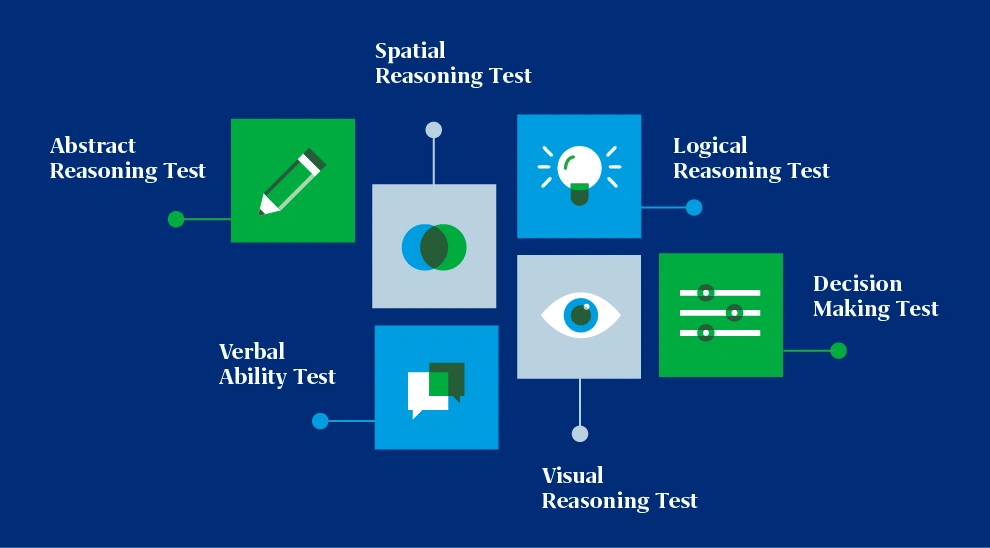
Image Source: Mettl Blog - Mercer | Mettl
Companies employ many different aptitude tests to assess candidates' natural abilities and future potential. Each test reveals something unique about how people think and work. These insights help organizations make better hiring choices.
Numerical Reasoning: Data Interpretation and Math Logic
Numerical reasoning tests show how well candidates can analyze numbers and data in charts, tables, or text. We tested simple arithmetic, percentages, ratios, and data interpretation skills. About 60% of companies now use these tests in their hiring process. They help identify people who excel at handling complex numerical information. These tests are vital for jobs that need strong analytical and quantitative skills.
Test takers face questions about data interpretation, financial math, and number patterns within strict time limits. The math level stays at GCSE-level. The tests reveal problem-solving abilities, logical thinking, and how well someone makes decisions using numbers.
Verbal Reasoning: Comprehension and Language Skills
Verbal reasoning tests measure a candidate's grasp of written information. These are some of the most popular tests companies use in all types of industries. They show how well someone understands business language and draws logical conclusions from text.
Candidates read short passages and decide if statements are true, false, or cannot be determined from the given information. The tests measure analytical thinking, inference making, objectivity, and comparison skills. Companies find these tests are a great way to get candidates who can handle complex written information and communicate well—key skills for workplace success.
Logical and Abstract Reasoning: Pattern and Rule Recognition
Logical and abstract reasoning tests reveal how well candidates spot patterns and solve problems using visual sequences of shapes, diagrams, and icons. They measure fluid intelligence—knowing how to tackle new information and unfamiliar problems without prior knowledge.
Abstract reasoning proves especially valuable for jobs needing creative problem-solving. Candidates look at matrices or sequences to find hidden rules and patterns. Strategy firms, engineering companies, architectural firms, banks, and software companies often use these tests.
Mechanical Reasoning: Understanding Physical Principles
Mechanical reasoning tests check a candidate's grasp of simple mechanical and physical concepts. Questions cover forces, levers, pulleys, gears, and basic electrical circuits. Candidates see images of simple objects or situations and answer questions about how they work.
Engineering firms, technical companies, trade schools, and emergency services rely on these tests. On top of that, they help select auto mechanics, aircraft technicians, machine operators, firefighters, and military personnel.
Spatial Reasoning: Visualizing Shapes and Objects
Spatial reasoning tests measure how well candidates understand object relationships in space. They show someone's ability to work with 2D and 3D objects, find shape patterns, and picture how shapes move.
Architects, engineers, pilots, designers, IT professionals, manufacturers, and defense contractors value spatial skills. These tests are scientifically proven to predict job performance better than resumes alone. They work especially well for jobs needing strong visualization and spatial problem-solving.
Situational Judgment: Decision-Making in Work Scenarios
Situational judgment tests (SJTs) show candidates real workplace scenarios and ask for their responses. Instead of actual simulations, candidates pick from possible solutions. The tests reveal social skills like handling conflicts, working with others, solving problems, and leading teams.
SJTs excel at measuring management and leadership abilities. Candidates see them as fair ways to assess workplace skills. They also show smaller differences between racial groups compared to cognitive tests.
Types of Skill Assessments for Job Readiness
Skill assessments measure job-ready abilities through practical tests that focus on immediate application rather than potential. Companies now use these assessments to verify candidates' actual skills before hiring. These tests differ from aptitude tests that predict future learning capacity by showing what someone can do right now across key areas.
Technical Skills: Coding, Software, and Tools
Technical skill assessments show specific job-related expertise like programming efficiency, system design, and engineering capabilities. Companies like Microsoft, Tesla, and Oracle use these tests to review software engineers, data scientists, and cybersecurity analysts. Candidates face hands-on technical challenges that match real workplace tasks.
Popular technical assessment formats include:
- Coding tests that show programming efficiency, debugging capabilities, and algorithmic thinking
- Software proficiency evaluations that check expertise with specific programs and platforms
- Technical reasoning assessments that test industry-specific knowledge
These tests give clear proof of technical capabilities and remove the guesswork from resume reviews.
Soft Skills: Communication, Teamwork, and Adaptability
Soft skills assessments look at interpersonal abilities that shape team dynamics and workplace success. While harder to measure than technical skills, these traits better predict long-term success. Research shows seven core soft skills that lead to professional achievement: communication, emotional intelligence, adaptability, problem-solving, leadership, teamwork, and time management.
Companies check soft skills through behavioral questions, psychometric tests, and simulated interactions. Leadership candidates might need to describe how they handled difficult colleagues to show their conflict resolution skills. Emotional intelligence tests reveal a candidate's ability to understand and manage emotions—vital qualities for effective leadership.
Role-Specific Tasks: Simulations and Work Samples
Job simulations rank among the best ways to predict performance by letting candidates show their skills through real work experiences. These tests create actual job scenarios and give applicants a true picture of daily tasks. They work like "day-in-the-life" situations that test both technical and soft skills together.
Common simulation formats include:
- Situational judgment tests with real workplace challenges
- Role-playing exercises that show social interaction skills
- In-basket simulations that reveal organizational and decision-making abilities
Both employers and candidates benefit from these assessments. Companies make better hiring decisions while candidates learn what the job really involves.
Typing and Data Entry: Speed and Accuracy Tests
Typing and data entry assessments measure basic workplace skills for roles needing documentation, data processing, or customer communication. These tests check both speed and accuracy under time pressure. Fast, accurate typing becomes essential especially when you have positions requiring error-free data input or real-time written communication.
Data entry tests show candidates different text formats including names, addresses, phone numbers, and email information. Speed counts, but accuracy matters just as much. Many tests calculate the percentage of correct characters from the total text.
Companies use these assessments mainly for customer support, administrative, data entry, and operational roles where documentation speed affects productivity directly.
Which Predicts Job Success Better?
Research shows that picking the right assessment tool makes a big difference in hiring outcomes. A well-laid-out skill evaluation can boost hiring quality by up to 24% compared to just doing interviews. Many organizations still find it hard to pick tests that best predict success at work.
Predictive Validity: Aptitude vs Skill Tests
Tests that accurately forecast job performance tell an interesting story. Work sample tests are much better predictors than traditional interviews. These tests score 0.54 on accuracy while regular interviews only manage 0.14. Cognitive aptitude tests land somewhere in the middle with a score of 0.31.
Different tests shine in different ways. Skill assessments show you exactly what someone can do right now. Aptitude tests give an explanation of how quickly someone learns and adapts. Both these options are a much better way to spot talent than going with gut feel.
Short-Term Fit vs Long-Term Potential
Companies pick between aptitude and skill tests based on what they need now versus later. Skill assessments help find people who can:
- Jump right in with minimal training
- Solve urgent business problems
- Start adding value from day one
Aptitude tests, on the other hand, spot candidates who might grow into superstars. These people could become great leaders or adapt quickly as their jobs change.
Teams with tight deadlines usually go for skill-based hiring. Companies thinking about their future talent usually lean toward aptitude tests. One researcher puts it perfectly: "The choice between hiring for experience and hiring for potential is about deciding between filling the immediate role and investing in your business's future progression".
Meta-Analysis Insights and Industry Benchmarks
The largest longitudinal study gives us a clear picture of which tests work best for different roles. General mental ability (GMA) tests score 0.45 on job performance and 0.54 on training success. Job complexity plays a vital role - the harder the job, the better these tests work at predicting success.
Test accuracy changes based on the type of job too. These methods work better for management positions than other roles. This means aptitude tests are particularly good at evaluating candidates for complex jobs that need strong problem-solving skills.
Neither type of assessment is always better than the other. The best choice depends on your organization's needs, the role you're filling, and your long-term goals. Often, using both types of tests together gets the best results.
When to Use Aptitude Tests vs Skill Assessments
The best time to use different assessment types depends on specific job requirements and what organizations need. Companies should choose between measuring potential and checking existing proficiency based on what the role requires.
Entry-Level Roles: Focus on Learning Potential
Different aptitude test types work better for entry-level positions by finding candidates who learn quickly rather than those with existing skills. These roles usually involve lots of on-the-job training, which makes trainability more valuable than immediate expertise. Junior positions get better results when simple mathematics tests are combined with attention-to-detail assessments to check numerical accuracy and focus.
Many industries put emphasis on extensive training programs—like multi-month training for 911 dispatchers or entry-level manufacturing positions. These situations don't need existing skills as much as they need candidates with strong mental capabilities and commitment to finish the work to be done. Companies that use aptitude assessments for entry-level hiring see great results. To cite an instance, one early study showed companies saved 73,000 hours of managerial time when they used situational judgment tests at the start of their hiring process.
Specialized Roles: Emphasis on Proven Skills
Technical or immediate-impact positions just need a full assessment of skills to verify specialized expertise. These roles require complete skill evaluations to confirm readiness, precision, and how well candidates match specific job requirements. Recruiters can use skill tests in multiple ways throughout the hiring process:
- As initial screening replacements for resumes
- After resume submission to check soft skills
- Following interviews to verify technical capabilities
This well-laid-out approach is vital since 25% of employers plan to remove bachelor's degree requirements for some positions by 2025. Direct skill verification becomes more significant for specialized positions when degree credentials aren't used as filters.
Blended Roles: Combining Both for Balanced Evaluation
Positions that need both technical proficiency and growth potential benefit from mixing assessment types to learn about candidates better. Mid-level roles often need a combination of technical and interpersonal capabilities. Numerical problem-solving tests work well with abstract reasoning. Leadership positions get better results by combining critical thinking assessments with cognitive aptitude evaluations to measure strategic thinking and adaptability.
Research shows this dual approach works—companies using combined assessment strategies report 25% higher hire quality. This balanced method gives the fullest picture of candidates and addresses both current role requirements and future growth potential.
Combining Both for Smarter Hiring Decisions
Using multiple assessment methods gives organizations better results than relying on a single approach. Combined assessments help understand both what candidates can do now and what they might achieve in the future.
Benefits of a Dual-Assessment Strategy
Organizations that use both aptitude tests and skill assessments get better hiring results. Recent studies show 82% of employers now include assessments in their hiring process. This combined approach brings clear advantages:
- Higher quality hires with 73% of executives crediting complete talent assessments for better hiring decisions
- Boosted productivity with companies seeing a 20% increase after adding structured assessments
- Better predictions leading to 10-15% improvement in employee performance
The right combination of tests helps measure the skills needed for each role. Recruiters can focus on what matters most, which saves time and leads to better hires.
Reducing Turnover and Improving Retention
Money saved from lower turnover makes the strongest case for using two types of assessments. Harvard Business Review research shows companies using structured hiring practices cut their turnover rates by half. This leads to lower training costs and creates a stronger workplace environment.
The numbers tell the story clearly. A financial firm added cognitive ability tests to their skill assessments and saw turnover drop from 20% to 10% in just one year. NV5, a US-based engineering company, brought their turnover down from 16% to 5% with this approach.
Case Study: Manufacturing and Customer Support Roles
A tech startup in Bangalore struggled with software developers leaving too often. They started looking at both technical skills and cultural fit. Their new approach led to 30% better hiring outcomes and kept more employees around.
A large retail chain took a similar path. They matched behavioral assessments with technical evaluations for customer service jobs. The result was 20% better employee retention and happier customers.
Comparison Table
| Comparison Factor | Skill Assessments | Aptitude Tests |
|---|---|---|
| Main Focus | Current proficiency and job-ready abilities | Natural capacity and learning potential |
| What They Measure |
|
|
| Predictive Validity | 0.54 (work samples) | 0.31 (cognitive aptitude) |
| Best Used For |
|
|
| Time Frame | Short-term results | Long-term growth |
| Key Types |
|
|
| Main Benefit | Shows readiness for specific job tasks | Spots candidates who learn fast |
| Best For Hiring | Candidates who can deliver results with minimal training | Candidates who show growth potential |
Conclusion
Skill assessments have proven their worth in predicting how well someone will perform in a job right away. These hands-on evaluations show what candidates can actually do, which takes the guesswork out of hiring decisions. They work best when you need to fill specialized roles where people must hit the ground running.
Notwithstanding that, aptitude tests are still vital. They show how well candidates learn and adapt - qualities that matter for their growth and advancement. Research shows you can't rely on just one of these methods. The most successful companies use both types of assessments in smart ways, based on what each role needs.
Companies that use both assessment types see much better results. They make better hires, see boosted productivity, and what's really exciting is their turnover rates drop dramatically. This integrated approach gives hiring managers a solid foundation to make smarter decisions that work well for everyone involved.
The best hiring practices will without doubt combine these two methods going forward. Smart companies keep fine-tuning how they assess candidates. They know skill assessments confirm what people can do now, while aptitude tests reveal their growth potential. These two tools working together help find exceptional talent in today's competitive job market.
Companies must balance what they need right now with their future growth. Skill assessments tell you if candidates can do the job today. Aptitude tests show if they'll grow with your company tomorrow. Using both types of assessments ended up creating the most detailed evaluation system, which leads to hiring decisions that last.
Key Takeaways
Understanding the strategic differences between aptitude tests and skill assessments can transform your hiring outcomes and significantly reduce costly turnover.
• Skill assessments predict immediate job success better with 0.54 validity versus 0.31 for aptitude tests, making them ideal for specialized roles requiring proven expertise.
• Aptitude tests reveal long-term potential and learning capacity, making them perfect for entry-level positions and roles requiring extensive training or future growth.
• Combined assessment strategies deliver 50% lower turnover rates and 25% higher hire quality compared to using either method alone.
• Match assessment type to role requirements: Use skill tests for technical positions needing immediate impact, aptitude tests for trainee roles, and both for leadership positions.
• Work sample tests outperform traditional interviews dramatically with validity coefficients of 0.54 versus just 0.14 for conventional interview methods.
The most successful organizations strategically combine both assessment types, creating comprehensive candidate profiles that balance immediate job readiness with future growth potential. This dual approach addresses the critical hiring challenge of finding candidates who can both perform today and evolve with your organization tomorrow.
FAQs