

Introduction
Talent analytics tools are no longer optional for hiring teams drowning in resumes, interview feedback, and ATS logs. Structured assessments improve quality of hire by up to 24%. Organizations achieve 82% better hiring outcomes through informed evaluations. The change from intuition to intelligence is complete.
Modern recruitment just needs more than tracking time to hire. We've compiled the six best talent analytics tools for 2026 that help you make smarter decisions and reduce bias. You can build stronger talent pipelines from day one.
What Are Talent Analytics Tools and Why They Matter

Image Source: Beamery
Definition of Talent Analytics Tools
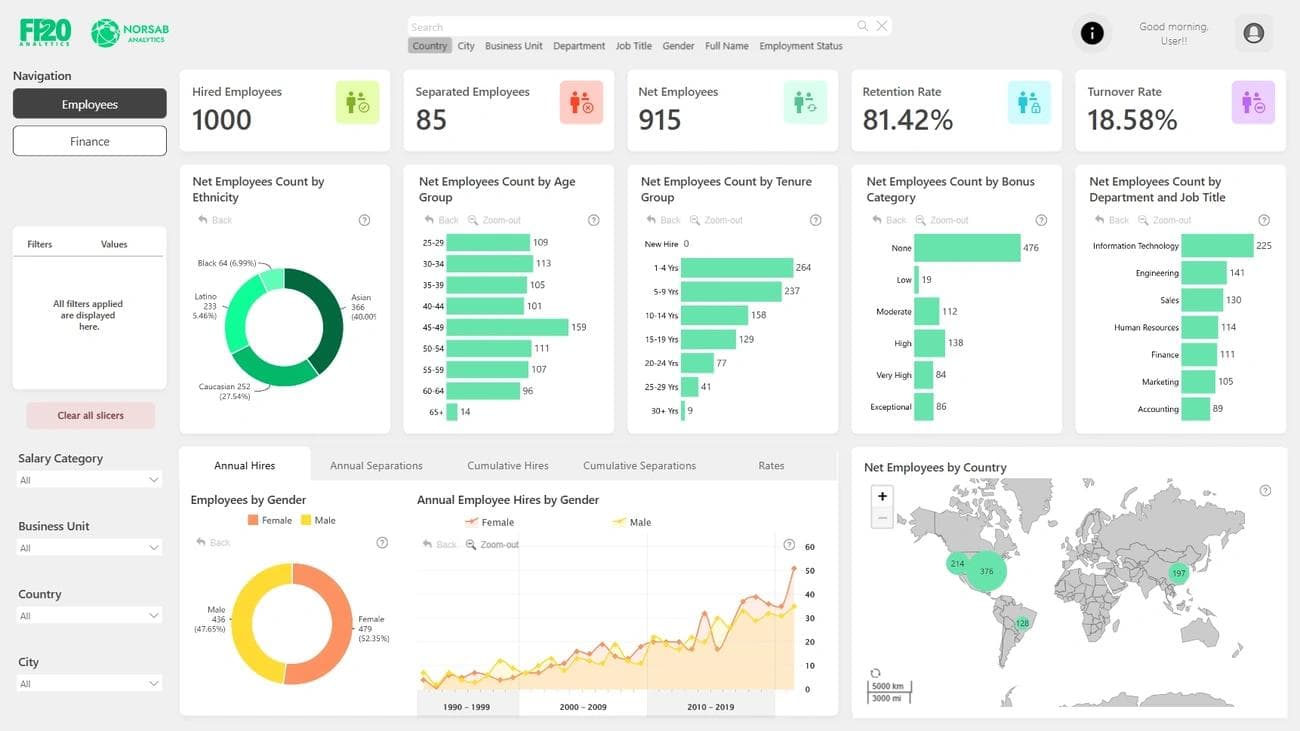
Talent analytics tools represent a data-centric approach to workforce decision-making that uses software to gather and analyze information about current and future employees. These platforms go beyond simple HR reporting. They collect, interpret, and transform workforce data into actionable insights that improve business results. The fundamental goal is straightforward: make better business decisions by understanding patterns in hiring, performance, engagement, and retention through quantitative evidence rather than gut feelings.
Strategic depth sets talent analytics apart from traditional HR metrics. These tools total data from multiple sources, including applicant tracking systems, performance management platforms, employee engagement surveys, and labor market databases. The result is a unified view of your workforce. This integration allows HR teams to relate seemingly disconnected data points. You can now track how onboarding experience scores relate to 6-month retention rates or analyze how training programs affect team performance.
How Modern Analytics Platforms Transform Hiring Data
The mechanics of transformation happen through several layers. AI-powered screening tools analyze thousands of applications within minutes and identify best-fit candidates based on predictive success patterns. Machine learning algorithms process application data to look for specific qualifications and keywords. They select candidates for interviews without human bias influencing the original selection. This change from manual review to algorithmic assessment has proven most important. Organizations achieve up to 63% reduction in time-to-hire through automated workflows.
Predictive analytics takes this further by forecasting candidate success through historical performance data. These platforms evaluate patterns in employee behavior, tenure since last promotion, financial data like salary and benefits, performance metrics, and absenteeism records. They can predict employee attrition before it happens. Organizations using predictive analytics are 2x more likely to improve their recruiting efforts, precisely because they can act on insights before problems escalate.
Immediate dashboards enable talent teams to adjust sourcing strategies and engagement campaigns on the fly. You can see which outreach efforts convert talent most effectively. You allocate resources where they actually generate returns. Advanced Boolean search techniques combine multiple data points to refine targeting and increase the likelihood of finding candidates who match job requirements precisely.
Key Benefits: Efficiency, Fairness, and Evidence-Based Decisions
The efficiency gains are measurable. Big-name tech firms report up to 30% reduction in time-to-hire and as much as 40% reduction in cost-per-hire through evidence-based approaches. These improvements stem from identifying bottlenecks in the hiring process and optimizing them. Recruiters track metrics like application drop-off rates and candidate satisfaction scores. They pinpoint where the experience falls short and address issues immediately.
Fairness represents another critical advantage. Analytics tools help spot and reduce unconscious bias by standardizing evaluations and identifying patterns of discrimination in hiring decisions. Screening processes rely on data rather than subjective impressions. Organizations can build more diverse teams. Case studies show companies acquiring people from wider demographic profiles by implementing evidence-based candidate screening systems.
The strategic value becomes clear when you think over that workforce costs represent 50-80% of operating expenses for most organizations. A 10% improvement in talent outcomes translates to millions in value. Organizations embracing analytics see measurable gains: reduced turnover prevents costly departures worth $50,000-$200,000 per person, faster hiring captures productivity that would otherwise be lost, and better quality of hire delivers higher performance and longer retention.
The metrics worth tracking include time-to-fill, cost-per-hire, source of hire, quality of hire measured after 6-12 months, applicant drop-off rates, interview-to-offer ratios, and diversity metrics at each recruitment stage. These data points connect across your hiring ecosystem. You stop guessing where problems exist and start addressing them with precision.
Metaview: AI-Powered Interview Intelligence
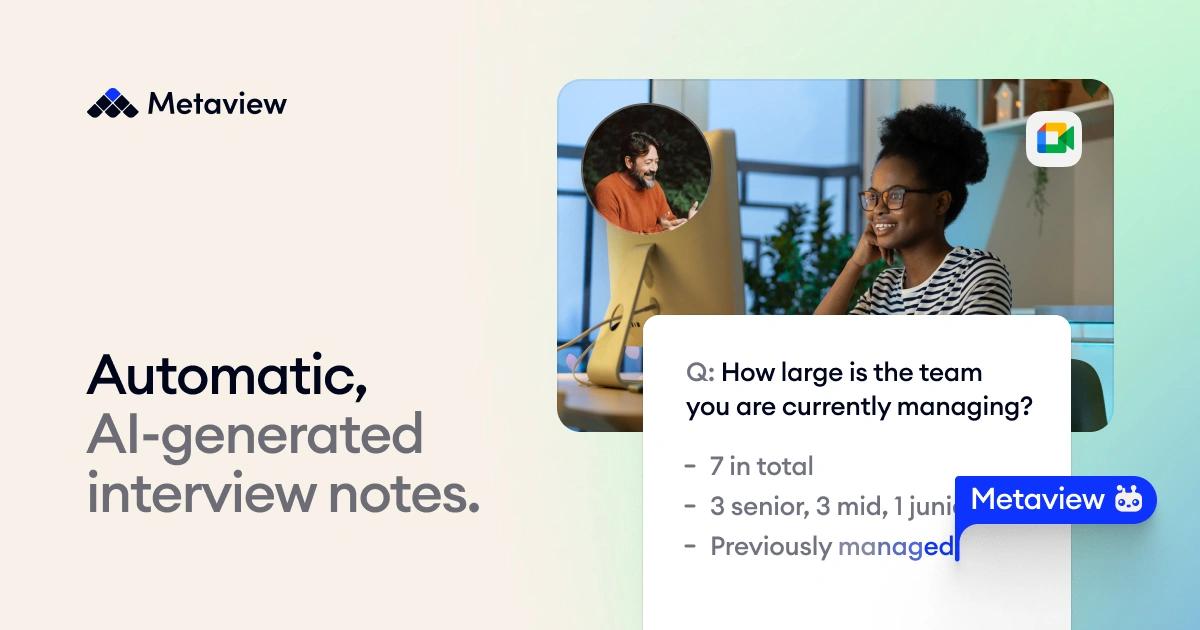
Image Source: www.metaview.ai
What Metaview Offers
Interview documentation creates a persistent bottleneck for recruiting teams. Interviewers split attention between engaging candidates and capturing feedback. This results in incomplete notes and delayed scorecards. Metaview addresses this through AI-powered interview intelligence purpose-built for recruiting workflows.
The platform generates structured, configurable interview notes grounded in the context of each specific hire rather than producing generic transcripts. Teams record interviews across video or phone and receive outputs tailored to their scorecard format, competencies, and hiring workflow. This eliminates the manual notetaking burden and allows interviewers to stay present during conversations, which improves signal quality.
Metaview detects conversation types and applies purpose-built templates for coding or system design interviews. Summaries include the problem being solved, the candidate's approach and reasoning, key code written during the interview, debugging steps or iterations, and trade-offs discussed during system design. The platform captures relevant screenshots when screen sharing occurs and incorporates visual artifacts like code changes, architecture diagrams, and whiteboard sketches into final notes.
Ground organizations see measurable results. Engine's recruiting team saves approximately 40 minutes daily per recruiter on submitting scorecards, with the platform capturing over 8,400 interviews to date. What previously took 45 minutes now takes five. Perk's recruiters use Metaview end-to-end, from briefing stages with hiring managers through wash-up meetings. They capture nuances that would otherwise never make it into job descriptions.
Key Features and Capabilities
The platform delivers several recruiting-specific capabilities that distinguish it from generic meeting recorders:
- Structured AI-generated interview notes: Standardized formats that line up with your evaluation criteria, not raw transcripts
- One-click scorecard auto-completion: Evidence-cited feedback that eliminates manual entry
- Interviewer coaching insights: Personalized guidance to improve interview quality and reduce bias
- Multi-platform compatibility: Works across Zoom, Teams, Meet, and phone interviews
- Native ATS integrations: Smooth connections with Greenhouse, Lever, Ashby, and other systems
- AI Reports: Customizable reporting engine to track and optimize the entire hiring process
- Analytics dashboard: Visualizes patterns, interviewer performance, and candidate trends
The AI Assistant enables instant information retrieval from any interview. Recruiters can ask questions like "Which software engineers in our current pipeline mentioned interviewing with other companies?" and receive immediate answers drawn from structured conversation data. This searchable interview intelligence helps teams identify trends, standard interviewer performance, and improve decision quality.
Metaview supports compliance through SOC 2 Type II, GDPR, and CCPA certifications. The platform prioritizes candidate rights and data control. It offers transparency, opt-out options, and full data ownership for customers.
Pricing and Best Use Cases
Metaview offers a free tier with 25 conversations per month and 14-day history. This allows teams to review the platform on ground interviews. The Pro plan costs $50 per user monthly (billed annually at $50/month or $60/month billed monthly) and provides unlimited conversations, unlimited history and members, and custom templates. Enterprise pricing is available for larger organizations requiring advanced administrative controls, dedicated support and training, and enterprise-grade security features.
An AI Sourcing add-on enables 24/7 candidate searches at $100 per month per user and supports infinite concurrent searches across platforms.
The platform fits best for in-house recruiting teams and executive search firms seeking to standardize evaluation without retraining their entire organization. Organizations conducting 10+ interviews weekly see compounding time savings and find analytics features useful for process improvement. Teams using Greenhouse, Lever, or Ashby as their ATS benefit from smooth integrations, while heads of talent gain useful data on interview quality and consistency across teams.
SkillSauce: Data-Driven Talent Insights
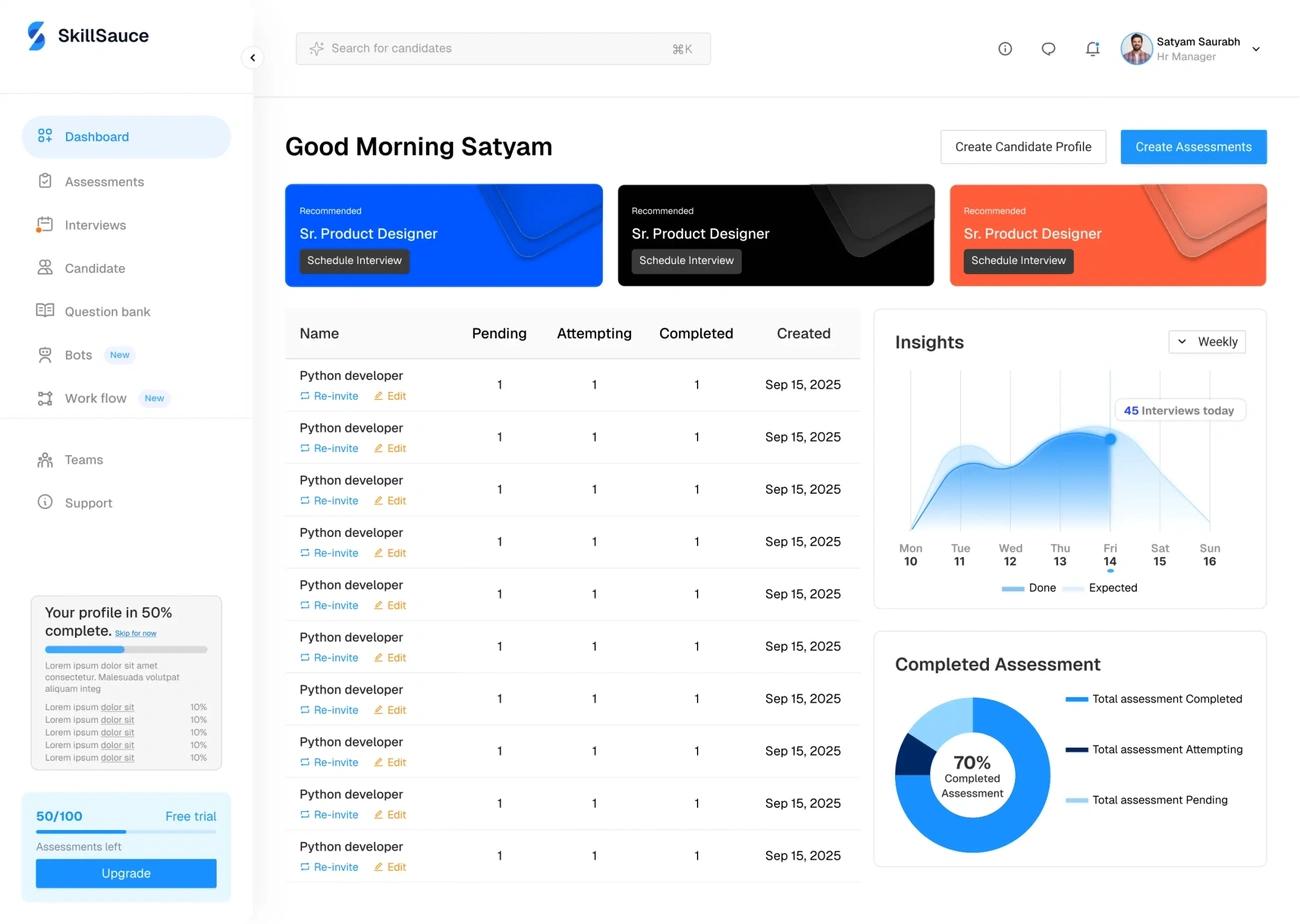
Image Source: SkillSauce
What SkillSauce Offers
Assessment accuracy determines hire quality long before interviews begin. SkillSauce operates as an AI-powered candidate assessment platform built to review technical and non-technical talent through well-laid-out, standardized testing. The platform addresses a fundamental recruitment challenge: resumes rarely reflect actual capabilities, and manual screening introduces subjective bias that compromises hiring decisions.
SkillSauce provides access to over 100,000 pre-built skill assessments at its core. These span IT roles, non-IT business functions, psychometric evaluations and aptitude tests. This library covers roles in sales, marketing, operations, HR, customer support and finance. Recruiters can review competencies that affect workplace performance directly. Organizations using the platform report measurable improvements: 40% faster hiring cycles, 25% better quality of hires and 50% reduction in recruiter workload.
The platform integrates TESSA AI (Talent Evaluation & Selection System Assistant), which functions as an intelligent layer across the assessment ecosystem. TESSA makes it possible for recruiters to interact with candidate databases conversationally, rank applicants using AI algorithms automatically and generate insights without manual analysis. Organizations see 40% faster recruitment cycles and a 25% drop in early attrition rates when using well-laid-out assessments for non-IT recruitment.
Key Features and Capabilities
SkillSauce delivers talent analytics through several integrated components. The AI-powered interview feature analyzes candidates across multiple dimensions. These include responses, speech patterns, body language and role suitability. The system uses natural language processing, facial recognition and analytical insights to provide unbiased assessment that eliminates inefficiencies inherent in traditional methods. AI interviews speed up the recruitment cycle by up to 50% and enable faster hiring decisions grounded in objective data.
Advanced proctoring maintains assessment integrity through multiple-face detection, multiple-voice detection, eye-tracking and multiple-device detection. These monitoring techniques ensure fair evaluations while respecting ethical boundaries. The platform's ATS workbench extracts and categorizes candidate data automatically, eliminates unqualified applicants based on predefined criteria and ranks results by test scores. Recruiters identify top performers through centralized dashboards that track application status, test scores and next steps immediately.
Assessment reports provide detailed candidate insights with role suitability calculations that assign match percentages based on performance data. Skills analysis details each question and compares candidate responses to expected solutions while displaying test case outcomes and performance metrics. The comments section lets evaluators document observations and work together around candidate results transparently. Assessments measure persuasion and communication for sales positions, creative thinking and analytical ability for marketing, empathy and conflict resolution for customer support, leadership and cultural alignment for HR, and numerical reasoning for finance roles.
Pricing and Best Use Cases
SkillSauce structures pricing across four tiers. The Free Trial provides 40 credits (10 assessments or AI interviews) with full platform access, human-researched premade library, advanced proctoring, basic ATS mapping and unlimited team members. The Plus plan costs INR 4,219.02 for 80 credits (20 assessments/interviews) and adds advanced ATS mapping, in-depth assessment reports, interview scheduling and priority support. The Pro plan runs INR 8,438.05 for 200 credits (50 assessments/interviews). This includes TESSA database interaction, unlimited scheduling, custom branding, analytics dashboard and 24/7 priority support. Enterprise packages offer tailored solutions for organizations requiring custom implementations.
The platform fits best for organizations conducting volume hiring across technical and non-technical roles. Recruiters managing large applicant pools for sales, HR, marketing and finance positions benefit from flexible screening that filters thousands efficiently. Companies seeking to reduce early attrition gain value from well-laid-out assessments that predict role fit accurately. Teams prioritizing bias reduction and standardized evaluation find the AI-driven approach delivers consistent candidate assessment whatever the reviewer.
LinkedIn Talent Insights: Labor Market Analytics
Image Source: LinkedIn's Economic Graph
What LinkedIn Talent Insights Offers
Labor market intelligence separates reactive hiring from strategic workforce planning. LinkedIn Talent Insights functions as a talent intelligence platform that translates data from the world's largest professional network into applicable workforce decisions. The platform provides access to 12 billion+ data points on talent, companies, jobs, skills and schools, drawing from over 1.3 billion members who generate real-life activity across 20 million companies and 15 million active job listings.
Two primary reporting mechanisms power the platform. The Talent Pool report delivers complete workforce snapshots that show where candidates are located, which companies employ them, their educational backgrounds and job titles. You also see what skills they possess. Searching for DevOps Engineers in Dubai or Content Marketers in Copenhagen? The report reveals which organizations they currently work for, where they studied and what capabilities they bring.
The Company Report allows detailed organizational analysis. You can get into workforce size, functional distribution, hiring velocity and attrition patterns. Talent flows show where employees come from and where departing staff move. This competitive intelligence helps measure your organization against peers and identify talent pools competitors are tapping.
Three sections organize the dashboard's insights. Talent Pool provides data on professionals within specific industries and includes their skills and geographic distribution. Talent Supply shows how many professionals seek jobs, remain open to opportunities or stay content in current roles. Talent Demand reveals job posting volumes, hiring companies and professionals being recruited across industries. The data draws live from LinkedIn's global network, so the information stays current rather than relying on outdated static reports.
Key Features and Capabilities
Several use cases enable strategic decision-making through the platform. Recruiters use Talent Insights to understand local talent availability when entering new markets or opening offices in unfamiliar locations. They learn engagement patterns with their brand, candidate priorities when evaluating employers and how typical career paths differ regionally. Organizations expanding operations gain concrete data on talent density and market dynamics before committing resources.
The Employer Value Proposition tool transforms candidate outreach. It reveals what specific talent segments prioritize in their next role based on survey results. Recruiters can arrange their messaging, highlight relevant benefits and frame career progression opportunities to match market expectations. This evidence-based approach to EVP development will give your offering something that strikes a chord with target candidates.
Competitive intelligence applications include tracking where the core competitors gain or lose talent and identifying which skills and functions competitors add to their workforce. You can analyze academic partnerships through degree and field of study data while monitoring workforce composition changes across locations. Talent flow analysis reveals whether competitors face attrition in specific areas, which potentially creates recruitment opportunities for your team.
The platform identifies which competitors attract departing employees for attrition management. It measures hiring demand intensity for at-risk talent segments and measures your organization against competitors on job satisfaction factors. Location growth rate tracking shows which geographic hubs gain or lose specific skillsets and informs decisions about where to concentrate recruiting efforts.
Pricing and Best Use Cases
LinkedIn Talent Insights costs INR 506,282.70 to INR 1,687,609.02 annually depending on scope. This represents a substantial investment separate from any Recruiter plan subscriptions. The platform fits best for organizations making strategic workforce decisions that justify the cost through improved planning accuracy.
Companies expanding into new geographic markets benefit from market intelligence that prevents costly missteps. Talent leaders developing long-term workforce strategies use the data to identify emerging skill gaps and plan proactive hiring. Organizations competing for scarce talent gain advantages through competitor analysis that reveals where to source candidates and how to position opportunities. Recruitment teams managing hiring manager expectations find concrete data helps set realistic timelines and targets based on actual market conditions rather than assumptions.
Greenhouse Analytics: ATS with Advanced Reporting
Image Source: PR Newswire
What Greenhouse Analytics Offers
Recruiting workflows generate massive volumes of data that most organizations struggle to translate into useful information. Greenhouse approaches this by embedding analytics directly into its applicant tracking system and treats reporting as a core function rather than an afterthought. The platform delivers informed answers to hiring questions through dashboards, pre-built reports and custom analysis tools designed to adapt to varying reporting needs in organizations of all sizes.
Report dashboards provide instant visibility into talent sourcing, pipeline health and hiring processes. Recruiting operations teams don't need to pull reports manually. Anyone at the organization accesses at-a-glance information on key metrics and eliminates bottlenecks where hiring managers wait for data before making decisions. This self-serve model saves time and promotes accountability through accessible interfaces that deliver insights without ever touching a spreadsheet.
Greenhouse offers 40+ key reports covering common needs: managing current and past recruiting activity, audience-specific reports for hiring managers and executives, tracking sourcing efforts, assessing team performance and running analysis on raw data. These pre-built templates establish consistent measurement frameworks and ensure everyone assesses success using the same metrics. Organizations can automate report distributions to keep stakeholders informed on recurring schedules.
Teams requiring deeper customization can unlock Report Builder through Advanced and Expert tiers. This enables custom reports with advanced data filtering through boolean searches and multilayer options. The BI Connector sends clean data to existing tools like Tableau, PowerBI and Looker. It combines Greenhouse information with other HR and business data for unified analysis. Teams can filter, save and schedule critical reports for automatic email delivery.
Key Features and Capabilities
The platform's diversity and inclusion measurement capabilities track candidate demographics at every hiring stage and calculate pass-through rates to identify where qualified diverse candidates exit the process. Sourcing ROI analysis reveals which channels reach diverse and qualified talent, which informs resource allocation decisions. Companies combine demographic data with candidate survey results to improve experience systematically.
Greenhouse reimagined its Analytics builder to provide self-serve insights for Applications, Interviews and Offers datasets. Users choose datasets, add filters, select metrics and groupings, then switch chart styles to communicate findings clearly. Drill-down functionality reveals data behind any number, with read-only SQL access for validation. A recruiter who notices rising time-to-schedule in Engineering can explore affected roles and share dashboards with hiring managers to resolve bottlenecks right away.
The structured hiring methodology that underlies Greenhouse reduces bias by 30%, improves quality of hire by 25-40%, decreases time-to-hire by 20% and increases offer acceptance by 15%. Scorecards with predefined criteria receive 4.6/5 ratings from users and replace gut-feel decisions with consistent evaluation frameworks. Organizations report saving 5-10 hours weekly on reporting that previously required manual spreadsheets.
Pricing and Best Use Cases
Greenhouse structures pricing through Core, Plus and Pro tiers customized by hiring volume and organizational complexity. Customers pay between INR 506,282.70 to INR 5,906,631.56 depending on selected plans and features. Core has the basics for hiring. Plus adds automation and deeper reporting, while Pro delivers enterprise-grade governance and analytics for global operations. Analytics capabilities are available in all tiers, with advanced features like Report Builder reserved for Plus and Pro.
The platform fits organizations committed to structured hiring methodology, not just software adoption. Companies hiring 150+ annually find enterprise pricing delivers lower cost-per-hire than smaller plans given the dedicated customer success management included. Greenhouse's 400+ native integrations connect with HRIS systems, background checks, assessments, scheduling tools and sourcing platforms. Organizations like Airbnb, Cisco and HubSpot use Greenhouse to make hiring decisions grounded in data rather than intuition.
Workday: Unified HCM with Embedded Analytics
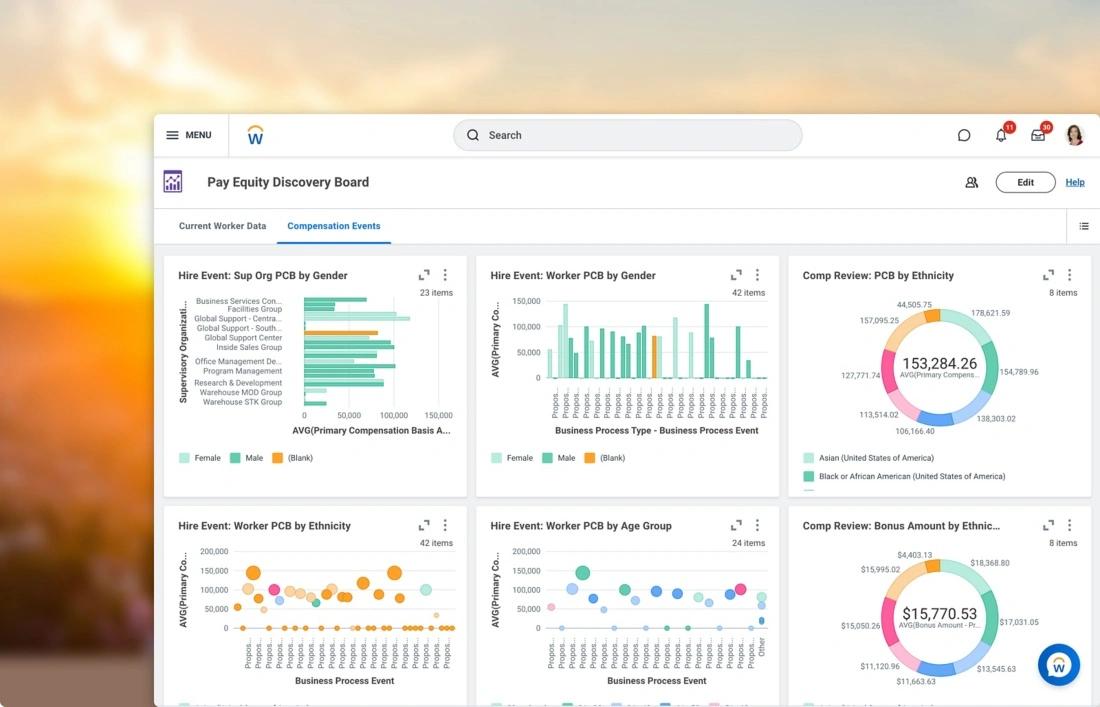
Image Source: Workday
What Workday Offers
Enterprise organizations face a distinct challenge: recruiting analytics exist in isolation from broader workforce management systems. Workday eliminates this fragmentation through a unified Human Capital Management platform where analytics embed directly into core HR functions rather than operating as separate tools. The cloud-based system centralizes payroll, benefits, talent management and workforce planning within a single data model. Recruiting decisions connect to organizational context automatically.
Workday's analytics suite operates across three layers. Core reporting and analytics deliver up-to-the-minute insights through 5,300+ prebuilt configurable reports, 200 dashboards and discovery boards, and self-service analysis capabilities that generate 3 billion monthly reports. Workday People Analytics adds AI-powered intelligence that surfaces hidden trends, risks and opportunities using increased analytics and natural language generation. The platform analyzes countless data permutations across worker type, location and salary bands to answer predefined business questions without manual effort.
Workday Prism Analytics extends beyond internal data by mixing external sources like contingent worker systems and payroll vendors with core HCM information. This eliminates data silos and manual spreadsheet reconciliation while maintaining Workday's security model across integrated datasets.
Key Features and Capabilities
The platform delivers workforce intelligence through discovery boards that enable managers to create visualizations using drag-and-drop features without technical knowledge. Embedded analytics surface directly within business processes and allow hiring managers to review historical performance data and compensation trends while evaluating candidates. Workday People Analytics provides 40+ visualizations and 70+ metrics around recruitment optimization, attrition analysis, headcount movement, skills assessment, diversity tracking and performance development.
Organizations report 39% increase in HR efficiency and 50% faster compensation planning. The automated storyteller engine analyzes millions of data combinations to identify focus insights that answer critical business questions proactively.
Pricing and Best Use Cases
Workday operates on a per-employee-per-month model covering all employees, not just active users. The average annual cost reaches INR 4,136,245.32 based on organizational deployments. Implementation requires certified partners and takes 9-18 months for mid-market organizations.
The platform fits enterprises with 1,000+ employees requiring unified HCM and financial management. Organizations report 30-50% reduction in HR administrative time through automation. Core reporting capabilities are included with Workday HCM subscriptions and make advanced workforce analytics available without separate purchases.
Visier: Purpose-Built People Analytics Platform
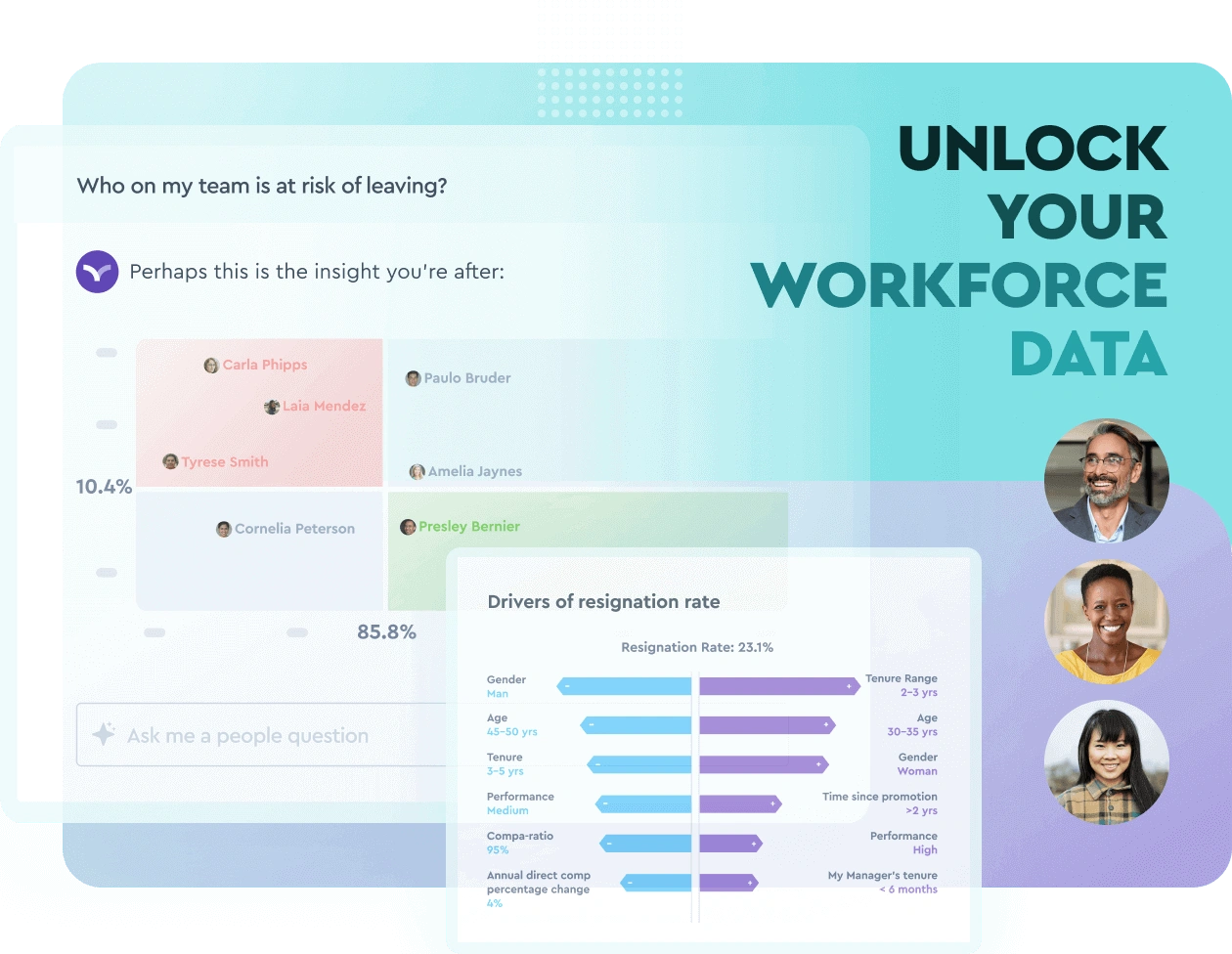
Image Source: Visier
What Visier Offers
Workforce intelligence extends beyond recruiting metrics into strategic people decisions across the entire employee lifecycle. Visier operates as a purpose-built people analytics platform. The platform unifies data from multiple HR systems, operational databases and external measures into a single trusted layer designed for workforce analysis. Generic business intelligence tools updated for HR can't match this. The platform provides thousands of pre-configured, AI-ready metrics built around how organizations manage people.
Visier Workforce AI functions as decision-making GPS for HR leaders. The system combines people data with industry measures from 2,000,000+ users and delivers guided recommendations on retention, mobility and workforce trends. Organizations get predictive insights that identify risks like attrition and skill gaps before they affect business outcomes. The platform allows scenario testing for hiring plans, restructuring initiatives and skills investments among other cost and staffing projections, with tracking as plans execute.
The platform tackles complexity inherent in workforce analytics by managing schema changes and record updates over time. Visier's people data platform delivers accurate point-in-time insights without manual data reconciliation. The extensible data model has built-in descriptions, relationships and calculations. These give AI systems the context needed to generate trustworthy answers rather than hallucinations.
Key Features and Capabilities
The platform delivers 5,300+ pre-built reports and analytics covering talent acquisition, workforce composition, performance trends, retention analysis, diversity tracking and compensation work. Pre-built connectors integrate data from existing HRIS, payroll, performance management and cloud storage systems while maintaining enterprise-grade security. Dynamic role-based permissions ensure users access only the data relevant to their responsibilities. The system adjusts permissions as organizational structures change.
Vee, the AI assistant, allows conversational interaction with workforce data through natural language queries. Managers ask questions like "Which departments show highest turnover risk?" The system provides immediate answers with full explanations and interactive visualizations. Every insight has transparent sourcing and granular security controls. This eliminates concerns about acting on untrustworthy information.
Predictive analytics capabilities use machine learning to forecast attrition, time-to-fill for open positions and quality of hire outcomes based on historical patterns. The platform tracks hiring sources that produce high-performing employees. Recruiting teams can optimize channel investments.
Pricing and Best Use Cases
Visier does not publish standard pricing. The company requires direct consultation based on organizational size and requirements. Customers report INR 151.88M+ in reduced cost of ownership with 7.5-month payback on investment. Over 65,000 companies trust the platform for workforce analytics.
The platform fits enterprises requiring detailed people analytics that connect HR decisions to business outcomes. Organizations with 1,000+ employees benefit from the depth of pre-built analytics and data. Companies competing in tight labor markets or seeking scarce skillsets gain advantages through predictive talent acquisition analytics. These forecast likelihood of filling positions based on historical data.
Comparison Table: 6 Best Talent Analytics Tools for 2026
| Tool | Main Focus | Main Features | Pricing | Best Use Cases | Key Benefits | Integrations |
|---|---|---|---|---|---|---|
| Metaview | AI-powered interview intelligence |
• Structured AI-generated notes • Auto scorecards • Interview coaching insights • AI assistant for interview retrieval • Analytics dashboard |
Free: Limited usage Pro: ~$50–$60/month Enterprise: Custom |
In-house recruiting teams; executive search firms | Saves ~40 mins per recruiter; faster scorecards | Greenhouse, Lever, Ashby; SOC 2, GDPR compliant |
| SkillSauce ⭐ | AI-powered candidate assessment platform |
• 320,000+ pre-built assessments • AI interview analysis • Proctoring (face/voice tracking) • ATS auto-ranking • Detailed reports |
Free Trial: 40 credits Plus: ₹4,219/month Pro: ₹8,438/month Enterprise: Custom |
Volume hiring across tech & non-tech roles | 40% faster hiring; 25% better hires; reduced attrition | ATS integrations; custom branding |
| LinkedIn Talent Insights | Labor market intelligence |
• Talent pool reports • Workforce analytics • Demand tracking • Competitive insights |
₹5L–₹18L/year approx | Workforce planning; strategic hiring | Data from millions of professionals & companies | LinkedIn ecosystem integrations |
| Greenhouse Analytics | ATS + reporting |
• Custom reports • Diversity tracking • ROI analysis • Dashboards |
₹5L–₹59L/year | Structured hiring teams | Improves hiring quality; reduces bias | 400+ integrations |
| Workday | Unified HCM analytics |
• Workforce analytics • Financial planning • Automated insights |
Enterprise pricing | Large enterprises (1000+ employees) | Improves HR efficiency; planning speed | Payroll, HR systems integrations |
| Visier | People analytics platform |
• Predictive analytics • Scenario modeling • Live dashboards |
Custom pricing | Enterprise workforce strategy | Predictive insights; risk identification | HRIS, payroll integrations |
Conclusion
The right talent analytics tool depends entirely on your specific hiring challenges. Metaview excels at interview intelligence, SkillSauce delivers detailed assessments with applicable information, LinkedIn Talent Insights provides market intelligence, Greenhouse optimizes ATS reporting, Workday unifies enterprise HCM, and Visier offers deep workforce analytics.
Every platform on this list isn't necessary. Identify your biggest bottleneck first: Is it interview consistency or market intelligence? Pick the tool that addresses your immediate pain point. Measure the effect, then expand from there.
Organizations that compete for talent get separated from those that actually win it by analytical hiring in the long run.
Key Takeaways
Modern talent analytics tools transform hiring from guesswork into strategic advantage, with organizations achieving up to 82% better outcomes through data-driven decisions.
- Structured assessments boost quality of hire by 24% - Moving beyond resume screening to standardized evaluations significantly improves hiring accuracy and reduces early attrition rates.
- AI-powered interview tools save 40+ minutes daily per recruiter - Platforms like Metaview automate note-taking and scorecard completion, allowing interviewers to focus on candidate engagement.
- Assessment platforms reduce hiring cycles by 40% while cutting recruiter workload in half - Tools like SkillSauce streamline volume hiring across technical and non-technical roles through automated screening.
- Labor market intelligence prevents costly expansion mistakes - LinkedIn Talent Insights provides real-time data on talent availability and competitive dynamics before entering new markets.
- Unified analytics platforms deliver 39% increase in HR efficiency - Enterprise solutions like Workday and Visier connect recruiting data to broader workforce planning for strategic decision-making.
The key is starting with your biggest bottleneck—whether interview consistency, assessment accuracy, or market intelligence—then expanding your analytics capabilities as you measure impact and build data-driven hiring practices.