


Problem-Solving Assessments: The Future of Filtering Tech Talent Beyond Coding
In today's rapidly evolving tech landscape, problem-solving assessments have emerged as the single most vital tool for filtering tech talent beyond mere coding ability. These tests evaluate analytical thinking, adaptability, and real-world troubleshooting skills—qualities indispensable for modern technology roles. As the industry pivots to skills-based hiring, prioritizing a candidate's cognitive agility over rote knowledge is becoming the new standard.
Defining Problem-Solving Assessments (PSA)
Problem-solving assessments (PSAs) are structured, often scenario-based, tests designed to measure how well candidates approach complex, unfamiliar situations. Unlike traditional coding assessments that check syntax and algorithm memory, PSAs transcend programming syntax, focusing instead on cognitive agility, reasoning, and creativity in real or simulated work scenarios.
These assessments often include:
- Case Studies and Situational Judgment Exercises (SJTs): Presenting real-world workplace dilemmas.
- Business and Logical Reasoning Challenges: Requiring candidates to break down complex issues into manageable parts.
- Puzzles and Abstract Reasoning Problems: Testing non-verbal, fluid intelligence.
- Real-World Simulations: Requiring rapid adaptation and application of knowledge.
Why Problem-Solving Skills are the Top Predictor of Success
The shift toward problem-solving assessments is driven by overwhelming data demonstrating their high predictive validity for job performance, which far exceeds that of traditional resumes or interviews.
| Assessment Method | Correlation ($r$) with Job Performance |
|---|---|
| Problem-Solving Assessments (Cognitive Ability) | ≈ 0.51 |
| Structured Behavioral Interviews | ≈ 0.51 |
| Unstructured Interviews | ≈ 0.38 |
| Experience/Years of Education | ≈ 0.10 - 0.20 |
Key Statistics on PSA Effectiveness (2024–2025)
- Skills-Based Hiring: 81% of employers are now using skills-based hiring methods (up from 56% in 2022), with cognitive and problem-solving tests being a primary component.
- Predictive Power: Hiring for skills, which includes problem-solving, is reported to be 5x more predictive of job performance than hiring based on education alone.
- Retention & Mis-Hires: Companies using multi-measure testing (blending coding and PSAs) report a significant reduction in mis-hires (up to 90%) and improved retention (up to 91%).
Problem-Solving Assessments vs. Technical Coding Tests
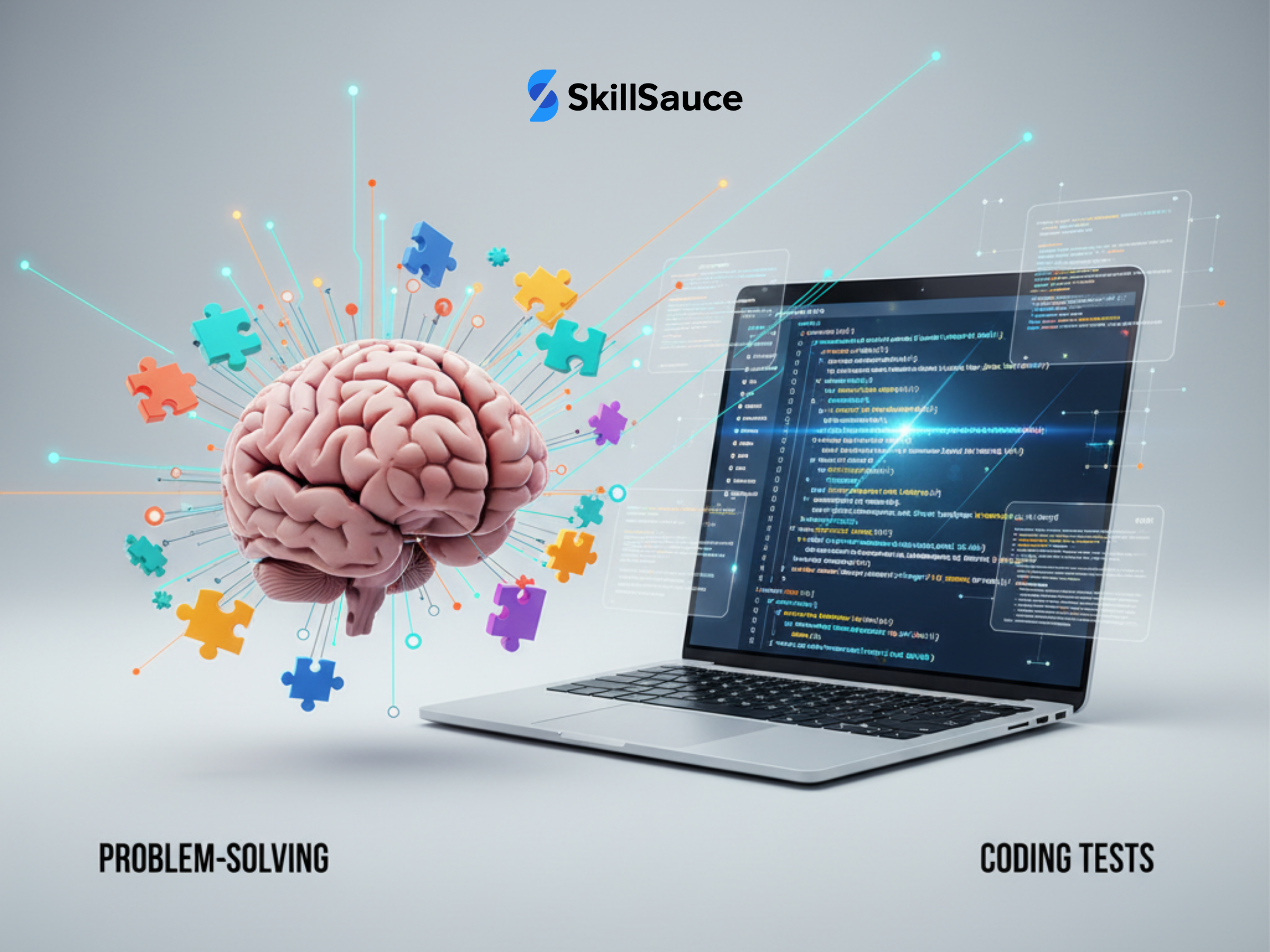
It is crucial to view PSAs as a complement to, not a replacement for, coding tests. They evaluate fundamentally different, yet equally essential, skills.
| Feature | Problem-Solving Assessments (PSAs) | Structured Behavioral Interviews | Traditional Coding Tests |
|---|---|---|---|
| Primary Focus | Critical thinking, logical structuring, and analytical ability on new problems. | Past behavior to predict future soft skills (e.g., teamwork, conflict resolution). | Recall of syntax, algorithm knowledge, and quick execution of known tasks. |
| Measurement | Methodology, efficiency of thought, data interpretation, and solution quality. | Use of frameworks (like STAR), communication, and interpersonal skills. | Clean code, successful compilation, time/space complexity ($O(n)$). |
| Role Suitability | High-level roles: Engineers, Data Scientists, Product Managers, Consultants. | Management, Leadership, Customer-Facing Roles. | Entry-level Software Development. |
| Key Advantage | Measures potential and learnability by assessing how one thinks. | Measures cultural fit and past reliability. | Measures technical baseline and immediate task readiness. |
Read more on coding challenges in tech hiring and how they fit into the hiring pipeline.
Implementing Problem-Solving Assessments: Best Practices
To maximize the return on investment and ensure a fair candidate experience, employers must adhere to a validated, structured approach for their PSAs.
1. Ensure Role Relevance (Contextual Validity)
The scenarios presented must directly mirror the complexity and type of problems the candidate will actually face. Avoid abstract math puzzles for a front-end developer; use a debugging simulation instead.
2. Adopt a Blended Assessment Approach
The most predictive strategy is multi-measure testing. Combine an early-stage problem-solving assessment (for cognitive screening) with a role-specific coding challenge (for technical validation) and a final interview.
3. Prioritize Transparency and Candidate Experience
Candidates prefer skills-based hiring (68%). You must:
- Set clear expectations about the assessment format and time limit.
- Offer constructive feedback where possible to maintain a positive brand experience.
4. Use Validated Tools & Mitigate Bias
Use established assessment platforms that have proven bias mitigation strategies. Problem-solving assessments are inherently less prone to bias than unstructured interviews because the scoring is objective.
5. Embrace Future Trends: AI and Gamification

- AI-Driven Adaptive Testing: AI can tailor the difficulty of problem-solving questions in real time based on a candidate's prior responses, optimizing the assessment length and reducing stress.
- Gamification & Simulation: Game-like scenarios and simulations are growing, replicating real-world collaboration and decision-making challenges.
Conclusion: The Bottom Line for Problem-Solving
By embedding well-designed problem-solving assessments into the tech recruitment funnel, organizations are effectively future-proofing their teams. They move past the limitations of the resume and the algorithm, unlocking stronger hires who possess the cognitive agility and critical thinking skills necessary to navigate an ever-changing technological landscape. Prioritize this metric, blend it with coding checks, and use data to refine your strategy.
Learn about transparent hiring best practices for a world-class candidate journey.