

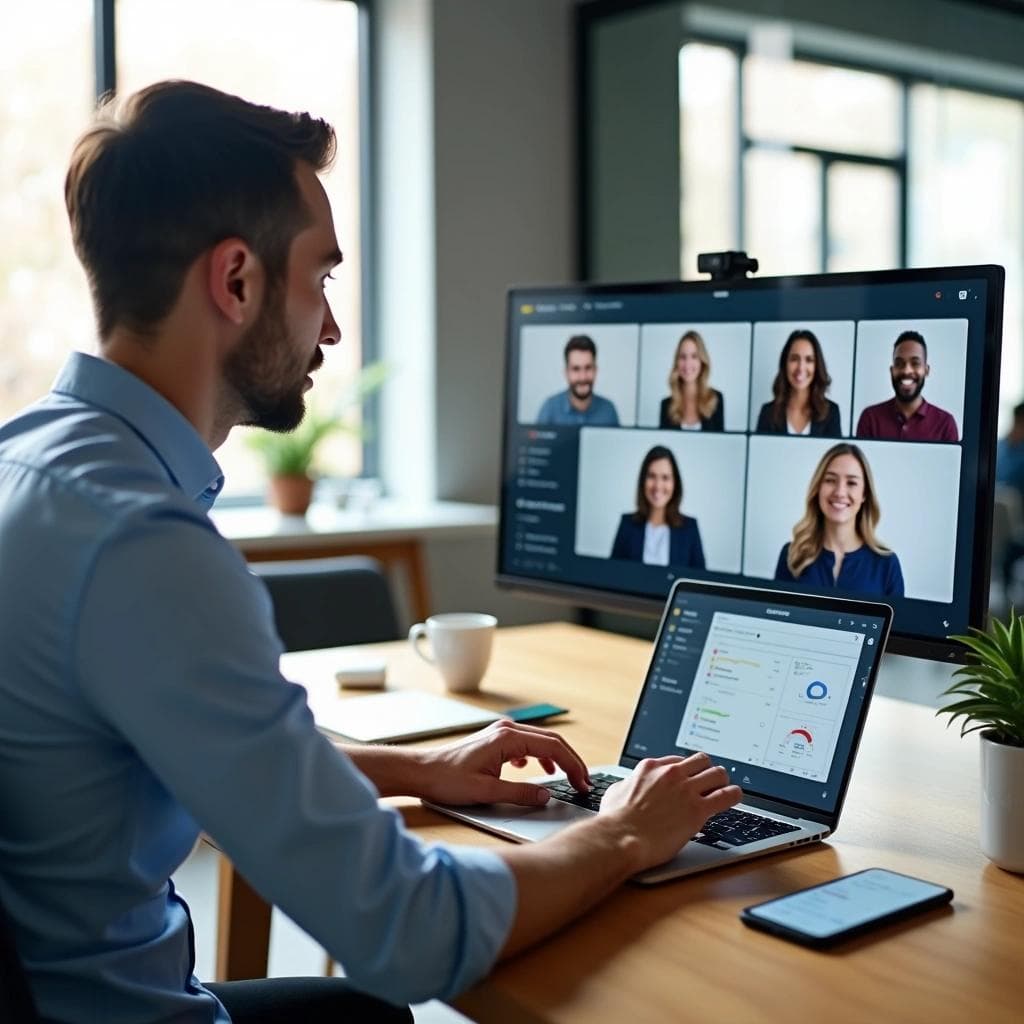
Video interview platforms have changed recruitment workflows. Companies cut time-to-hire by 50% and save over $50,000 in recruitment costs. In fact, approximately 88% of companies now use some form of AI for candidate screening at the start. The best video interview platforms offer flexibility and are more affordable compared to traditional face-to-face interviews. You might be evaluating online video interview platforms, one-way video interview platforms, asynchronous video interview platforms, or ai video interview platforms. Understanding key features is significant. In this piece, we'll walk through the core capabilities, assessment tools, integrations and security measures that make video interview platforms work to help hiring managers.
Core video interview platform capabilities
Every functional video interview platform operates on two core modes: live interviews that connect candidates and interviewers in real time, and asynchronous interviews where responses are recorded independently. This dual capability shapes how recruiters screen, assess and advance candidates through hiring stages.
Live and asynchronous interview options
Asynchronous video interviews eliminate the scheduling constraints that slow down high-volume hiring. Candidates receive preset questions and record responses on their own schedule. Hiring teams review submissions when convenient. The process follows a straightforward pattern: recruiters create question sets, establish parameters like think time (30-90 seconds) and recording limits (60-180 seconds per response), send invitation links and receive completed interviews for review.
Asynchronous interviews serve different purposes than live formats. We use them for original screening stages where standardizing questions across hundreds of candidates produces fairer comparisons. Live interviews follow later for in-depth discussions that require real-time interaction and immediate follow-up questions. Some enterprises report replacing first phone screens with asynchronous formats reduces scheduling overhead by up to 80% and cuts early-stage screening time from 3-5 days to under 24 hours.
Asynchronous formats come in three structures. Structured interviews follow predetermined questions with standardized response formats. Unstructured versions use open-ended prompts that give candidates flexibility in their answers. Semi-structured approaches blend both and combine set questions with exploratory prompts to assess adaptability.
Recording and playback functionality
Recording transforms interviews from single-observer events into persistent review assets. Purpose-built platforms like VidHirePro start recording when live sessions begin and stop when they end, with no manual initiation required. The recording is the submission itself for asynchronous submissions.
The playback capability solves a practical problem: hiring managers in different time zones can review the same interview independently and form assessments before collaborative discussions. A recruiter can replay specific segments to evaluate responses more carefully. Panel members can compare their assessments against shared rubrics rather than relying on one person's verbal summary.
Platforms store recordings securely and link them to candidate profiles and evaluation data. Multiple reviewers access recordings, score against shared rubrics and leave timestamped comments without requiring synchronous review sessions. This produces higher-quality collective decisions by eliminating the telephone game that happens when stakeholders depend on secondhand accounts.
Multi-device compatibility
Browser-based platforms work across multiple devices without requiring app downloads. Candidates need only a device with a camera, microphone and internet connection. Device choice affects interview quality and functionality, but.
Supported specifications vary by platform. Talview recommends these minimum requirements:
- Laptops: Windows 10+, macOS 12.6.7+, or Linux with 4GB+ RAM
- Mobile phones: Android or iOS with 4GB+ RAM
- Tablets: Android or iOS operating systems
Laptops remain the recommended choice. They provide more stable interfaces and better support for typing or technical tasks. They also handle camera, microphone and screen functions better during live interviews. Mobile devices offer flexibility for candidates who prefer recording on smartphones, but platforms must include official mobile apps for full compatibility.
Simple scheduling tools
Automated scheduling removes the manual coordination that bogs down interview logistics. Calendar integration allows candidates to self-book from available interviewer time slots with two-way sync. Calendar updates happen instantly when candidates select a time, and reminders send automatically.
The scheduling connects with interview stages and moves candidates smoothly from booking to the actual interview session. Time zones are handled automatically when interview panels span different locations. Recruiters can add buffer time and booking limits to prevent interviewer burnout between consecutive calls. AI assistants like Taira handle scheduling through conversational chat after analyzing resumes and conducting automated pre-screening.
Essential features for candidate assessment
"With an AI video interview system, Unilever was able to filter out 80% of candidates based on AI-analyzed interview responses, reducing time-to-hire by 90% and saving an estimated 50,000 hours of recruiter time." — Unilever, Global consumer goods company
Assessment features separate simple video interview platforms from tools that help make hiring decisions. These capabilities determine how well you can review candidates, reduce bias, and involve your team in selection.
Pre-recorded interview questions
One-way video interviews use preset questions that candidates answer through brief recordings. We send applicants a series of questions with set timeframes that range from 30 seconds to three minutes per response. Most platforms provide practice rounds where candidates test equipment before actual questions begin.
The format standardizes early screening. Every candidate receives similar questions in the same order and this creates fair comparisons in large applicant pools. Questions span nine categories: behavioral (past situations), situational (hypothetical scenarios), skill-based (role competencies), cultural fit, technical knowledge, problem-solving, experience-related, creativity, and personality assessment.
Platforms like TestDome report that one or two minutes of recorded responses often reveal what would take one or two hours in live interviews to find. Behavioral questions predict job performance, so many ai video interview platforms incorporate 14 behavioral questions covering adaptability, leadership, teamwork, and culture fit.
Custom evaluation scorecards
Scorecards transform subjective impressions into structured assessments. They define job-relevant competencies, rating scales (1-5 or 1-10), weighted criteria, and space for evidence-based scoring.
Digital scorecards in asynchronous video interview platforms allow customization of evaluation criteria using your organization's language. You can create multiple scorecards and assign specific ones to different roles. The data shows that scorecards help focus interviewers on critical job aspects while preventing biases based on gender, race, age, or unrelated factors.
AI-powered screening and analysis
AI evaluation examines communication patterns, behavioral indicators, and competency alignment without requiring manual video review. Natural Language Processing assesses vocabulary, speech patterns, clarity, and communication style. Computer vision analyzes facial micro-expressions, reaction time, posture, confidence, and eye contact to form behavioral profiles.
The technology uses structured scoring models based on competencies and creates shortlists ranked by skill signals and communication clarity. Organizations reduce screening time by 60-80% and shorten time-to-shortlist from weeks to days.
Interview sharing with hiring teams
Collaborative review allows multiple stakeholders to access recorded responses, score against shared rubrics, and leave timestamped feedback without synchronous sessions. Hiring managers can review interviews before group discussions and teams can share recorded responses for collaborative decision-making.
Automated transcription and summaries
Transcription converts spoken responses into searchable text records. You can use search functions to locate specific words or phrases and then click to jump to that video segment. Transcripts support 21 languages including Arabic, Danish, Dutch, English, French, German, Hebrew, Hindi, and Japanese.
AI-powered summaries condense recorded answers into structured reports through speech-to-text conversion, key-point extraction, tone analysis, and summary generation. A recruiter handling 50 one-way interviews can review 50 summaries instead of watching 50 full videos.
Platform integration and workflow management
Integration determines whether your video interview platform becomes part of your hiring workflow or creates extra work. Most video interviewing software connects with applicant tracking systems and recruitment management systems, but integration depth varies substantially.
ATS and HRMS integration
Bidirectional ATS integration syncs candidate data and hiring activity between your video platform and existing systems. Scores and evaluations sync with your ATS when candidates complete interviews, which eliminates duplicate data entry and keeps all candidate information centralized.
Native integrations with major platforms matter. Willo connects with Greenhouse, Ashby, BambooHR, Pinpoint, Lever, Bullhorn, and Oracle ATS. HireVue integrates with Workday, SAP SuccessFactors, Oracle and Taleo, SmartRecruiters, PageUp, iCIMS, Eightfold, Avature, Greenhouse, and Oleeo. Organizations using Talentpool report reducing time-to-hire by 70% through simplified tracking and standardized process flows.
The strongest integrations move beyond data sync. Stage-change triggers send interview invitations when candidates meet preset criteria. Completed interviews push overall scores and structured summaries back into the ATS without manual export. Some platforms offer Chrome extensions that display full evaluations and recording access directly in candidate profiles.
Automated interview scheduling
Automated scheduling tools speed up interview coordination by 84%. Calendar integration creates two-way sync with Google Calendar and Microsoft Outlook. Confirmed interviews show instantly on both sides. Candidates self-schedule by selecting from interviewer availability through chat, SMS, or email.
AI assistants sync recruiter and hiring manager calendars, share open times with qualified candidates, and handle complex scenarios like panel interviews in multiple locations. Organizations using automated scheduling eliminate the back-and-forth coordination that consumes up to 2 hours per hire.
Email notifications and reminders
Automated notifications reduce no-shows through customizable confirmations and reminder links sent via email or SMS. Daily interview reminder emails list candidate names, interview times, job titles, interview locations, and links to interview kits.
Centralized candidate data management
Candidate Management Systems create a single source of truth by automating how applicant information is captured and stored. Resume parsing feeds directly into centralized systems with AI intelligence categorizing skills, experience, and job relevance. Automated tagging and contextual search help recruiters locate ideal profiles within seconds.
Security, compliance, and anti-cheating measures
Remote hiring introduces security risks that video interview platforms must address through multiple protective layers. These measures determine whether your platform meets enterprise security standards, preventing candidate impersonation and protecting sensitive data.
Identity verification and proctoring
Identity verification confirms that registered candidates complete their own interviews. The process requires candidates to present government-issued identification such as passports or driver's licenses through document scanning. Face authentication compares the ID photo against live images captured via webcam. Some platforms require candidates to perform gestures like blinking or nodding to confirm live presence.
AI-powered systems match facial features between submitted IDs and live video feeds during interviews. Platforms flag these incidents for manual review when mismatches occur or multiple faces appear in frame. This verification prevents impersonation tactics where candidates hire proxy test-takers or use technical methods like screen sharing to receive external assistance.
Browser lockdown and monitoring
Browser lockdown features restrict candidate access during assessments. Respondus LockDown Browser, used at over 2,000 higher educational institutions, prevents printing and copying while blocking access to other URLs and external applications during tests. The browser displays assessments full-screen with disabled menu options except navigation.
Monitoring tracks suspicious behaviors. These include excessive tab switching, copy-paste actions and extended periods where candidates look away from the screen. Focus tracking logs when candidates move away from interview tabs or paste content. These controls ensure candidates rely on their own knowledge rather than external AI tools during technical assessments.
Data encryption and privacy controls
End-to-end encryption protects interview recordings during transmission and storage. Reputable platforms encrypt data in transit using HTTPS protocols and at rest using industry-standard algorithms. Access controls limit viewing permissions to authorized personnel through multi-factor authentication and role-based permissions.
GDPR and regional compliance certifications
Leading platforms keep SOC 2 Type II, ISO 27001, ISO 27017 and ISO 27018 certifications. GDPR compliance requires explicit candidate consent, EU-region storage with encryption and simple deletion workflows. VidCruiter offers full compliance with GDPR, PIPEDA, CCPA and VPAT accessibility standards with data residency options for jurisdictional requirements. HirePro provides ISO 27001 certification and GDPR compliance with AWS-hosted data, encrypted personally identifiable information and keeps audit trails for all activities.
Candidate experience and engagement features
"Building a good candidate experience does not happen by accident. It happens by design." — Clare Muscutt, Customer experience expert
Candidate-facing features determine whether your video interview platform attracts or alienates applicants. Small friction points in the interview process affect completion rates and employer brand perception.
No-login interview access
Passwordless access removes account creation barriers that cause candidate drop-off. Platforms like Willo and Spark Hire send secure links via email or SMS. Candidates click to begin interviews right away. No username, password, or app download required.
Mobile-optimized interface
Browser-based platforms adapt to smartphones, tablets and desktops without requiring separate apps. Candidates complete interviews on any device with a camera and microphone. Mobile optimization matters when candidates prefer recording responses from personal spaces rather than formal desktop setups.
Practice questions and preparation tools
Practice rounds let candidates test equipment and familiarize themselves with recording interfaces before actual questions begin. Workable's platform has device-agnostic practice sessions, while Spark Hire provides pre-recorded tips and sample recording options. Candidates rated their Spark Hire experience 4.5 out of 5 stars.
Company branding customization
White-label capabilities display your logo, color scheme and office imagery throughout the interview experience. Custom domains replace generic platform URLs. Branded email templates maintain consistent touchpoints from invitation through completion.
Multi-language support
Platforms now offer 40+ languages. This removes barriers for global candidates. Candidate drop-off rates fall by 22% when interviews are offered in native languages. Research shows 78% of candidates would accept lower salaries if the interview process respected their language priorities.
Conclusion
Selecting the right video interview platform requires balancing functionality with user experience. As shown above, the strongest platforms combine core interviewing capabilities with strong assessment tools and smooth integrations. Security measures that protect both your organization and candidates are essential.
We recommend evaluating platforms based on your specific hiring volume and technical requirements. Companies conducting high-volume screening benefit especially when you have AI-powered analysis and asynchronous formats. Those prioritizing collaborative decisions should focus on recording playback and shared scorecards.
Start by identifying your must-have features. Test candidate-facing interfaces before committing. The platform you choose becomes your hiring team's daily workspace, so a complete evaluation upfront matters.
Key Takeaways
Video interview platforms have revolutionized modern recruitment by combining efficiency with strategic candidate assessment. Here's what hiring managers need to know:
- Dual interview modes maximize flexibility: Asynchronous interviews reduce scheduling overhead by 80% for initial screening, while live formats enable real-time interaction for in-depth candidate evaluation.
- AI-powered screening cuts time-to-hire by 60-80%: Automated analysis of communication patterns, behavioral indicators, and competency alignment eliminates manual video review and shortens shortlisting from weeks to days.
- Seamless ATS integration eliminates duplicate work: Bidirectional sync automatically transfers candidate data, interview scores, and evaluations between platforms, reducing time-to-hire by up to 70%.
- Security measures prevent fraud and ensure compliance: Identity verification, browser lockdown, end-to-end encryption, and GDPR certifications protect both organizations and candidates throughout the hiring process.
- Candidate experience directly impacts completion rates: No-login access, mobile optimization, practice rounds, and multi-language support reduce drop-off by 22% and strengthen employer brand perception.
The right platform balances robust assessment capabilities with frictionless candidate experience. Prioritize features aligned with your hiring volume, evaluate candidate-facing interfaces thoroughly, and ensure integration compatibility with existing systems before committing.
FAQs
Q1. What are the key features to look for in a video interview platform?
Essential features include both live and asynchronous interview options, recording and playback functionality, multi-device compatibility, automated scheduling tools, custom evaluation scorecards, AI-powered screening capabilities, ATS integration, and security measures like identity verification and data encryption.
Q2. How does recording capability benefit the interview process?
Recording transforms interviews into persistent review assets that multiple stakeholders can access independently. It allows hiring managers in different time zones to review the same interview, replay specific segments for careful evaluation, and compare assessments against shared rubrics without relying on secondhand accounts.
Q3. Which platforms are commonly used for conducting virtual interviews?
Popular video interview platforms include VidHirePro, Talview, HireVue, Willo, Spark Hire, and Workable. These platforms integrate with major applicant tracking systems like Greenhouse, Workday, SAP SuccessFactors, BambooHR, and iCIMS to streamline the hiring workflow.
Q4. What makes an interview structured and effective?
A structured interview includes predefined questions asked in the same order to all candidates, standardized response formats, custom evaluation scorecards with weighted criteria, and clear assessment rubrics. This format creates fair comparisons across applicants and helps prevent biases based on unrelated factors.
Q5. How do video interview platforms ensure security and prevent cheating?
Platforms implement multiple security layers including identity verification through government-issued ID scanning, face authentication, browser lockdown features that restrict access to external resources, continuous monitoring for suspicious behaviors, end-to-end data encryption, and compliance certifications like GDPR, SOC 2 Type II, and ISO 27001.